
Raymond J. Pool, Field Notes, 1912, Part 1
Field Notes, 1912
1
Sand Hills 1912
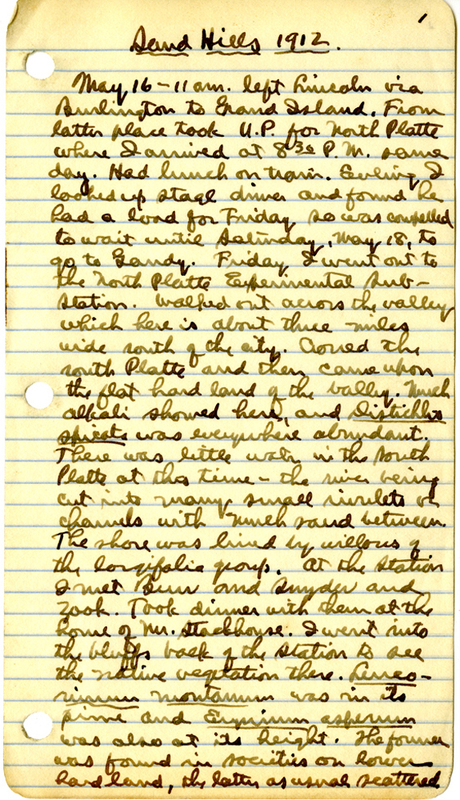
May 16 & 11 am. left Lincoln via Burlington to Grand Island. From latter place took U.P. fro North Platte where I arrived at 8:30 P.M. same day. Had lunch on train. Evening I looked up stage driver and found he had a load for Friday so was compelled to wait until Saturday, May 18, to go to Gandy. Friday, I went out to the North Platte Experimental Substation. Walked out across the valley which here is about three miles wide south of the city. Crossed the North Platte and then came upon the flat hand land of the valley. Much alkali showed here, and Distichlis spicata was everywhere abundant. There was little water in the South Platte at this time — the river being cut into many small in rivulets or channels with much sand between. The shore was lined by willows of the longifolia group. At the station I met Burr and Snyder and Zook. Took dinner with them at the home of Mr. Stackhouse. I went into the bluffs back of the station to see the native vegetation there. Leucocrinum montanum was in its prime and Erysimum asperum was also at its height. The former was found in societies on lower hard land, the latter as usual scattered.
2
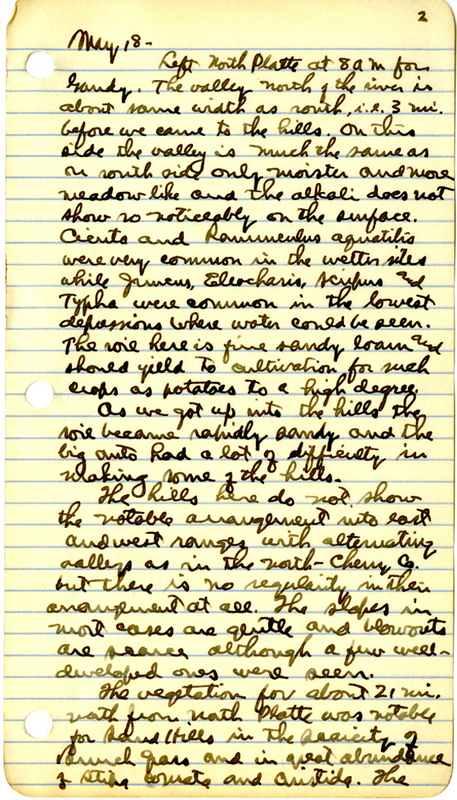
As we got up into the hills the soil became rapidly sandy and the big auto had a lot of difficulty in making some of the hills.
The hills here do not show the notable arrangement into east and west ranges with alternating valleys as in the north — Cherry Co. but there is not reqularity in their arrangement at all. The slope in most cases are gentle and blowouts are scarce although a few well developed ones were seen.
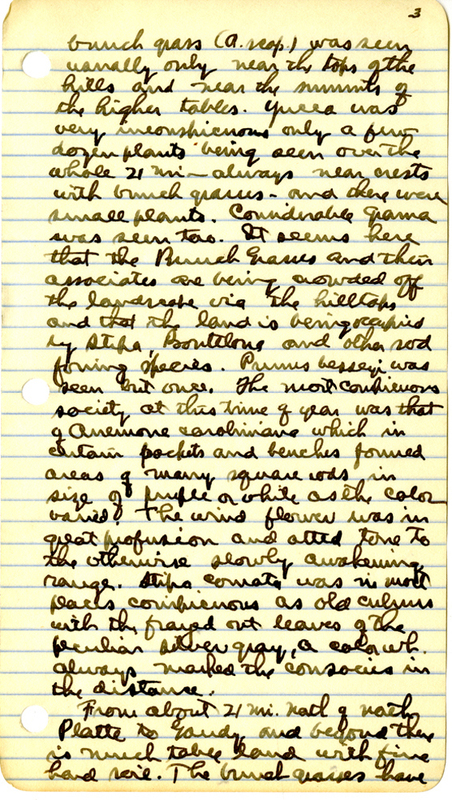
The vegetation for about 21 mi. north from North Platte was notable for Sand Hills in the scarcity of Bunch Grass and in great abundance of Stipa comata and Aristida. The
3
bunch grass (A. scop.) was seen usually only near the tops of the hills and near the summits of the higher tables. Yucca was very inconspicuous only a few dozen plants being seen over the whole 21 mi. always near crests with bunch grasses — and there were small plants. Considerable grasses was seen too. It seems here that the Bunch Grasses and their associates are being crowded off the landscape via the hilltops and that the land is being occupied by Stipa, Bouteloua, and other sod forming species. Prunis besseyi was seen but once. The most conspicuous society at this time of year was that of Anemone caroliniana which in certain pockets and bunches formed areas of many square sods in size of purple or white as the color varied. The wind flower was in great profusion and added tone to the otherwise slowly awakening range. Stipa comata was in more places conspicuous as old culsuss with the frayed out leaves of the peculiar silver gray, a color wh. always marked the consocies in the distance.
From about 21 north of North Platte to Gandy, and beyond there is much table land with fine hard soil. The bunch grasses have
4
almost completely crowded out of these hundreds of acres of “Table.” The soil here is not nearly so sandy and the topography is much like that of the prairies much farther east. The farmers are giving much of the land for wheat and corn. Many potatoes are produced on there tables – and with the new railroad and better facilities for marketing produce, the potato crop should be immense here. Westward from Gandy the tableland soon gives way to sand hills again, but it extends eastward to the rolling country of the loess region of Custer County. In all this cultivated region the tumbleweeds, Salsola tragus, Cycloloma atriplicifoliumare abundant and at this time of year the old plants are piled high against every obstruction such as fences, sheds, etc. Gandy is near the south side of the valley of the South Loup which here is about three miles wide with the river near the north side. Near the river the land is rather swampy. Fine patch, 8 acres of alfalfa in east side of Gandy. When old fields are abandoned entirely they go back to bunch grass in about 20 yrs. A. gnaphalodes is a late stage in the meaning; Salsola and Cycloloma a much early stage. H. petiolaris = one of 1st to come in.
5
Lesquerella spatulata a common copious species of spring aspect over the uplands.
Cornus stolonifera
Castilleja sessiliflora is common on the hard land here. Some plants have as high as 20 stems.
6
Stopped for dinner with a bachelor, “Frank” about six miles south of the Dismal. After lunch started on northward. The country becomes much more broken from this point on to the river. The valleys disappear and only “pockets” remain as we rapidly ascended to the highest hills south of the river. Blowouts became much more numerous and much larger, but still yucca is not especially conspicuous altho more abundant than farther south. Prunus melanocarpa, P. Americana formed extensive thicks in this portion — many pockets being almost filled by these species. Abover there often extending to the tops of the hills, occured scattered bushes of Ceanothus Ovatus in bud. The Prunus were in full bloom. P. Besseyi was past its height of aestivation. Troximon cuspidatum was everywhere conspicuous as single plants. Lithospermum angustifolvim was very abundant, sometimes becoming almost gregarious. L. gracilis was also common, but not nearly so abundant as the former species. Both these are much more abundant on south exposures than anywhere else. Senecio is copious on north exposures. Rosa arkansana forms conspicuous societies in the this region.
Lathyrus omatus occasionally conspicuous societies.
7
especially on south exposures near tops of hills. The highest hills just north of Bead‘s are from 214 — 300 ft. above river land. Blowouts are very numerous here — being in size from 30 — 100 to 60 — 275. At this time there are many seedlings in the bottoms of there blowouts. In many places the old culins & leaves of Redfieldia flexuousa are completely blown to pieces and out of the blowout and in their place many new offshoots are appearing from the persistent rhizomes. Lathyrus omatus is now in its prime — being most abundant on the most open soil where there is considerable hummus, i.e. hard soil, but is also copious all over the hills on all exposures. There are few willows up in the hills here — no very noteworthy willow — dogwood thickets on north slopes as at Halsey.
Very frequently in the shallow pockets high up in the hills one finds a society of Eriogonum annuum which in early spring is as conspicuous as in late summer became of the many stems with flat umbels which are as gray as when plants were alive and in flower. The places are where water stands for some time after summer rains. The soil is usually solid and the plants practically cover the available space. At this time there are hundreds
of seedlings
8
of the Eriogonum here beneath the old plants. In many of the deeper pockets Celtis occidentalis occus in close groves of 6 — 30 individuals that stand abone the Pruni and the arborescent species. These sometimes occurs far up in the hills away from rivers and lakes. At one spot 1 mi. west of Black‘s on the north side of the river I counted 68 blowouts to the east of me and all within one mile from where I stood. These were most all and active at this time — none of enormous size.
The vegetation of the Dismal River
9
the course having cut such trees as Celtis, Acer, Prunus, Juniperus, Fraximus, in fact all wood species have been worked upon by the little beasts. Their houses are numerous. Muskrats are also extremely common. Yesterday I discovered a coon den in an old beaver home. The old coon was there with 2 little ones about a week old.
The vegetation here is as a distinct resemblance to that in the eastern part of the state. The trees show a tendency everywhere to take the thicket form of growth. So in coves or short lateral gullies one finds such stands of Fraixum vividis, Celtis occidentalis, Prunus americana & P. melanocarpa, Juniperus virginians, with Populus sargentii as small specimens only occasionally. There seldom get far beyon the breaks immediately adjacent to the river. Beneath these trees one finds such species as Cystopteris fragilis, higher in hills, Woodsia oregana, Vaquera stellata
10
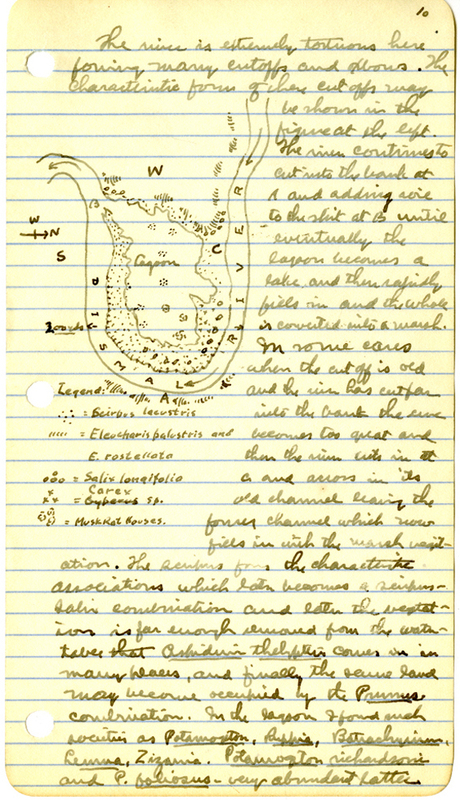
The river is extremely tortuous here flowing many cutoffs and oxbows. The characteristics form of where cut offs may be shown in the figure at the left. The river continues to cut into the bank at A and adding soil to the slit at B until eventually the lagoon becomes a lake and then rapidly fills in and the whole is converted into a marsh.
In some cases when the cut off is old and the view has cut far into the bank the curve becomes too great and then the view cuts in at A and across in its old channel leaving the former channel which now fills in with the marsh vegetation. The scirpus form the characteristic associations which later becomes a ruderal salin combination and later the vegetation is far enough removed from the water-table that ruderal comes in many places, adn finally the same land may become occupied by the Prunus combination . In the lagoon I found much societies as Potamogeton, Ruppia, Batrachium, Lemna, Zizania, Potamogeton richardsonii, and P. foliosus — very abundant latter.
11
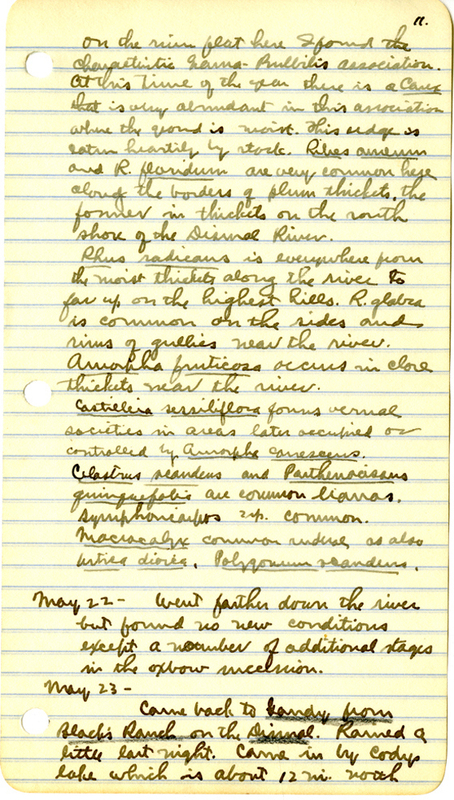
on the river flat here I found the characteristic Nama — Bulbilis association. At this time of the year there is a Carex that is very abundant in this association where the ground is moist. This sedge is eaten heartily by stork. Ribes aureum and R. floridum are very common here along the borders of plum thickets. The former in thickets on the south shore of the Dismal River.
Rhus radicans is everywhere from the moist thickets along the river to far up on the highest hills. R. glabra is common on the sides and rims of gullies near the river. Amorpha fruticosa occurs in close thickets near the river. Castieleja sessiflora forms vernal societies in areas later occupied or controlled by Amorpha canescens. Celastrus scandens and Parthenocissus quinquefolia are common lianas. Symphoricarpos esp. common. Macracalyx common ruderal as also as Urtica dioica, Polygonum scandens.
May 22 - Went farther down the river but found no new conditions except a number of additional stages in the oxbow succession.
12
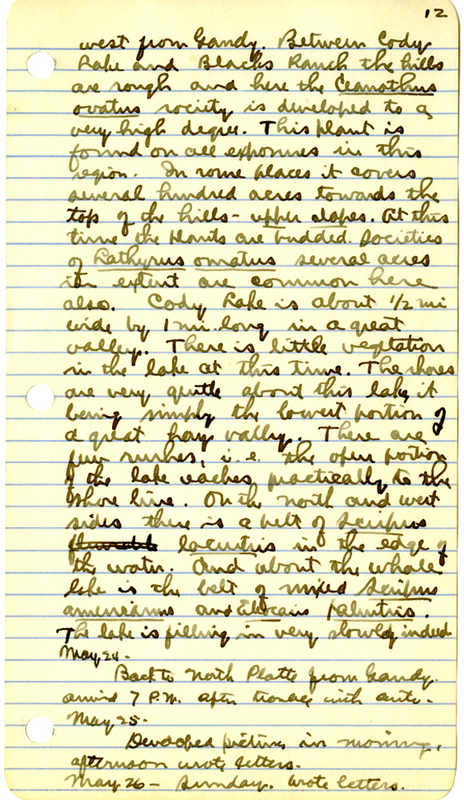
west from Gandy. Between Cody Lake and Black’s Ranch the hills are rough and here the Ceanothus ovatus society is developed to a very high degree. This plant is found on all exposures in this region. In some places it covers several hundred acres towards the top of the hills — upper slopes. At this time the plants are budded. Societies of Lathyrus omatus several acres in extent are common here also. Cody Lake is about 1/2 mile wide by 1 mi. long in a great valley. There is little vegetation in the lake at this time. The shores are very gentle about this lake it being simply the lowest portion of a great hay valley. There are few numbers, i.e. the open portion of the lake reaches practically to the shore line. On the north and west sides there is a belt of Scirpus lacutris in the edge of the water. And about the whole lake is the belt of mixed scirpus americanus and Eleocharis palustris. The lake is filling in very slowly indeed.
13
14
which gives the tone to the landscape in many places we have Stipa comata coming into blossom and being the really dominant grass at this time over a short-grass sod. This short-grass sod is composed mostly of Boutelona oligostachya, but there is also considerable Bulbilis dactyloides in mixture especially on the harder land. Then the old communities of A. Hallii are very persistence of the old upright stems.
Where land controlled by the Bouteloua — Stipa — Aristida — Artemsia coveristion is broken hear and allowed to stand idle we first get a weed stage if the land is not exposed to strong winds. The species
Erysimum asperum is very abundant in some old fields. Helianthus petiolaris is liable to be one of the first to come in in such places.
15
that are common in this stage are Salsola tragus, Ambrosia artem., Cenchrus, Helianthus pet., and Malvastrum coccineum. A little later Hymenopappus fil., Coreopsis, Kuhnia, Lithospermum angustifolium. Anogra latiflorus becomes very abundant at about this time and last of may is very conspicuous in such old fields with the large large white flowers. Coreopsis is very abundant on the edges of swales where it imparts a light green tone to the soil. Salvia lanceolata is also here, and Gama coccinea in abundance, and Pentstemon acuminatus. By this time Stipa Comata has come in and gives the effect of a grazing pasture to the old field. In early spring the old Cubus with frayed-out leaves are always noticeable in there places. Well defined chunks of A. filifolia are now appearing from old roots and Bouteloua and especially Aristida are working in from the sides of the field. The field is at this time essentialy a Stipa meadow, but from now the B.B. & Aristida come in rapidly and in a few years we get the usual short grass sod well developed and many of the weedy pioneers, if persistent at all, become much less abundant and subordinate to the short grasses. Stragglling plants of the Anogra persist for many year after the establishment of the short grass sod.
If the old field is in a windy
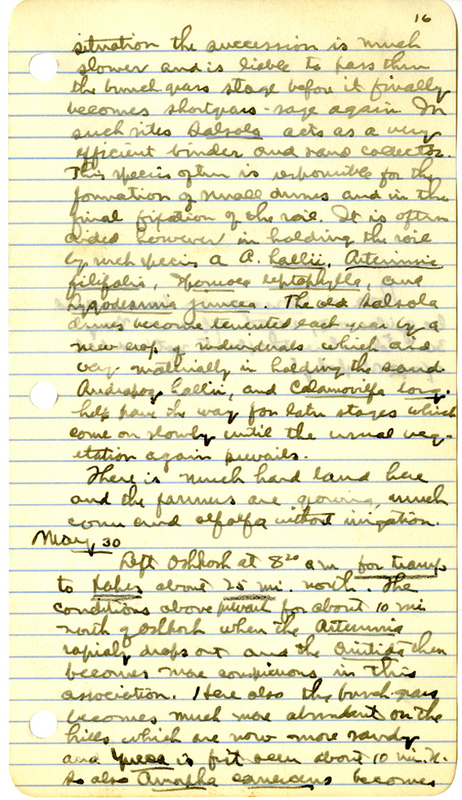
16
situation the succession is much slower and is liable to pass them the bunch grass stage before it finally becomes shortgrass — sage again. In such sites Salsola acts as a very efficient binder and sand collector. This species often is responsible for the formation of swale dunes and in the final fixation of the soil. It is often aided however in holding the soil by such species as A. Hallii, Artemisia filifolia, Ipomoea leptophylla, and Lygodesmia juncea. The old Salsola become tenanted each year by a new crop of individuals which aid very very materially in holding the sand. Andropogon hallii, and Calamovilfa long. help pave the way for later stages which come on slowly until the usual vegetation again prevails.
There is much hard land here and the farmers are growing much corn and alfalfa without irrigation.
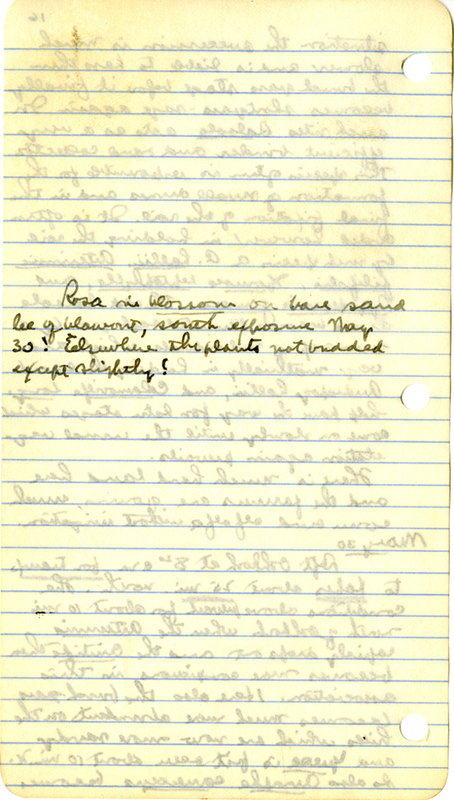
Rosa in blossom on base sand of blowout, south exposure May 30! Elswhere the plants not budded except slightly!
17
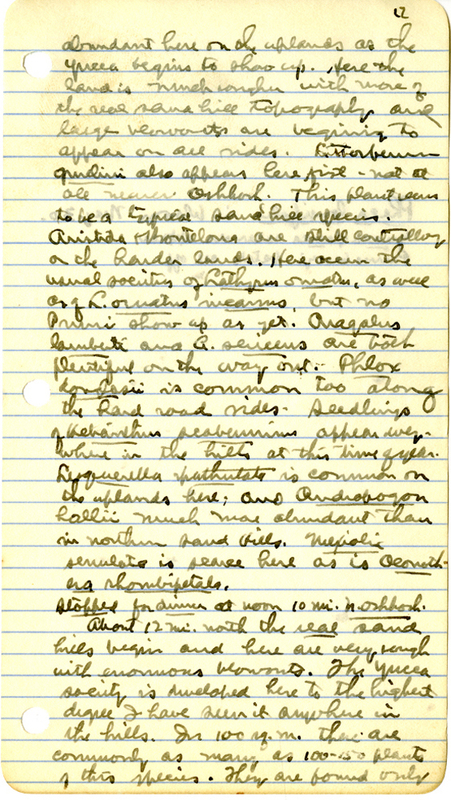
abundant here on the uplands as the yucca begins to show up. Here the land is much rougher with more of the real sand hill topography and large blowouts are beginning to appear on all sides. Lithospermum gmelini also appears here first — not at all nearer Oshkosh. This plants seems to be a typical sand hillspecies. Aristida & Bouteloua are still controlling the harder lands. Here occur the usual societies of Lathyrus omatus, as were as L. ormatusa vicarus but no Prunus show up as yet. Aragalus lambertii and A. sericeus are both plentiful on the way out. Phlox douglasii is common too along the hard road sides. Seedlings of Helianthus scaberrimus appear here where in the hills at this time of year. [?] Lesquerella spatulata is common on the uplands here; and Andropon hallii much more abundant than in northern sand hills. Mexiolia senulota is scarce here as is Oenothera rhombipetala.
Stopped for dinner at noon 10 mi. N. Oshkosh.
About 12 mi. north the real sand hills begin and here are very rough with enormous blowouts. The Yucca society is developed here to the highest degree I have seen it anywhere in the hills. In 100 sq. m. there are commonly as many as 100-150 plants of this species. They are formed only
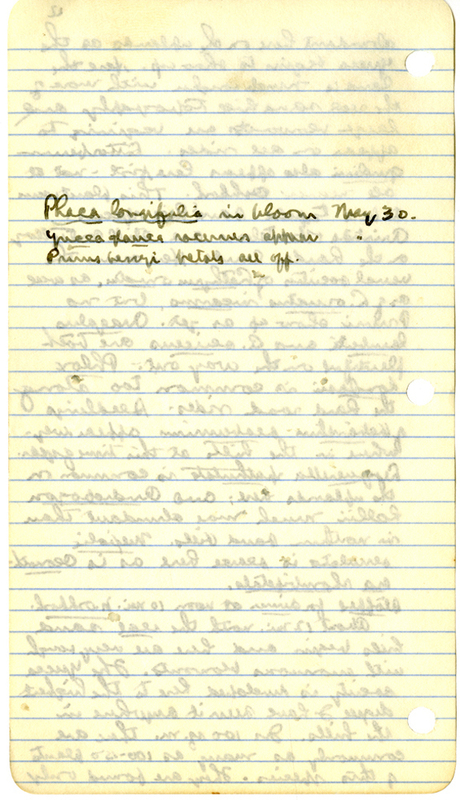
Phaca longifolia in bloom May 30.
Yucca glauca racemes appear
Prunus besseyi petals all off.
18
on the uplands, but here occur on practically all exposures, but as usual are much more abundant on the south exposures where they bore heavy fruit in 1911. Lesquerella frequently forms societies here especially on north exposures.
Rumex venosus is very common in sandiest situations. The most notable novelty so far here are the societies of Rosalea mierantha and Redfieldia on the wide lee slopes of blowouts. There occur expecially where the slope is very gentle and where practically feat. such groups of several acres are common just of Blue Creek straight north of Oshkosh.
Prunus besseyi is not abundant here and Ceanothus I have not seen all day. Artemisia filifolia has dropped out altogether now, but there is considerable A. canadensis There is much Carex pensylvanica here almost giving color in low places.
Some of the extremely numerous Yuccas are showing the racemes just peeking out.
Discovery!!
Muhlenbergia — Yucca Association!
In some blow-outs here Psoralea micrantha is the only plant. This sp. spatulata seems to beat Redfieldis sometimes. Very commonly the two are associated. The deep woody root of of Psoralea with their numerous lateral rhizomes makes this plant an especially good sand binder. Seldom except in worst places are the woody roots blown out. It produces an abundance of seeds and the bottoms of many blowouts and surfaces of sand area show many seedlings of this species at this time of year!
19
The most surprising thing noted this morning is that Muhlenbergia pungens is everywhere on the uplands and that there is scarcely a bit of Andropogon scoparius here! Why not make this classification = Andropogon — Yucca Association over most of the hills, and for Garden — Morrill Co. portion make it Muhlenbergia — Yucca association? This is good distribution of Yucca, and since it is in practically all parts througout the year = hardly mere society. It is always in the A. scap. in most places but here in very same sites with Muhlenbergia. And this leads to another my probable stage in developement of R-S. formation here — i.e. the Muhlenbergia — Yucca association suceeding the Andropogon — Yucca assoc.! Then too there are many Redfieldia plants in this assoc. here outside the blowouts which certainly indicates that this area is much younger developmentally than any other I have seen. The greater abundance of Yucca here also contributes to this view as well as the fact that there are many more bare blowouts here than anywhere else in the hills! The Carex pensylvanica society of this association is conspicuous at this season. The distribution of Muhlenbergia over the ground is in some places somewhat like Bouteloua, but as a rule a scattered tufts similar in form standing close together.
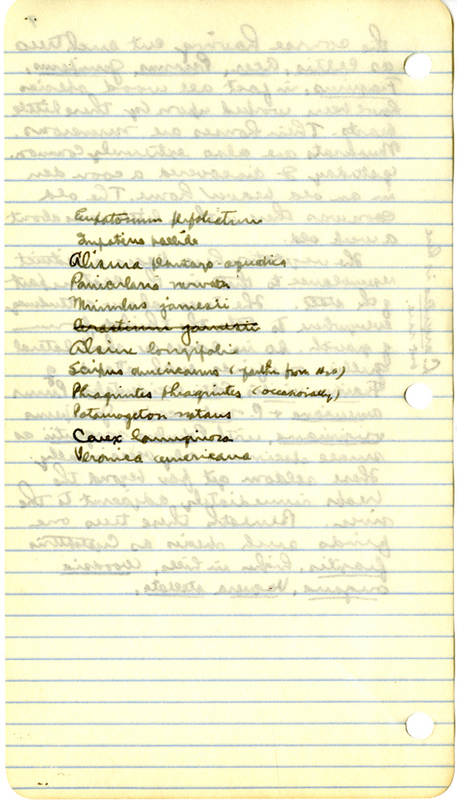
Along Blue Creek I found the usual marshy associations. The societies of
Azolla is very abundant at head of Blue Creek — in places giving a distinct maroon color to the surface of its pools!
20
Mimulus jamesii are especially noteworhty at this time. Blue Cr. heads in a swampy area of about 100 acres — the myriads of large springs bubbling out from the vanes of the hills surrounding the head. There hills are the roughest and barest of any I have seen in the whole region. Blowouts of the largest size seem on every side and the vegetation of the uplands is of the Yucca — Muhlenbergia type on every side, no Andropogon scoparius at all. The pockets are small and almost as bare as the hills — Muhlenbergia — Redfieldia and Psoralea being about the only plants here, with now and then clusters of Penstemonhaydenii. Hills of this sort stretch in every direction from the lakes — there being some hard table land to the east of the lakes — between them and the hills immediately about the head of Blue Creek. On these tables the soil is harder and the shortgrass association is well developed. Ate dinner near Crescent Lake with a M. Pickerell. After dinner went out to the lakes, but since it was still very cloudy, too cloudy for picking, I pushed on to Mumper where I arrived at 6:20 P.M. and had supper & staid all night with
21
Mr. & Mrs. Joe Hanser — Kriscaiders near Ankeny’s fine ranch.
22
and P. glaucus, and Lesquerella argentea were also numerous on this trip. They were as a rule confined to the harder, less sandy soil of the lower slopes and tables.
The Bunch Grass asscociation is well developed here, and there is little Yucca except on certain hills. Causthus is not here at all, and Amorpha canescens only occasionally.
In afternoon wrote letters napped
June 3 — Back to Mumper with Stan Man.
Bulbilis at height of flowering period.
The south shore of Crescent Lake is almos absolutely have — great blowouts and sand dunes cover whole beach. Psoralea micrantha is especially abundant here. In some places great points of hard sand stand out from the general leveal of the sandy and gravelly banks. At one place I saw gallons of the seeds of P. micrantha in the edge of the water among other debris.
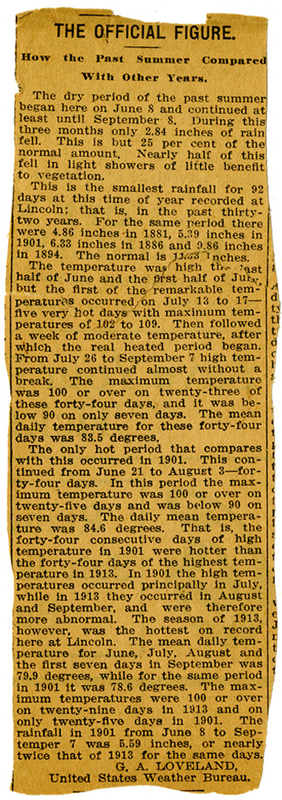
The Official Figure
How the Past Summer Compared With Other Years.
The dry period of the past summer began here on June 8 and conitnued at least until September 8. During this three months only 2.84 inches of rain fell. This is but 25 per cent of the normal amount. Nearly half of this fell in light showers of little benefit to vegetation.
This is the smallest rainfall for 92 days at this time of year recorded at Lincoln; that is, in the past thirty two years. Form the same period there were 4.86 inches in 1881, 5.39 in 1901, 6.33 inches in 1886 and 9.86 inches in 1894. the normal is 11.33 inches.
The temperature was high this last half of June and the first half of July , but the remarkable temperatures occured on July 13 to 17 — five very hot days with maximum temperatures of 102 to 109. then followed a week of moderate tempereature, after which the real heated period began. From July 26 to September 7 high temperature continued alomst without a break. The maximum temperature was 100 or over on twenty three of those forty-four days was ,and it was below 90 on only seven days. The mean daily temperature for these forty-four days was 83.5 degrees.
The only hot period that compares with this occurred in 1901. This continued from June 21 to August 3 — for forty-four days. In this period the maximum temperature was 100 or over on twenty-five days and was below 90 on seven days. The daily mean temperature was 84.6 degrees. That is, the forty-four consecutive days of high temperature in 1901 were hotter than the forty-four days of the highest temperature in 1913. In 1901 the high temperatures occured in August and September, and were therefore more abnormal. The season of 1913, however, was the hottest on record here at Lincoln. The mean daily tempereature for June, July, Aguest adn the first seven days in September was 79.9 degrees, while for the same period in 1901 it was 78.6 degrees. The maximum temperatures were 100 or over on twenty-nine days in 1913 and on only twenty-five days in 1901. the rainfall in 1901 form June 8 to September 7 was 5.59 inches, or nearly twice that of 1913 for the same days.
G.A. Loveland,
United States Weather Bureau.
23
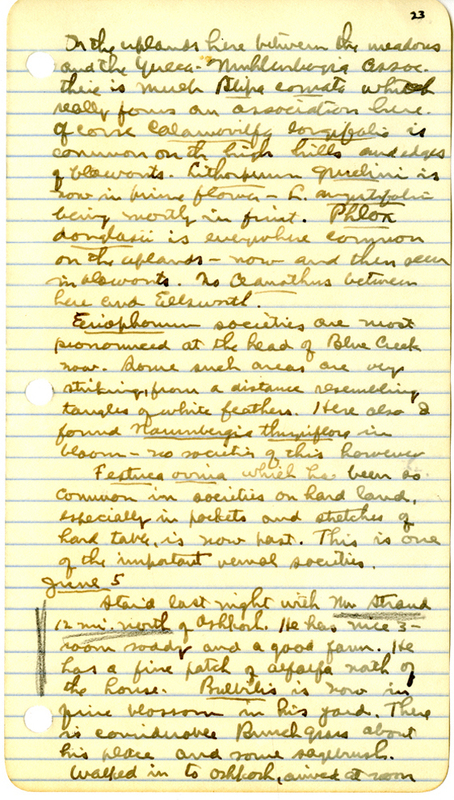
On the uplands here between the meadows and the Yucca & Muhlenbergia assoc. there is much Stipa comata which really forms an association here. Of course, Calamovilfa longifolia is common on the high hills and edges of blowouts. Lithosperm gmelini ins now in prime flower — L. angustifolium being mostly in first. Phlox douglasii is everywhere common on the uplands — now and then occur in blowouts. No Ceanothus between hear and Ellsworth.
Eriophorum societies are most pronounced at the head of Blue Creek now. Some such areas are very striking, from a distance resembling tangles of white feathers. Here also I found Naumburgia thyrsiflora in bloom — no society of this however.
Festuca ovina which has been so common in societies of hard land, is now past. This is one of the imporant vernal societies.
24
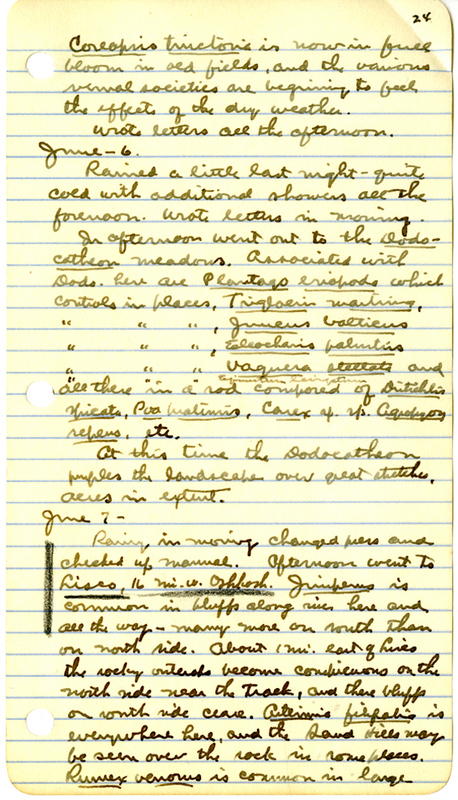
Coreopsis tinctoria is now in full bloom in old fields, and the various vernal societies are beginning to feel the effects of the dry weather.
Wrote letters in morning.
In afternoon went out to the Dodocatheon meadows. Associates with Dods. here Plantago eriopoda which controls in places, Triglochin maritima,
” ” “, Juncus balticus,
” ” “, Eleocharis palustris,
” ” “, Vaquera stellata and
” ” ” Equisetum laevigatum and all there in a rod composed of Distichlis spicata, Poa malimsis, Carex sp. sp. Agropyron repens, etc.
At this time the Dodecatheon pimples the landscape over great sketches, acres in extent.
25
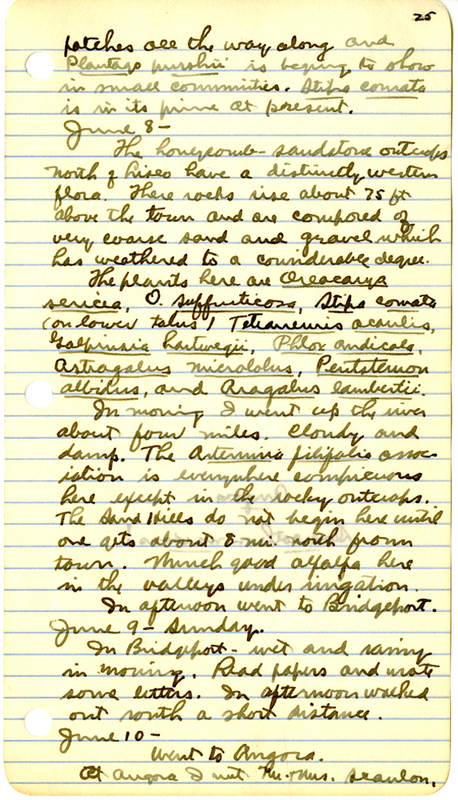
patches all the way along and Platago purshii is begining to show in small communities. Stipa Comata is in its prime at present.
The plants here are Oreocarya sevicea, O. suffucticosa, Stipa comata (on lower talus), Tetraneuris acaulis, Galpinaria hartwegii, Phlox andicola, Astragalus Micrololus, Penstemon albidus, and Aragalus lambertii.
In moving I went up the river about four miles. Cloudy and damp. The Artemisia filifolia association is everywhere conspicuous here except in the rocky outcrops. The Sand Hills do not begin here until one get about 8 mi. north from town. Much good alfalfa here in the valleys under irrigation.
In afternoon went to Bridgeport.
At Angora I visit Mr. & Mrs. Scanlon
Angora
Dodecatheon meadows!
26
former university people. In the afternoon Mr. S and I rode out the Sand Hills which begin about three miles north of town. This area of hills as an exterior of the Sand Hill region farther east. The toungue extends many miles farther west. The hills are about as farther east altho mot so many high hills or so many blowouts as farther east. There is scarcely any bunch grass here, but the Yucca — Muhlenbergia association is here developed about as it is in Garden Co. to the eastwards. On some of the hills Yucca is very thick. Andropogon hallii is very common here as a copious species. Calamovilfa longifolia is also abundant here. Stipa comata is the most abundant species, covering extensive ares on the lower slopes in mixture with Bouteloua. The meadows in valleys here are typical, and, with the presence of Dodecatheon, resemble those about Oshkosh. Dodecatheon is very thick in some of the meadows all along betweeen Angora and Bomner. Among scecordary species the following are the commonest: Galpinsia, Lineorium montanum, Penstemon albidus, Anagalus lambertii, Astragalus microlobus, Orophaca sericea, Lathyrus omatus, Phaca longifolia, and Psoralea micrantha, as much is often controlling in very sandy areas. Prunus besseyi is not abundant and is little P. melanocarpa. There is
27
No Ceanothus at all. Aragalus lambertii forms societies here. The hard land here is fine for alfalfa, a number of very good fields were seen without irrigation. Land sells a from $8.00 — $15.00 here and many kind consider one proving up and selling out.
The rocky areas south of town supports a flora like outcrops about Lisco.
East from Alliance there is not much Yucca on Bunch Grass for a number of of miles, but Stipa Comata is controlling on the uplands. this is to be expected as migration from the High Plains eastward. In the “breaks” along the upper course of the Middle Loup. Juniperus occurs as scattered individuals, being in no place so common as along the Dismal or North Platte river.
At Seneca Koleria critata is an abundant species in mixture until Stipa Comata. Stipa vinidulo
28
is very common here too in lower places as in pockets and along the railroad tracks. Cactus vurbasas and Opuntia fragilis are very common here. Bunch Grass controls the upland, but in places Yucca is abundant. The Batrachium — Myriophyllum society is in its prime here now.
Heard a man say he had a ranch to sell as follows: 2000 A, 1500 in hay land, $8.00 per acre.
Cactus missouriensis beginning to bloom.