
Curriculum and Learning Strategies
Courses Offered Within the Centennial College
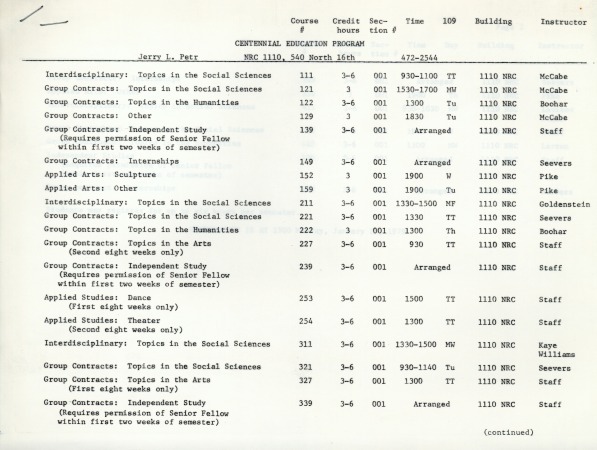
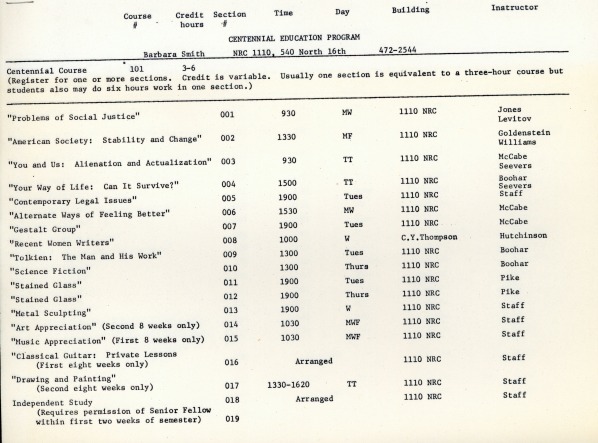
The Centennial College curriculum covered a large variety of courses, at all levels of undergraduate study. While the extent of the college's courses contained a wide variety of subject matter ranging from the arts, humanities, social sciences, and many more -the original documents containing the full list of courses can be seen at left- some of the more unique courses were typically available at the lower levels of study, and included:
-Problems of Social Justice
-You and Us: Alienation and Actualization
-Your Way of Life: Can It Survive?
-Alternate Ways of Feeling Better
-Tolkien: The Man and His Work
-Stained Glass
-Metal Sculpting
-Classical Guitar (Private Lessons)
-Drawing and Painting
Additionally, at higher levels of study, many group courses were available. These courses typically involved group work to discuss and apply education in social topics, arts topics, humanities, dance, and theater.
Curricular Program Design
The Centennial College’s curriculum was designed around new philosophies toward learning; the idea that education can be more effective if students are given freedom to choose to study topics that they are interested in. The college essentially offered elective course material without students having to sift through many extra subjects. Frequently students would pick a topic of interest, and then the professorial staff involved would design a semester-long course based around this choice, frequently involving large projects that the student would work on, and make progress reports on to the staff periodically.
Additionally, almost all classes offered in this fashion were done so under a pass/fail grading system, effectively eliminating the students’ pressure to learn and regurgitate information on exams, and putting a larger emphasis on self-development. Naturally, exceptions were available, usually if the teacher requested a student’s work be graded on the usual four-point scale due to exceptional work.
This curriculum design allowed for openings for guest instructors and material as well. For example, later in the program’s existence (in the school year of 1977-1978), there was an in-dormitory rotation of guest instructors who lived in Love - Heppner, including a guitarist who instructed interested students in classical guitar, a professional painter, a mural artist, and a mime, pantomime, mask performance and juggling instructor.