
Nu History
Item set
- Title
- Nu History
Items
-
 None the less it is observable that the only striking disproportion in the enrollment is in the case of the wholly general and non-professional College of Arts and Sciences. The figures for that college, indeed, are somewhat deceptive, for the Teachers' College and some of the schools are organized within it and demand certain deductions from its totals. Still, after all deductions are made, the numbers enrolled there are greater than those of any other division of the University, and show a persistent vitality in this oldest of all the colleges. The problem of the arts college is today the principal problem of higher education in America and especially in the state universities of the Middle West. The keying up of the economic life and the growing disrepute of leisure have tended to put a pressure upon the student to make every moment of his training count—in almost a Prussian degree— toward his efficiency in some demonstrably useful activity. Out of this shift of emphasis there has grown a corresponding vagueness as to the exact values for which the arts college is to stand. But however much technical training may become the chief function of the state university, it can not wholly displace the pursuit of those other studies whose aim is to inform the mind broadly in the thoughts and experience of the past, and put the present into its just perspective by widening the student's outlook. How vitally this purpose clings to the prevailing idea of education is to be seen in the enrollment in those courses that have no other reason for being. And the problem of the arts college lies in the proper correlation of those studies to that end. To return to the general condition of the University, perhaps the best survey of the range of subjects of study offered by its colleges in its fiftieth year, and of the teaching done in them, may be had in a glance at the list of its separate departments and the numbers of students registered in them in a recent typical semester.
 -
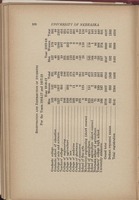 REGISTRATION AND DISTRIBUTION OF STUDENTS Year 1916-17 Year 1917-18 Men Women Total Men Women Total Graduate college 189 142 331 127 175 302 Graduate school of education 55 37 92 45 41 86 College of arts and sciences 1227 1357 2584 895 1260 2155 Teachers' college 51 391 442 19 397 416 College of engineering 346 ... 346 251 1 252 College of agriculture 310 282 592 221 253 474 College of law 176 2 178 113 2 115 College of medicine 263 11 274 276 9 285 College of pharmacy 62 6 68 31 9 40 School of commerce 275 9 284 142 16 158 School of fine arts 8 125 133 16 110 126 Mechanical engineering (short course) 15 ... 15 ... ... 15 School of agriculture 324 151 475 243 118 361 School of agriculture (short course) 155 2 157 164 1 165 Nebraska school of agriculture 75 86 161 55 86 141 Teachers' college high school 98 189 287 132 308 440 University extension 164 167 331 317 274 591 Grand total 3793 2957 6750 3047 3060 6107 Deduct repeated names 652 693 1345 592 991 1583 Total registration 3141 2264 5405 2455 2069 4524
 -
 have been wanted, and presents, too, something of the comparative demand for them in the number of students enrolled for each one. It is not quite just, however, either to the institution as a whole or to the individual parts of it, to let the table stand without adding a grain of salt to its interpretation. Thus, a dropping off of 881 students in the year 1917-18 was an abnormal circumstance due to the war, and rather a source of pride than otherwise. The preceding year, however, was a normal one, and represents better than its successor the normal growth in registration. The biennium as a whole, as a result of the growth of that year, shows an increase of more than 500 above the enrollment for the preceding one. The figures, moreover, do not include either the S. A. T. C. of the fall of 1918, or the 2,400 men trained for the army in technical courses, from June to December, 1918. The table is worth another glance. It reveals other things besides the bare proportions of the University. Looked at reflectively it speaks of the various ambitions which animate the youth of the state and which in the end are directed back into the general life—so many engineers, so many doctors, so many trained in law, so many in agriculture or domestic economy, and so on. For the most part these numbers reflect, not the relative popularity of school or college as such, but, more largely, the general needs of the community. For choice of profession goes, by and large, with the social demand. Another thing to be observed is the degree to which the University has developed in its technical and professional branches. More than two-thirds of the men and more than half the women students of the year 1916-17 were registered in the professional course. And it may be added that many of those not so registered were underclassmen, freshmen and sophomores, still undecided to which profession to enter, but taking meantime such courses in the general curriculum as would give them the chance to try their aptitudes.
 -
 the measure of how much that kind of thing has been wanted. Those who have come have been the gauge, not of a generalized ideal of what a state should do for its youth, but of the individual and actual desire for those particular services. The vitality of the state university is thus demonstrated by its continued existence and continued growth. By such a test the University of Nebraska—we may pardonably boast—has shown a vigor that leaves as its only problem the one of how to contain and direct it. The University has, indeed, repeatedly outgrown its own house. Its colleges are now spread over three campuses. The newest of these, the one for the College of Medicine, at Omaha, is on a hillside not quite at the edge of town, overlooking a broad valley and the open prairies beyond. By situation it is open to indefinite expansion. Already it has a large, well equipped hospital, a laboratory building of modern style and equipment, and another laboratory building under construction. The campus of the College of Agriculture, the Farm, is, on the whole, the pride of the institution. Its half-section of land at the outskirts of the city, with its thirty-two buildings, its well kept lawns, and its model fields, is the show place of Lincoln. Further building is in progress there also. The city campus, where more than two-thirds of the five thousand students go to their classes, is not so fortunate in its site or equipment. But though at the moment the uninitiated visitor will gain an impression of chaos from the jumble of buildings there and the diversity of architecture, yet there is a plan slowly emerging, of which the newer buildings—Bessey Hall, Chemistry Hall, the Social Science Building, and the Teachers' College High School—are the earnest, and which promises to bring the city campus into more than fair comparison with the others. What the University has come to in the course of its minority—colleges, schools, and extra-mural activities—may best be seen in a table adapted from the regents' report to the legislature for the biennium that has brought the institution to its majority. The table is a little forbidding, but it presents an array of just those services that
 -
 Professor W. L. Westermann. To the many friends of the University this is one a their proudest moments. As in war so in peace the University of Nebraska is playing no small part. ANNIS S. CHAIKIN. THE UNIVERSITY TODAY The fiftieth birthday of the University of Nebraska is a kind of family holiday—not quite a day of rest, as it has proved, but one of a good deal of good feeling. The external relations of the University are peculiarly happy at the moment, for its record in the war just ended has been such as to bring it the touch of pride necessary to a pleasant sense of self-satisfaction. And its internal relations are more than usually harmonious. We may be forgiven, therefore, for a little more complacency than might be appropriate at another time and outside the family, and a little more frankness of self-examination than would be palatable from outsiders. The moment ought to be thoughtful as well as festive for the University may be felt to have come of age at its fiftieth year. It is no longer an experiment. It has gone through its time of gangling growth, has had its periods of stagnation and its spurts of expansion, and has emerged into maturity with the complete organization of the typical American university. For the typical American university is the state university. Whether it is a finer product than the endowed or the denominational school is a matter of opinion, but it has the distinction of having arisen out of the direct impulse of the people themselves, and of having expanded, college by college and department by department, in response to their immediate demand. Its support has been not the inertia of an endowment, but the appropriation moment by moment of what they have wanted to afford for that kind of thing, and its attendance has been
 -
 abroad; while a large number of overseas service men as yet have not been recorded. Base Hospital No. 49, now serving overseas, was organized under the auspices of the college of medicine, and is manned largely both in its officers and its privates by University men. Two University women also are in its corps. There are many Nebraska men in the medical and ambulance corps of both army and navy. Many members of the faculty of the college of medicine are serving as commissioned officers in the medical corps. The women, too, of the University of Nebraska have contributed their share. Miss Alice Howell and Miss Blanche Grant of the faculty have gone overseas as canteen workers. An alumna, Miss Helen Sargent, gave up her life as a Red Cross nurse. Alumnae and students have furnished a large number of workers in the food conservation work, Red Cross, Y. W. C. A., canteen service, student nurses, dietitians, reconstruction workers, and other important branches of service. Campus life itself was transformed by the war. The student body in large measure gave up their social life in order to contribute their money to war funds and their time to war work. In every war drive the University went over the top. The department of athletics alone contributed $7,000 to Red Cross. Both men and women worked in the Red Cross rooms where surgical dressings were made daily. Members of the faculty added to their already heavy schedules of class-room work when members of their department were called into service granted leaves of absence. They went out over the state freely to give lectures upon the meaning and significance of the war. They served on numerous and varied war committees. Much more might be said of the University and its part in the war. Those who have come in contact with its faculty, alumni, and student body, know of their share. After the armistice was signed three men represented the University of Nebraska at the peace conferences at Versailles—General John J. Pershing, Major F. M. Fling, and
 -
 The department of physics was almost depleted of its faculty for a time, the head a the department and a number of his associates being called to Washington for special service. Prof. M. M. Fogg as state director for the department of public information developed a corps of four-minute men, many of them former University men, who attracted national attention because of their number and effectiveness. And even our famous football players gave up their coach, Dr. E. J. Stewart, who enlisted as a physical director under the Y. M. C. A. Other members of the faculty co-operated with the food and fuel administrators. In fact there was no member of the faculty or of the administrative force who did not lend his services in some form or another. Not only the faculty but the entire University plant was put at the disposal of the United States government. A national army training school was opened at Nebraska in July, 1918, which with one or two exceptions, handled a larger number of soldiers than any other state institution. This was under the supervision of Prof. O. J. Ferguson, acting dean of the college of engineering, who had as his assistants a number of the faculty. And when, at the beginning of the school year, the government decided to make use of the educational institutions of the country, the University of Nebraska opened its doors to a student's army training corps which numbered 1,730 men. All this was in addition to the special war courses, including a school in radio telegraphy, which were established at the very beginning of the war. The military department of the University furnished continually a large quota of men both from its alumni and its student body for the officers' training camps. But many men preferred to enlist as privates and to play their humble part in the great army of democratization. The fact that General Pershing, in command of the American Expeditionary Forces, was a former commandant at the University and also an alumnus drew many of his former boys to him. Six hundred of the 2,300 stars upon the service flag are known to represent men in France or other countries
 -
 THE UNIVERSITY AND THE WAR When the call to the colors came in the great world war, the University of Nebraska "went over the top" in every form of service she might possibly render. Faculty, alumni, students, buildings, and equipment, all were at the disposal of the United States government. Immediately upon the declaration of war more than a thousand young men withdrew for military, naval, or industrial service. And these numbers have been steadily growing with records still incomplete. The 2,300 stars upon the University service flag bear silent witness to her men, young and old, who entered camp and trench, ready if need be to die for their country. Forty-four of these stars are already known to have turned to gold, twenty-six of them among the American Expeditionary Forces. They represent privates and officers; a Lieutenant Colonel: an army chaplain; a Red Cross nurse; a physician; men killed in the thick of action; and men who gave their lives in the training camps. Faculty as well as students joined the colors. Fifty members of faculty and administrative officers entered military service, while others were called to Washington for important services in their specialized lines. Chancellor Avery was called to Washington because of his special knowledge of chemistry and was later commissioned a major in the chemical warfare service. Dean O. V. P. Stout of the college of engineering and Dean Irving Cutter of the college of medicine were granted leaves of absence by the University when commissioned a major and captain, respectively. Major L. W. Chase of the ordnance department, engaged in responsible work in the crating of gun carriages; Major Stokes of the medical corps in the organization of Base Hospital Unit 49; Major F. M. Fling in the historical section; Major Sturdevant of the Base Hospital at Camp Cody; Major Amos Thomas of the eighty-eighth division serving overseas; Captains P. M. Buck, A. R. Davis, C. J. Frankforter, and C. W. Taylor, are but a few of the faculty members who are serving as officers.
 -
 Nebraskans. Mr. Sherman's suggestion met with a great deal of favor on the campus and Albert Watkins, Jr., then prominent in college journalism, took up the idea and firmly established the name. JACK BEST No history of Nebraska athletics would be half complete without some tribute to the service of our beloved trainer, Jack Best. For almost forty years, he has been rubbing the sore spots out of stiff muscles, giving solace to discouraged candidates for athletic honors, and putting fight and the spirit of fair play into our athletes. His pleasant smile, whole-hearted sympathy, and unswerving loyalty have been the inspiration of the wearers of the Scarlet and the Cream. Jack will live in our hearts as long as there is life within us. The following couplets which are often sung on the campus nowadays will be sung by our great grandchildren. Old Jack Best from England came Best in heart, Best in name. Always there with a hearty laugh "Don't forget to turn off the bath." Inter-collegiate athletics have justified themselves at Nebraska. The critics say that competitive athletics develop only the few, while a proper system should develop the many. Around the Cornhusker athletes has grown that academic patriotism known as "college spirit" without which no large university can have an attractive college life. Isn't it true that a Cornhusker becomes the hero of every Nebraska boy as soon as begins to read the sporting page, and that he becomes zealous to develop his physique in order to emulate the deeds of his hero? GUY E. REED.
 -
 OTHER MINOR SPORTS Gymnastics have been maintained since the early 1900's. Our teams have been among the winners consistently, competing against all the largest colleges of the Western Conference. Wrestling was introduced in 1908 and meets with Ames and Iowa have been held in addition to the Western Conference meet. In 1916, our wrestlers succeeded in carrying off premier honors at the conference meet in Minnesota. There has not been a year in which we have not won at least one of the weights, even though our teams did not always carry off first honors. PHYSICAL EQUIPMENT Until 1908, the northwest corner of the old campus always served as an athletic field. It was either as hard as a pavement or was a sea of mud, and it is to be wondered how early football warriors ever survived a season. In 1908 a movement was started by the athletic board, headed by Graduate Manager Earl Eager, to acquire a block and one-half just north of the old campus, bordering on Tenth and T streets. This was acquired but was not ready for use until 1909-10, and in the meantime the Antelope baseball park was used for football and the state fair grounds track for track and field athletics. The present athletic field is as inadequate now as the old one was in 1907. When Grant Memorial Hall was built in 1887-8 it was one of the best gymnasiums in the Missouri Valley. Though it has outlived its early reputation, some very excellent basketball and gymnastic teams have been trained within its four walls. THE NAME "CORNHUSKER" The name "Cornhusker" was first applied to Nebraska athletic teams by Charles S. Sherman, then the sporting editor of The Nebraska State Journal. Before that time our athletes were known as Bug-Eaters, Tree-Planters, or
 -
 this spring. With the opening of several additional courts east of the athletic field, the training of a larger squad will be possible. BASKETBALL Basketball was introduced into the University in the winter of 1895-96 by Dr. Clark, who was at that time director of the gymnasium. In those days there were seven men on a team. The very earliest games were played with the Y. M. C. A. and other local organizations. Basketball has grown greatly in popular favor until it is now one of the most popular of the sports. Nebraska succeeded in the early years in winning most of the games played with other Missouri Valley colleges. In the early 1900's, Nebraska began to play with the Western Conference colleges and as a whole was generally on the short end of the score. Dr. Clapp became director of the gymnasium and professor of physical education in 1902. Basketball flourished under his guidance, and, though still losing to Western Conference teams, our boys made excellent records in the Missouri Valley competitions. Our small court in Grant Memorial Hall always proved a handicap, when our basketball teams journeyed to the larger courts of Minnesota, Wisconsin, or Chicago. After "Jumbo" Stiehm took charge of the team, we won two successive Missouri Valley championships and in 1915 gave Minnesota a double drubbing. The lack of a suitable gymnasium is alone responsible for the fact that Nebraska has not made a record in basketball as good as that made in football. The largest High School basketball tournament in America is held under the auspices of the University of Nebraska. As many as 130 teams have competed in a single tournament. As a consequence, good material is very plentiful and as soon as a good gymnasium is supplied, we will take our rightful plane in basketball among the colleges of the middle west.
 -
 TENNIS The tennis association of the University of Nebraska was organized in 1890, with Charles D. Chandler as first president. Two courts, soon increased to three, were laid out directly west of University Hall. Later they were moved to the site of the present Law building. The first holder of the University championship was Miss Louise Pound, who was on the team which played Doane College in the early '90's. She was Nebraska's representative for two years in singles, and with Emory C. Hardy made up our team in doubles. The tennis association has had many excellent players on its membership roll. Earl E. Farnsworth, champion in 1902, became state champion in singles, and with I. M. Raymond, Jr., won the state championship in doubles. He was collegiate champion of Kansas, Missouri, and Nebraska in the fall of 1903. H. V. Failor, '02, became a tri-state champion. Other men holding 'varsity firsts in singles or doubles were Arthur Scribner, Fred Wright, Ralph Cassady, '05, and C. M. Mathewson, '06. In 1905, competitions with Iowa and Minnesota were held. The tennis teams were never under the jurisdiction of the athletic department until 1912. The association ran as an independent association and made its own engagements for dual meets. In 1909, R. E. Weaverling and Harry Smith were our representatives against Kansas. In 1911 the first Missouri Valley conference meet was held, and Nebraska was victorious. John T. Tate won first place in singles, and with M. F. Goodbody as partner, won the doubles. Guy Williams, '14, was a leading player till his graduation, and so was E. F. Meyer. Last should be mentioned Lieutenant Harry Ellis, '16, recently wounded in the Argonne in France, who beside being college champion was three times a state champion in doubles, mad Lieutenant Edward Geeson, who won the title of state champion in 1917. In the fall of 1917 the game was abandoned at the University because of war conditions, but it will be resumed
 -
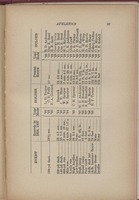 EVENT Records in 1896, 1897 Year Made HOLDER Present Record Year Made HOLDER 100-yd dash 10 1/2 sec. '91, '91, '92 L. E. Troyer, C. E. Tefft, E. A. Gerrard 10 sec. '98, '10, '13, '13 R. D. Andreson, Guy E. Reed, E. B. Scott, George Irwin 220-yd. dash 23 4-5 sec. '94 Hancock 21 4-5 sec. '11 Guy E. Reed 440-yd. dash 55 1-5 sec. '95 J. E. Shue 50 sec. '11 Guy E. Reed 880-yd. run 2 min. 10 sec. '94 W. Sawyer 2 min 4-5 sec. '10 W. I. McGowan Mile run 4 min. 57 1-5 s. '94 W. Sawyer 4 min. 26 sec. '11 L. R. Anderson 2-mile run None 9 min. 51 sec. '17 Glen Graff High hurdles 20 1-5 sec. '95 C. R. Spooner 15 3-5 sec. '17 L. R. Finney Low hurdles None 25 3-5 sec. '09 D. F. McDonald High jump 5 ft. 4 3/4 in. '97 W. E. Andreson 5 ft. 11 3/4 in. '13 C. B. Meyers Broad jump 19 feet '96 R. E. Benedict 22 ft. 7 in. '16 W. W. Wiley Pole vault 9 feet '97 R. E. Benedict 11 ft. 11 3/4 in. '13 D. D. Reavis 16-lb. shot put 35 ft. 6 in. '96 John Martz 42 ft. 9 in '16 Edson Shaw 16-lb. hammer throw 78 feet '95 E. F. Turner 151 ft. 7 in. '09 Sidney Collins Discus throw None 125 ft. 6 in. '13 C. B. Meyers Javelin None 158 feet '17 T. E. Riddell
 -
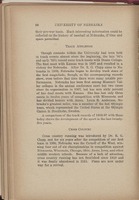 their pre-war basis. Much interesting information could be collected on the history of baseball at Nebraska, if time and space permitted. TRACK ATHLETICS Though contests within the University had been held in track events almost since the beginning, the late '80's and early '90's record some track meets with Doane College. The first meet with Kansas was in 1897 and resulted in a victory for Nebraska. After Dr. R. G. Clapp came to Nebraska in 1902, Nebraska began to develop track stars of the first magnitude, though, as the accompanying records show, even before that time there were many notable performances. Nebraska has been first among Missouri Valley colleges in the annual conference meet but two times since its organization in 1907, but has won sixty percent of her dual meets with Kansas. She has lost only three meets in twelve years of competition with Minnesota and has divided honors with Ames. Louis R. Anderson, Nebraska's greatest miler, was a member of the last Olympic team, which represented the United States at the Olympic Games in Stockholm, Sweden. A comparison of the track records of 1896-97 with those today shows the development of the sport in the last twenty-five years. CROSS COUNTRY Cross country running was introduced by Dr. R. G. Clapp, and for six years after the competition of our first team in 1904, Nebraska was the Cornell of the West, winning four out of six championships in competition against Minnesota, Wisconsin, Chicago, Ohio, Ames, Iowa, and other middle western schools. Because of a lack of attention, cross country running has not flourished since 1910 and it was finally abandoned in 1915. Plans are now under way for a revival.
 -
 1905 C. T. Borg 1913 L. R. Purdy 1906 Glen Mason 1914 Victor Halligan 1907 John Weller 1915 R. B. Rutherford 1908 J. B. Harvey 1916 H. H. Corey 1909 O. A. Beltzer 1917 Edson Shaw 1910 John Temple 1918 *Ernest Hubka 1911 S. V. Shonka 1919 Paul Dobson, Captain 1912 E. E. Frank Elect. BASEBALL Baseball is the oldest of Nebraska's sports. From the very beginning of the University, baseball contests were held between the various classes. An intercollegiate game with Doane in 1882 is the first outside contest recorded. Nebraska was victor by a decisive score, probably on account of the fact that Frederick Shepard now a judge of the district court a Lancaster County, had mastered the curve ball and had the opposing batsmen absolutely at his mercy. A great many creditable teams have represented Nebraska. Especially during the late '90's and early 1900's did we have excellent baseball teams, some of whose stars were Eddie Gordon, J. R. Bender, J. M. Bell, George Fenton, Robert Carroll. The coming of Western League Baseball in 1905 brought a decline of interest. The baseball teams began to be controlled by university factions, and though they made extended trips to the East and South, baseball became a liability from the manager's point of view. No more than a handful a spectators would be on hand to witness an important battle. In 1911 the sport was abandoned. Since that time, baseball has had several revivals but only a few games were played each season. Coach Stewart is now planning a real resurrection of baseball, to take place just as soon as conditions within the University return to *Roscoe Rhodes, Captain Elect for 1918, was killed in action in France.
 -
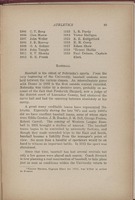
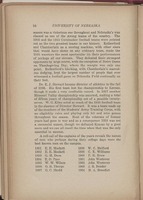 season was a victorious one throughout and Nebraska's was classed as one of the strong teams of the country. The 1902 and the 1915 Cornhusker football teams were pointed out as the two greatest teams in our history. Rutherford and Chamberlain as a scoring machine, with other stars that would have shone on any ordinary team, made the 1915 warriors the most spectacular iin [sic] their performances of perhaps all our elevens. They defeated their strongest opponents by large scores, with the exception of Notre Dame on Thanksgiving Day, where the margin was one point. Rutherford's blocking, with Chamberlain's marvelous dodging, kept the largest number of people that ever witnessed a football game on Nebraska Field continually on their feet. Dr. E. J. Stewart became director of athletics in the fall of 1916. His first team lost the championship to Kansas, though it made a very creditable record. In 1917 another Missouri Valley championship was annexed, making a total of fifteen years of championship out of a possible twenty-seven. W. G. Kline acted as coach of the 1918 football team in the absence of Director Stewart. It was a team made up of the members of the Students' Army Training Corps, with no eligibility rules and playing only hit and miss games throughout the season. Most of the veterans of former years had gone to war and as a consequence 1918 was not a successful season, though we defeated Kansas by a good score and we can all recall the time when that was the only essential to success. A roll call of the captains of the years reveals the names of men who perhaps during their college days were the best known men on the campus. 1891 E. E. Mockett 1898 W. C. Melford 1892 E. E. Mockett 1899 C. E. Williams 1898 G. H. Dern 1900 F. H. Brew 1894 E. O. Pace 1901 John Westover 1895 W. W. Wilson 1902 John Westover 1896 O. E. Thorpe 1908 J. R. Bender 1897 G. C. Shedd 1904 M. A. Benedict 1905 C. T. Borg 1913 L. R. Purdy 1906 Glen Mason 1914 Victor Halligan 1907 John Weller 1915 R. B. Rutherford 1908 J. B. Harvey 1916 H. H. Corey 1909 O. A. Beltzer 1917 Edson Shaw 1910 John Temple 1918 *Ernest Hubka 1911 S. V. Shonka 1919 Paul Dobson, Captain 1912 E. E. Frank Elect. BASEBALL Baseball is the oldest of Nebraska's sports. From the very beginning of the University, baseball contests were held between the various classes. An intercollegiate game with Doane in 1882 is the first outside contest recorded. Nebraska was victor by a decisive score, probably on account of the fact that Frederick Shepard now a judge of the district court a Lancaster County, had mastered the curve ball and had the opposing batsmen absolutely at his mercy. A great many creditable teams have represented Nebraska. Especially during the late '90's and early 1900's did we have excellent baseball teams, some of whose stars were Eddie Gordon, J. R. Bender, J. M. Bell, George Fenton, Robert Carroll. The coming of Western League Baseball in 1905 brought a decline of interest. The baseball teams began to be controlled by university factions, and though they made extended trips to the East and South, baseball became a liability from the manager's point of view. No more than a handful a spectators would be on hand to witness an important battle. In 1911 the sport was abandoned. Since that time, baseball has had several revivals but only a few games were played each season. Coach Stewart is now planning a real resurrection of baseball, to take place just as soon as conditions within the University return to *Roscoe Rhodes, Captain Elect for 1918, was killed in action in France.
 -
 From 1894 to 1900 Nebraska did not win another championship, although she was always represented by creditable teams which lost by nip and tuck battles. Following Crawford, Thomas, also of Michigan, Robinson of Brown, Yost of Lafayette, and Branch of Williams were employed as professional coaches, until the advent of "Bummy" Booth in 1900. From the beginning of his career as football coach until he left after the season of 1905, Nebraska had an unbroken string of championships of the Missouri Valley. In 1902 our opponents were held scoreless and we gained national recognition by defeating, for the first time, the strong Minnesota team. In 1903 Nebraska was again undefeated. In 1904 and 1905, though we were defeated by Western Conference schools, the Missouri Valley colleges succumbed to our attack. Foster of Dartmouth succeeded Booth in 1906, and though the team played well, it lost to Kansas, Minnesota, and Chicago. "King" Cole of Michigan as the football mentor in 1907, won another Missouri Valley championship. In 1908 and 1909, we lost the championship to Kansas. However, in "King's" last year, 1910, we came to our own by going through the season with only a single defeat and that at the hands of Minnesota. The preceding year the faculty representatives of the Missouri Valley Conference laid down the rule that coaches must henceforth be members of the faculty and elected for the entire year. This rule went into effect for the year 1911-12. Ewald O. Stiehm was our first all-year coach. He was the product of Wisconsin University, with several years of successful minor college coaching experience. His first football team, though falling a victim to Minnesota, made a clean sweep of the Missouri Valley and tied the University of Michigan in the last game of the season, after clearly outplaying its antagonist during the greater part of the game. In 1912 and 1913 the Cornhuskers won all games except that with Minnesota. After a series of defeats at the hands of Minnesota since 1902, Nebraska triumphed at last in 1914, by a score of 7 to 0, on the home field in a most exciting contest. The
 -
 ATHLETICS No brief survey of the history of athletics at Nebraska can possibly seem adequate. Unrecorded history after all is much more interesting than the statistics of victories and defeats. If a composite picture could be drawn which would mirror the individual heroisms, then only could we appreciate the records which the University of Nebraska has made on the courts, diamond, track, field, and gridiron since embarking in intercollegiate contests in the late '80's and early '90's. The students of the University confined themselves in the early days to intra-mural athletics. It has been said that if Professor G. E. Howard, who was among the first students, had matriculated at a later time he would have been one of the most famous of our all-round athletes. Though one would scarcely picture Professor Caldwell as a plunging fullback, it is well known that he was a baseball player of a great deal of ability. FOOTBALL Football has been the major sport since its very beginning. From a desire to beat Doane and thus win the state championship, the goal of our first football teams, we have passed to the ambition revealed in the schedule for 1919, which includes Iowa, Minnesota, Notre Dame, Oklahoma, Kansas, Ames, Missouri, and Syracuse. In 1890 with the aid of the football fans from among the faculty, the first football team was organized. The great rival for 1890 and 1801 was Doane; but in 1892 gridiron warriors tackled Kansas and were defeated by the score of 12 to 10. Their only other game that season was with Iowa, which resulted in a tie. The next year a professional coach was employed in the person of an old Michigan star by the name of Crawford, who piloted Nebraska through the season without a defeat. The 1894 team was the first team which was recognized as the champion of the Missouri Valley colleges.
 -
 vey, edited by Professor E. H. Barbour, and the recently established Studies in Language, Literature, and Criticism, edited by Louise Pound, H. B. Alexander, and F. B. Sanford. Finally deserving of mention is The Mid-West Quarterly, established in 1913-14 during the administration of Chancellor Avery, with Professor P. H. Frye as editor. According to its prospectus it was "established by the University of Nebraska the belief that there exists in this country a quantity of excellent writing for which there is no adequate medium of publication. While exact scholarship, the discovery and verification of fact, has received any amount of encouragement and stimulation, the cultivation of general ideas, the free play of intelligence, what Matthew Arnold would broadly call criticism, has met of late years with neglect if not with actual disfavor . . . . it is the hope of enlarging the opportunities of those who are interested in this manifestation of mental activity, irrespective of territorial limitations, which has led to the establishment of The Mid-West Quarterly." The Quarterly has contained contributions from writers and scholars of note, and has received much commendation from savants in many parts of the United States. OLIVIA POUND.
 -
 seems to be crowded out by restrictions of space, interest in the social organizations, or for other reasons. And, the school is now so big that it is difficult to "stalk" talent that does not come forward of itself. Opportunity or personal popularity are likely to bring staff positions, where genius for writing may remain buried save for some lucky chance. Some of the former contributors to University publications, all members of the English Club, who have since become distinguished, are Keene Abott of Omaha; Harvey Newbranch, editor of the Omaha World-Herald; Willa Cather, the novelist; Norris Huse, who was lately called to New York City for newspaper work; H. B. Alexander: D. N. Lehmer, now of the University of California; A. S. Johnson, sociologist, novelist, and one of the editors of The New Republic; Edith Abbott of Chicago, sociologist and author; George C. Shedd, novelist; Sara Birchall, now with Vogue, author of a book of verse; Ruth Bryan Owen; Margaret Lynn, essayist and short story writer; Leonard H. Robbins, of The Newark News; Leta Stetter Hollingworth of Columbia University; J. A. Sargent, a well known engineer; Emory R. Buckner, attorney; Fred Ballard, the playwright; Louise Pound; and Edwin Ford Piper, author of a newly published book of verse entitled Barbed-Wire and Other Poems. For faculty and graduate publications the University compares to great advantage with similar state institutions. The oldest publication, University Studies, includes studies of all kinds. It gained perhaps its greatest recognition by its publication of some of Professor C. W. Wallace's Shakespearian researches. The University Journal, a journalistic and educational bulletin, is edited by A. A. Reed, and it alternates with The Alumni Journal, edited by the alumni secretary, Miss Annis Chaiken. The publications of The Nebraska State Historical Society and of the Nebraska Academy of Sciences are issued from the campus. There are many departmental series, like Studies from the Zoological Laboratory, established by Professor H. B. Ward; Reports of the Botanical Survey of Nebraska, founded by Dr. C. E. Bessey; Reports of the Nebraska Geological Sur-
 -
 pression for campus artists and cartoonists. The paper started as a bi-monthly but during the period of the war was reduced to five or six issues a year. The first annual, The Sombrero, appeared in 1884. Copies are not now to be found. The second volume was issued in 1892, and the third in 1894. This last contained a cut of the Sombrero board of 1884. Underneath the cut is the legend "The docile donkey, recently found anchored in a recitation room on the third floor is an honorary member of this board. He refused to compromise himself by appearing in the engraving." It is said that the donkey referred to was a quaint little animal which the professor of French used to ride to school. Numbers of The Sombrero continued to be issued until 1907, when the name was changed to The Cornhusker. The Cornhusker is an amalgamation of the junior annual and the senior class-books which used to be issued by the seniors alongside the junior annuals. Classic among the senior books were that of 1905 with Alice Town Deweese as editor and moving spirit, and that of 1906 with Leta Stetter Hollingworth as a leading editor and contributor. The university annual is now an official or semi-official publication of the souvenir type, issued under the supervision and censorship of the publication board. On the literary or non-journalistic side, it is to be regretted that there is now no avenue of expression for the University students. News gatherers and humorists have opportunities but not so the writers proper. The Nebraska Literary Magazine, a quarterly, ran in 1895-96, under the encouragement of the department of rhetoric and of the English Club of the University; and, beginning in February, 1898, The Kiote, a monthly publication of the English Club, went through three or four volumes. The interest in writing that led to the publication of these magazines was, for the most part, due to the stimulus of Instructor Herbert Bates, and later to that of Professor Clark Fisher Ansley, of the department of rhetoric. Formerly there was much of a literary nature in the Sombrero. This material now
 -
 one of its editors, "Rag Riley" (Frank T. Riley of Kansas City). Since his day the college paper has always been called familiarly "The Rag." The most ambitious and the most ephemeral of student publications was The University Monitor, an attempt at serious journalism which rose and passed in 1896. On January 13, 1901, The Daily Nebraskan was organized. It was a consolidation of the two weekly papers, The Hesperian and The Nebraskan, and the literary monthly connected with the latter, The Scarlet and Cream. The first issue of The Daily Nebraskan came out in September, 1901. The editorship of the paper was at first elective by the student body, but it is now an official publication having financial backing from the university. The staff editors are selected by the faculty publication board. As to humorous publications, the earliest, according to tradition, was The Button Buster, issued in the early '80's by members of the Palladian society. This paper went through several issues at irregular intervals. Though copies have failed of preservation, a few gems illustrating its type of humor have been handed down. From a Soph's Album "May your life glide down The stream of time Like a bobbed-tailed chicken On a sweet potato vine." Our Favorite "She's a tall, slim girl without bang or curl But garbed in becoming apparel. She can give you askance a withering glance, As sour as a vinegar barrel.' A high-class humorous paper, The Arrow-Head, was published about 1899-1901 with Herbert Johnson, now a celebrated cartoonist, as managing editor. This publication showed unusual originality for a student production. Awgwan, the present student comic paper, was established in 1912-13, largely through the efforts of Ralph Northrup. Its drawings, and cover designs furnish an avenue of ex-
 -
 other seven after him. Mr. Hooper's Heroic resistance, one MAN against seventeen so paralyzed the nineteen desperadoes that nothing more is to be feared from Them. In 1892 Willa Cather became a literary editor of The Hesperian, and a few years later editor-in-chief; and it was under her vigorous leadership that the paper reached its maximum of excellence. The following passage is excerpted from the quarter-centennial number and suggests by its virile dash or composition Miss Cather's authorship: Along in '84 and '85 THE HESPERIAN had a literary column in which it felt in duty bound to review current literature. In reading this column we learned among other new and startling things that The Portrait of a Lady is a novel by Henry James, that it is very immoral and should be carefully kept from the young. Furthermore, we learned that War and Peace was a novel by Count Tolstoi, and that it was very good, though somewhat voluminous. Of Sordello the literary editor merely says that it is a poem by Robert Browning. It is a case in which silence speaks, apparently. In the local column we find a casual mention that Bismarck has been ill for a few days, and that Tennyson dined at Windsor Castle last week, and that the Queen of Spain has a new dress. In the editorial columns we find inspiring quotations from Faust, Hamlet, and Lucile. In the files we scanned we found thirteen essays on the inevitable Thomas Carlyle. It is a great temptation to reprint some of the literary productions of the olden times, for some of them are very good stuff indeed, but after all these years it would be cruel to treat our amiable librarian to her essay on the Founders of the Modern English Race, or to thrust upon the managing editor of The State Journal his own essay on Mahomet, and it would be little short of inhuman cruelty to expose Mr. Saunders by republishing the awful poetry he used to write under the graceful nom de plume of "Ivy." From time to time there were rival publications. A class paper, The Sophomorian, containing literary and journalistic matter, was conducted in 1889-90 by the enterprise of one student. In the two succeeding years, the same student, associated with a few classmates, published successfully The Lasso, "for the promotion of college spirit." There was a design of a cowboy on the front, and for some reason all of its early numbers were in black covers. The Nebraskan, founded about 1894, was a rival of The Hesperian. This paper was nicknamed "Riley's Rag" after
 -
 manhood, were now about to enter the broad arena of life's contest, with the peculiar devices she has taught emblazoned upon their shields, as her representatives, to labor and achieve in her name. The following, also gleaned by Mr. Barrett, was from a later column and concerns the high school: In the taste and beautiful arrangement the exercises were not excelled by any entertainment of the university. The graduating class consisted of three beautiful and talented young ladies and one young gentleman. The productions of the ladies.....were surprisingly excellent in thought, and couched in splendidly beautiful language. Every sentence seemed to sparkle with word-gems and sentences of pearls. The address of the young gentleman....., on "The Manias of the Age," was a worthy production. It lacked the glitter and music with which the young ladies adorned their thoughts, but we liked it equally as well. He showed the elements of manly thought in grappling with the knotty practical problems of the day, and evinced a conception of the follies and fantasies of the age. In the early nineties the management of The Hesperian became largely a matter of school politics. Alumni will recall the rather ornate cover designed by Miss Sarah Wool Moore of the art department. It represented a huge sunflower supported by two "Hesperian students." Across the face of the sunflower ran a ribbon bearing the letters "Hesperian Student." The typography of the paper became so careless that it was not unusual for the paper to appear with all the s's, or some other letters, in italics. These strange freaks of the printer became such a joke among the students that one day a fake edition of The Hesperian appeared. It was made up largely of the most absurd items from the real Hesperian. The following is an extract from the mock Hesperian and is said to be almost a reproduction of an article in a real issue: Hair-Breadth Escape of J. H. Hooper At the close of last term a brutal and cowardly attack was made upon J. H. Hooper by a band of nine sneaking thugs and assassius who attempted to bind and gag him; boubt less with the intention of robbing him and leaving him a Mutilated corpse by the roadside. But Hooper proved too much for them. Summoning all his resolution he hurled the villians [sic] from him—knocking down five and dragging the
 -
 In some important aspects at least, our present "Red-blood" board is stronger than any of its predecessors. But, the Red-blood "neither looks back nor looks ahead. He lives in present action. The Red-blood sees nothing; but the Mollycoddle sees through everything." Though "all the building is done by Red-bloods," yet "the whole structure of civilization rests on foundations laid by Mollycoddles," and "in the long run the Red-blood does what the Mollycoddle tells him." Says the strenuous Oswald—in Joan and Peter—"Don't you know that education is building up an imagination? Everybody knows that." A temerarious critic of the supreme American mollycoddle settles it in a sentence: "And if Lincoln had been a good executive, we should have had no Lincoln." ALBERT WATKINS. PUBLICATIONS Except for official bulletins or catalogues, the earliest regular publication issuing from the campus was The Hesperian Student, established about 1871 or 1872. The paper was managed entirely by students, but received little financial aid from the regents. The first editors of the paper lodged on the attic-like top floor of the building, as did the janitor; and they helped to keep up the fires in the stoves by which the building was heated. The contents of The Hesperian were varied. It ran a few original serial stories, and contained an article on "The Beautiful in Art," and one entitled "Nature and Art and Intellect." As a specimen of style, the following gem, concerning the graduates of 1877, unearthed from a local column by Mr. J. A. Barrett, in 1894, may be quoted: The hour when these young men departed from here fostering care, was one of deep interest and earnest solicitude, as well as pride, to their alma mater in her young maternity. An hour of joy and pride, because her progeny, rejoicing in the full vigor, elasticity, lofty aspiration and hope of intelligent, cultured young