
Sioux County; June 17-Sept. 4, 1911. Book; Part 2
June 17-Sept. 4, 1911. Book; Part 2
54
Species of Birds Observed in Sioux County, June 17th to July 2nd, 1911.
- Killdeer
- Bobwhite
- Sharp-tailed grouse
- Mourning dove
- Turkey vulture
- Krider hawk
- Ferruginous rough-legged hawk
- Prairie falcon
- Desert sparrow hawk
- Western horned owl
- Black-billed cuckoo
- Belted kingfisher
- Mountain hairy woodpecker
- Red-headed woodpecker
- Lewis woodpecker
- Northern flicker
- Red-shafted flicker
- Poor-will
- Western nighthawk
- White-throated rock swift
- Kingbird
- Arkansas flycatcher
- Say phoebe
- Desert horned lark
- Magpie
- Blue jay
- Pinion jay
- Crow
- Cowbird
- Red-winged blackbird
- Western meadowlark
- Bullock oriole
- Brewer blackbird
- Red crossbill
- Western goldfinch
- Western vesper sparrow
- Western grasshopper sparrow
- Western lark sparrow
- Western chipping sparrow
- Western field sparrow
- White-ringed junco
- Arctic towhee
- Black-headed grosbeak
- Lark bunting
- Laruli bunting
In the matter of bird notes I must draw sparingly upon the observations recorded,
for there is a mass of detail, which might be written here. I shall confine myself
to a list of species observed during our first trip to Sioux County, with notes regarding a limited number of species.
- White-rumped Shrike. —
Common about the heads of the canyons. At the head of Monroe Canyon for half a mile or more the barb—wire fence was decorated with the shrikes victims—
chiefly grasshoppers and crickets — sometimes as many as five being impaled on the
wires between two posts. - Red Crossbill. —
One flock seen. Doubtless a resident in this region. - Western Meadow-lark. —
Common in Hat Creek Valley, and particularly fond of hanging around the creeks, where I saw them sometimes in
flocks of a dozen or more, wading in the shallow water of marshy places like so many
sandpipers. - Crow. —
Rarely seen. - Blue Jay. —
Three specimens observed, one in Hat Creek Valley and two in Monroe Canyon. - Kingbird. —
Often associated with the Arkansas flycatcher, which is the prevailing species of the group here. - Yellow-shafted Flicker. —
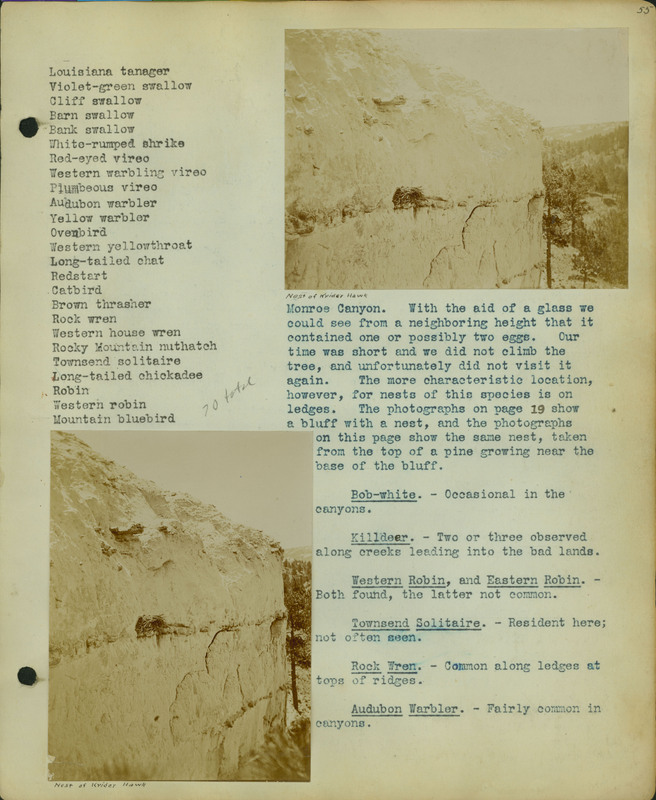
For several days I believed that I had been a yellow-shafted flicker associated with the common red-shafted flicker, and finally on two occasions saw specimens at short distances and unmistakably. - Krider Hawk. — A common species, the nests being placed on the face of bluffs, or in pines. The
birds nest early in the spring, so the nests we found were unoccupied- excepting one,
found June 28th, in the top of a large pine near the mouth of
55
- Louisiana tanager
- Violet-green swallow
- Cliff swallow
- Barn swallow
- Bank swallow
- White-rumped shrike
- Red-eyed vireo
- Western warbling viree
- Plumbeous viero
- Audubon warbler
- Yellow warbler
- Ovenbird
- Western yellowthroat
- Long-tailed chat
- Redstart
- Catbird
- Brown thrasher
- Rook wren
- Western house wren
- Rocky Mountain nuthatch
- Townsend solitaire
- Long-tailed chickadee
- Robin
- Western robin
- Mountain bluebird
Monroe Canyon.
With the aid of a glass we could see from a neighboring height that it contained one
or possibly two eggs. Our time was short and we did not climb the tree, and unfortunately
did not visit it again. The more characteristic location, however, for nests of this
species is on ledges. The photographs on page 19 show a bluff with a nest, and the
photographs on this page show the same nest, taken from the top of a pine growing
near the base of the bluff.
- Bob-white. — Occasional in the canyons.
- Killdeer. —
Two or three observed along creeks leading into the bad lands.
Western Robin, and Eastern Robin. – Both found, the latter not common. - Townsend Solitaire. — Resident here; not often seen.
- Rock Wren. —
Common along ledges at tops of ridges. - Audubon Warbler. —
Fairly common in canyons
56
- Plumbeous Vireo. —
A nest with four eggs found June 20th, in box elder above road in Monroe Canyon. The mother bird sat very closely, peering over the edge of the nest as we pulled
down the branch to investigate. Hatched in due course. - Violet-green Swallow. —
Occasionally seen. - Lazuli Bunting. —
One seen at Crawford in city park. - Black-headed Grosbeak. —
Fairly common. - White- winged Junco. —
Often seen; doubtless nests in these canyons. - Bullock Oriole. —
Occasionally seen. - Pinion Jay. —
The characteristic bird of the region, and a great favorite with us all. They possess
the habits and vocal abilities of the jay tribe, and were so common that mental picture
of Monroe Canyon always contains at least one. Their notes are more softly modulated than those of
the blue jay, their favorite remark being “queevy—quavey, queevy—quavey,” or under
stress of great excitement — which is a common state of all jays — this may be rendered
“queevy queevy queevy queevy queevy” — perhaps a dozen times in succession if the
attendant circumstances are extremely hazardous, remarkable, or scandalous. When I
awoke mornings in my sky bed—room it was common to find a committee of half a dozen
of the birds camped about the neighboring branches, and by pretending to be still
very much asleep I frequently got fine views of the jays, which is ordinarily difficult
of accomplishment, as they are very shy. At the first movement they would queevy—queevy
into the distance with great alacrity. — Leussler added his mite to ornithological lore by saying that the species was very common
about Omaha, where, however, they are called “opinionated jays” — which will do for him. - Magpie,. — Fairly common, but moreso on the other side of the ridge in the Glen region.
- Say Phoebe. — Chiefly in Hat Creek Valley.
- White-throated Rock Swift. — Fairly common about high points of buttes on ridges.
Poor—will. — Common. We had a poor-will concert every evening, and all night long. The note is plaintive and beautiful —an odd combination of words, but willfully put down —and it was not uncommon to have a dozen of the birds at once within hearing. Late
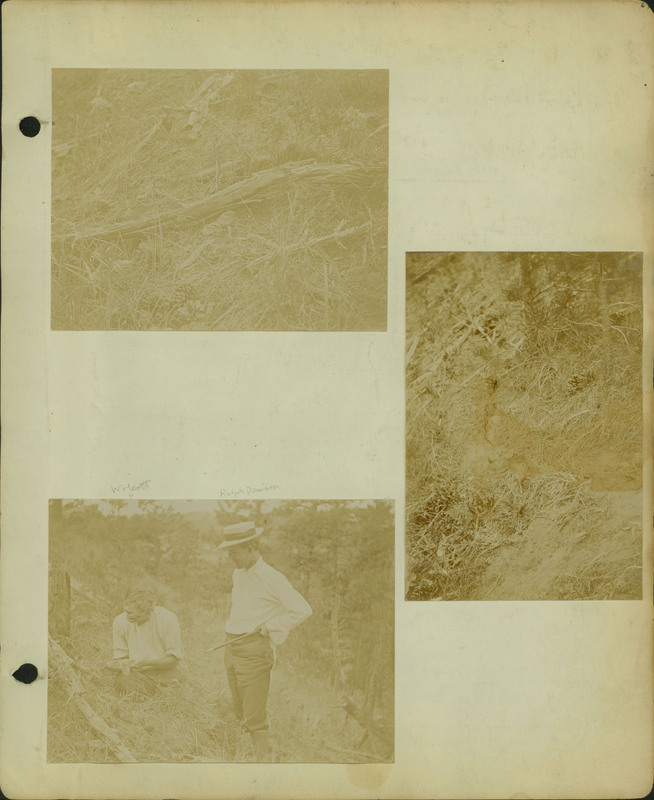
one night — one of the nights when Dr. Wolcott tore himself away from the cottage —we were making our way up the side of the canyon when we flushed a poor—will, which flew or fluttered near us for some distance, so we marked the place as worthy of
57
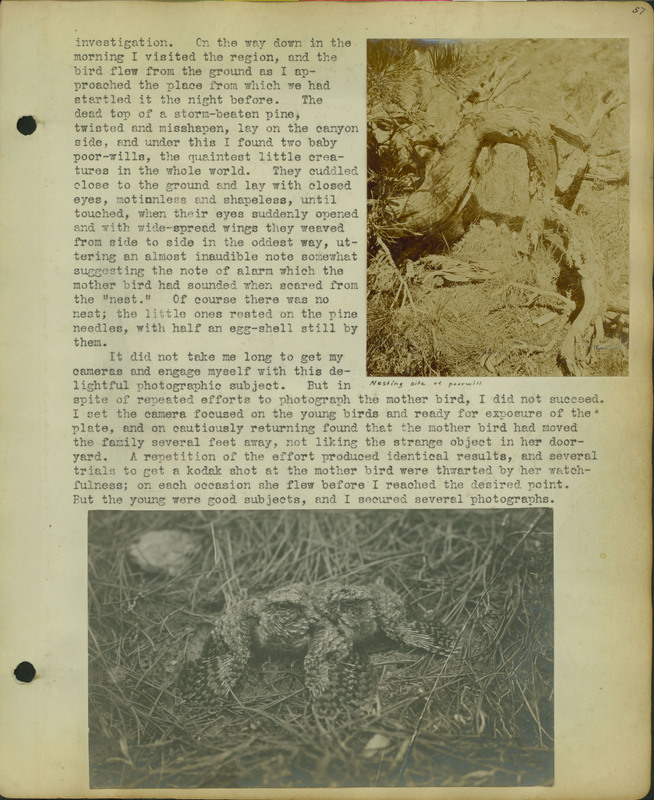
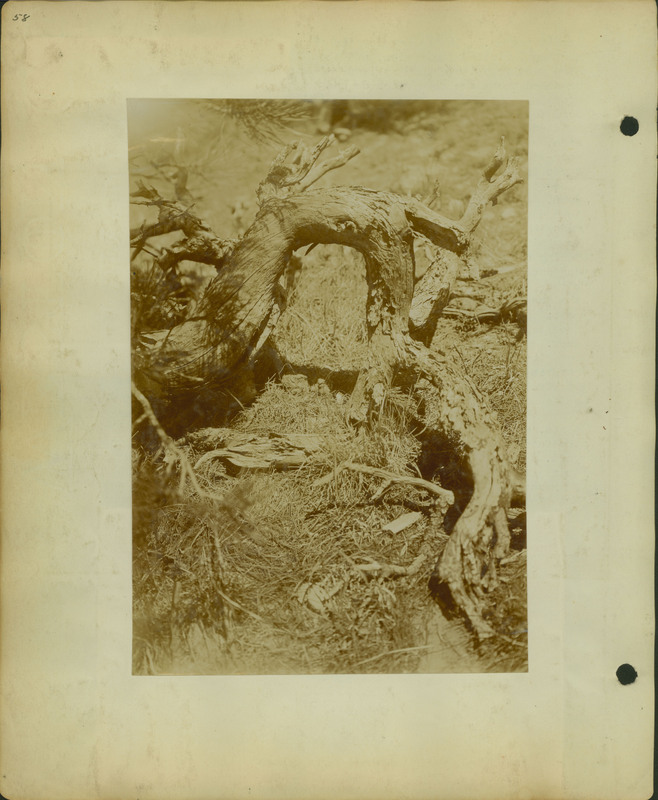
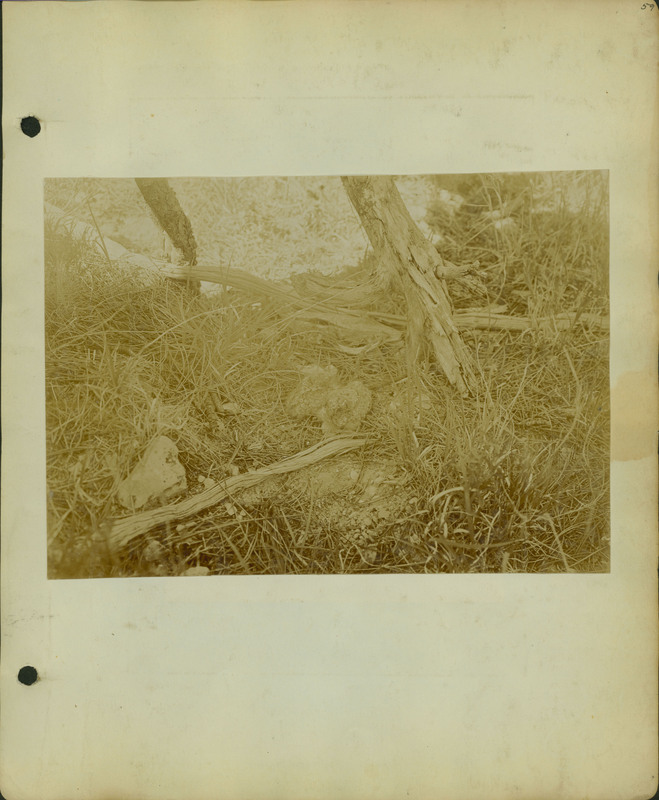
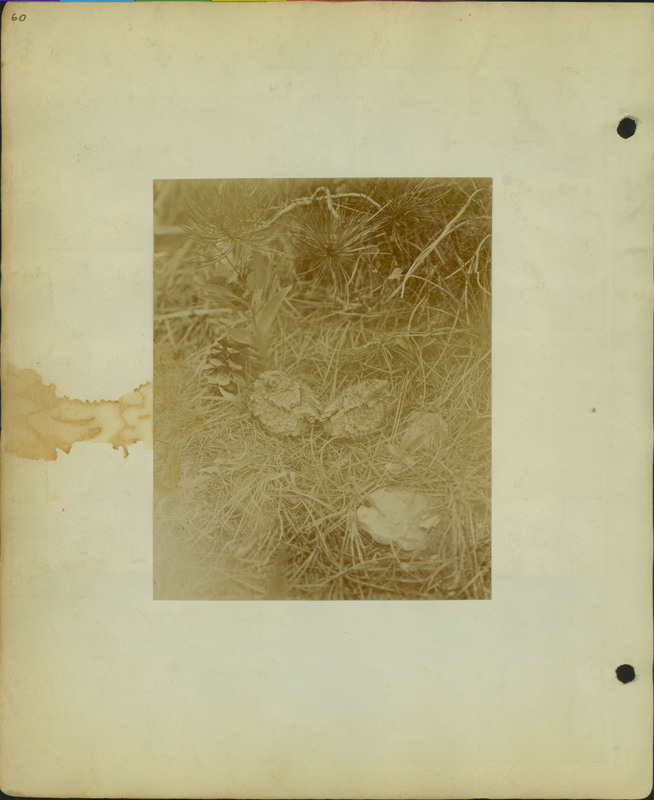
investigation. On the way down in the morning I visited the region, and the bird flew from the ground as I approached the place from which we had startled it the night before. The dead top of a storm-beaten pine, twisted and misshapen, lay on the canyon side, and under this I found two baby poor—wills, the quaintest little creatures in the whole world. They cuddled close to the ground and lay with closed eyes, motionless and shapeless, until touched, when their eyes suddenly opened and with wide—spread wings they weaved from side to side in the oddest way, uttering an almost inaudible note somewhat suggesting the note of alarm which the mother bird had sounded when scared from the “nest.” Of course there was no nest; the little ones rested on the pine needles, with half an egg—shell still by them.
Photo: Nesting site of poorwill
It did not take my long to get my cameras and engage myself with this delightful photographic subject. But in spite of repeated efforts to photograph the mother bird, I did not succeed. I set the camera focused on the young birds and ready for exposure of the plate, and on cautiously returning found that the mother bird had moved the family several feet away, not liking the strange object in her dooryard. A repetition of the effort produced identical results, and several trials to get a kodak shot at the mother bird were thwarted by her watchfulness; on each occasion she flew before I reached the desired point. But the young were good subjects, and I secured several
photographs.
58
59
60
61
Photo: Wolcott, Ralph Dawson
62
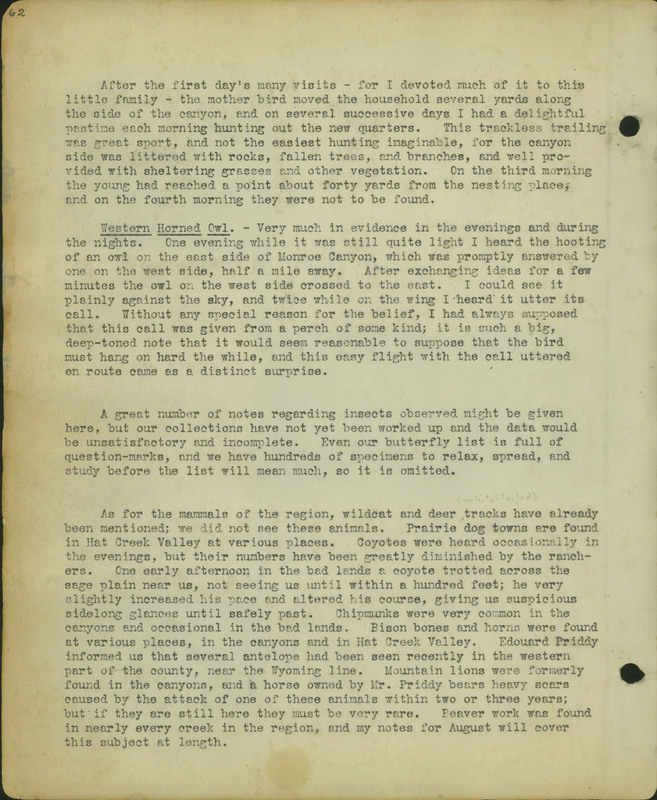
After the first day’s many visits — for I devoted much of it to this little family — the mother bird moved the household several yards along the side of the canyon, and on several successive days I had a delightful pastime each morning hunting out the new quarters. This trackless trailing was great sport, and not the easiest hunting imaginable, for the canyon side was littered with rocks, fallen trees, and branches,
and well provided with sheltering grasses and other vegetation. On the third morning the young had reached a point about forty yards from the nesting place; and on the fourth morning they were not to be found.
Western Horned Owl. — Very much in evidence in the evenings and during the nights. One evening while it was still quite light I heard the hooting of an owl on the east side of Monroe Canyon, which was promptly answered by one on the west side, half a mile away. After exchanging ideas for a few minutes the owl on the west side crossed to the east. I could see it plainly against the sky, and twice while on the wing I hear it utter its call. Without any special reason for the belief, I had always supposed that this call was given from a perch of some kind; it is such a big, deep—toned note that it would seem reasonable to suppose that the bird must hang on hard the while, and this easy flight with the call uttered en route came as a distinct surprise.
A great number of notes regarding insects observed might be given here, but our collections have not yet been worked up and the data would be unsatisfactory and incomplete. Even our butterfly list is full of question—marks, and we have hundreds of specimens to
relax, spread, and study before the list will mean much, so it is omitted.
As for the mammals of the region, wildcat and deer (white—tailed) tracks have already been mentioned; we did not see these animals. Prairie dog towns are found in Hat Creek Valley at various places. Coyotes were heard occasionally in the evenings, but their numbers
have been greatly diminished by the ranchers. One early afternoon in the bad lands a coyote trotted across the sage plain near us, not seeing us until within a hundred feet; he very slightly increased his pace and altered his course, giving us suspicious
sidelong glances until safely past. Chipmunks were very common in the canyons and occasional in the bad lands. Bison bones and horns were found at various places, in the canyons and in Hat Creek Valley. Edouard Priddy informed us that several antelope had been seen recently in the western part of the county, near the Wyoming line. Mountain lions were formerly found in the canyons,
and a horse owned by Mr. Priddy bears heavy scars caused by the attack of one of these animals within two or three years; but if they are still here they must be very rare. Beaver work was found in nearly every creek in the region, and my notes for August will cover this subject
at length.
63
Garter—snakes of a western variety which we have not yet determined were fairly common.
Bull—snakes were seen occasionally, both in Monroe Canyon and in Hat Creek Valley. One blue-racer was seen in Monroe Canyon, but it got into a deep hole before I could get within reach of it. In spite of careful
search and constant watchfulness, no rattle—snakes were seen.
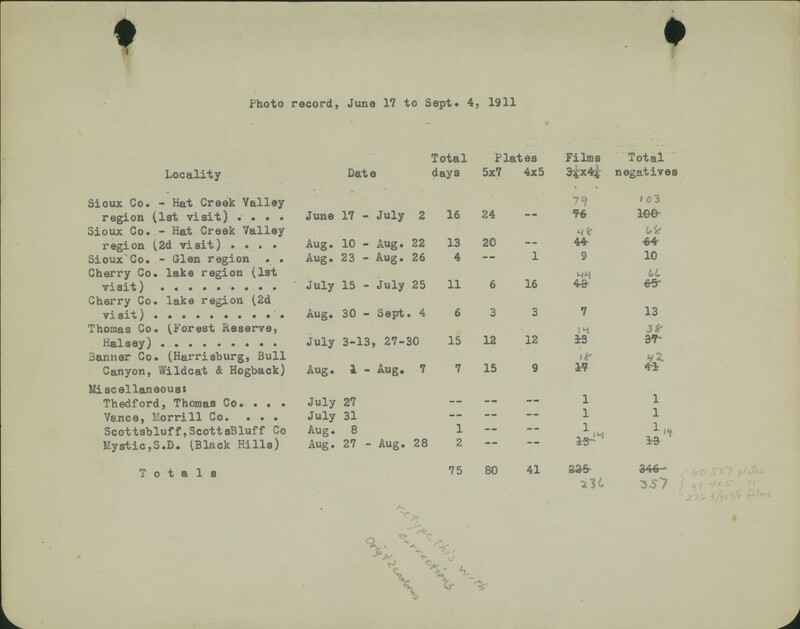
Photo record, June 17 to Sept. 4, 1911
| Locality | Date | Total Days | Plates 5x7 | Plates 4x5 | Films 3 1/4X4 1/4 | Total negatives | ||
|---|---|---|---|---|---|---|---|---|
| Sioux Co. - Hat Creek Valley region (last visit).... | June 17 - July 2 | 16 | 24 | -- | 79 |
103 |
||
| Sioux Co. - Hat Creek Valley region (2nd visit).... | Aug. 10 - Aug.22 | 13 | 20 | -- | 48 |
68 |
||
| Sioux Co. - Glen region.. | Aug. 23 - Aug. 26 | 4 | -- | 1 | 9 | 10 | ||
| Cherry Co. lake region (1st visit)......... | July 15 - July 25 | 11 | 6 | 16 | 44 |
66 |
||
| Cherry Co. lake region (2d visit)......... | Aug. 30 - Sept. 4 | 6 | 3 | 3 | 7 | 13 | ||
| Thomas Co. (Forest Reserve, Halsey)........ | July 3-13, 27-30 | 15 | 12 | 12 | 14 |
38 |
||
| Banner Co. (Harrisburg, Bull Canyon, Wildcat & Hogback) | Aug. 1 - Aug. 7 | 7 | 15 | 9 | 18 |
42 |
||
| Miscellaneous: | ||||||||
| Thedford, Thomas Co.... | July 27 | -- | -- | -- | 1 | 1 | ||
| Vance, Morril Co.... | July 31 | -- | -- | -- | 1 | 1 | ||
| Scottsbluff, ScottsBluff Co.... | Aug. 8 | 1 | -- | -- | 1 | 1 | ||
| Mystic, S.D. (Black Hills) | Aug. 27 - Aug. 28 | 2 | -- | -- | 14 |
14 |
||
| Totals | 75 | 80 | 41 | 236 |
357 |
357 |
80 5x7 plates, 41 4x5 '', 236 3'/4x4 1/4 films |
retype this with corrections oriq + 2 (intelligible)