
Nebraska Ornithologists’ Union, Letters, 1905, January
Nebraska Ornithologists’ Union, Letters, 1905, January
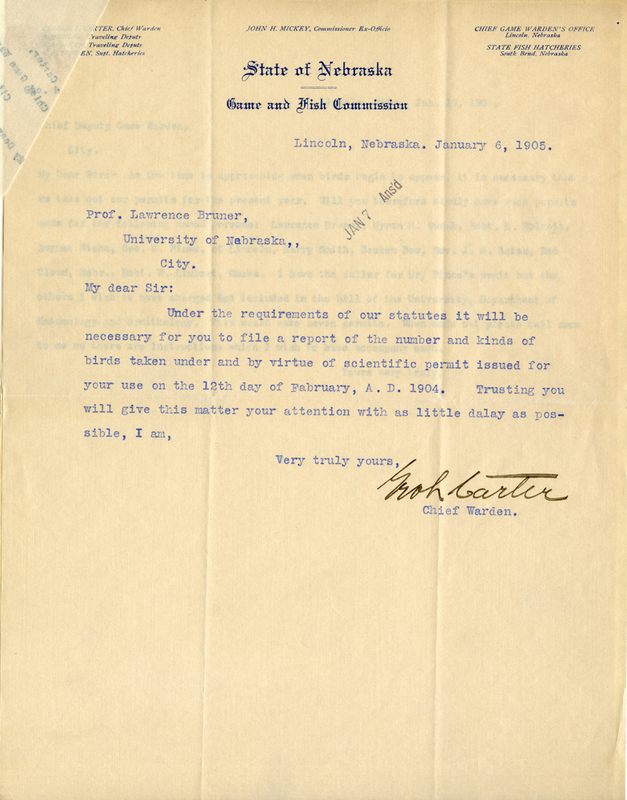
- Letter, Geo. L. Carter to Lawrence Bruner, 1905, Jan. 6
- Letter, Lawrence Bruner to Geo. L. Carter, 1905, Jan. 7
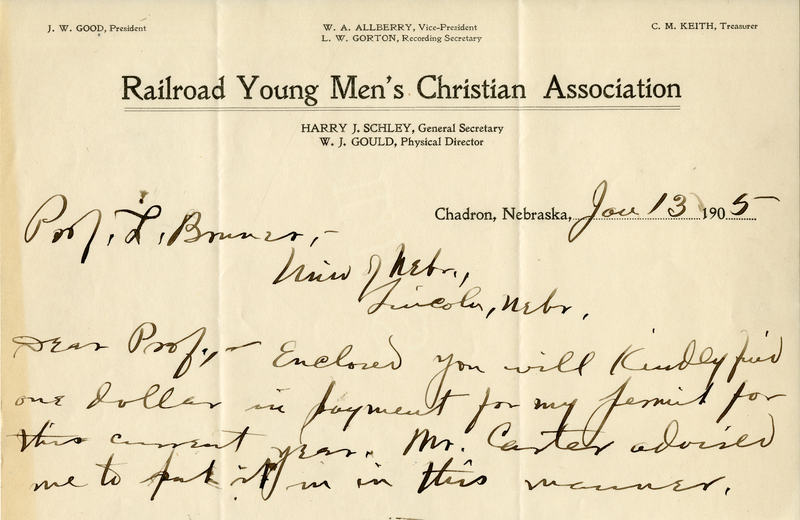
- Letter, Geo. M. Paines to Lawrence Bruner, 1905, Jan. 13
- Letter, H.A. Surface to Lawrence Bruner, 1905, Jan. 14
- Letter, Gustave Lenz to Lawrence Bruner, 1905, Jan. 16
- Letter, Lawrence Bruner to H.A. Surface, 1905, Jan. 17
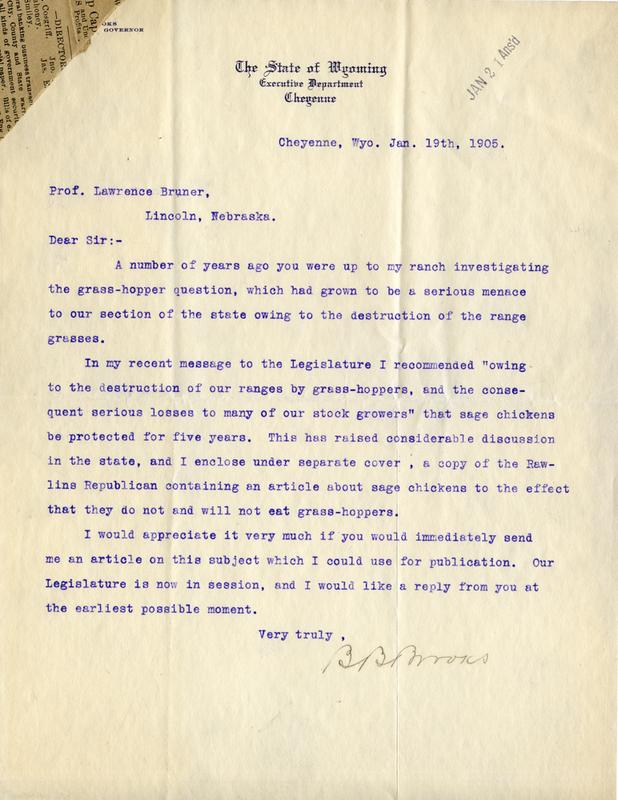
- Letter, B.B. Brook to Lawrence Bruner, 1905, Jan. 19
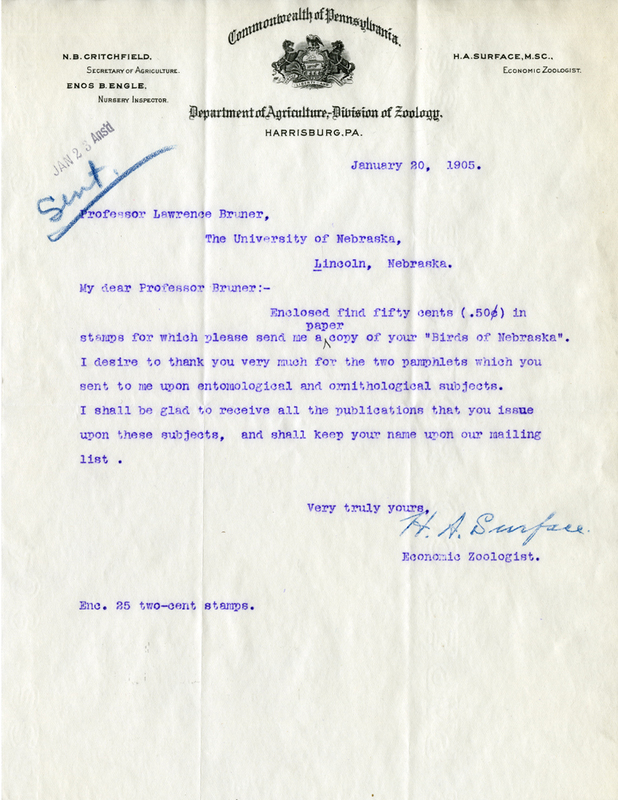
- Letter, H.A. Surface to Lawrence Bruner, 1905, Jan. 20
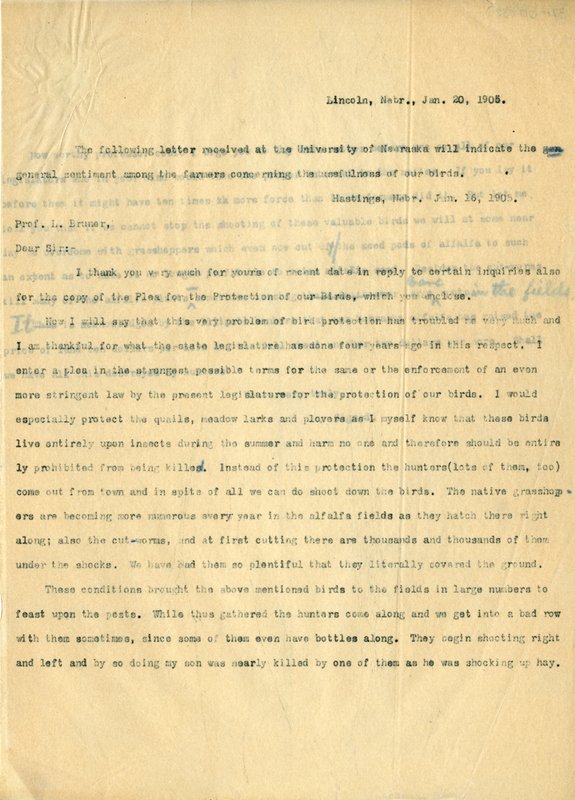
- Letter, Undentified to Lawrence Bruner, 1905, Jan. 20
Traveling Deputy
Traveling Deputy
EN, Supt. Hatcheries
John N. Mickey, Commissioner Ex-Officie
Chief Game Warden's Office
Lincoln, Nebraska
State Fish Hatcheries
South Bend, Nebraska
State of Nebraska
Game and Fish Commission
Lincoln, Nebraska. January 6, 1905.
Jan 7 Ans'd
Prof. Lawrence Bruner,
University of Nebraska,,
City.
My dear Sir:
Under the requirements of our statutes it will be necessary for you to file a report of the number and kinds of birds taken under and by virtue of scientific permit issued for your use on the 12th day of Fabruary, A. D. 1904. Trusting You will give this matter your attention with as little dalay as possible, I am,
Very truly yours,
Geo L. Carter
Chief Warden.
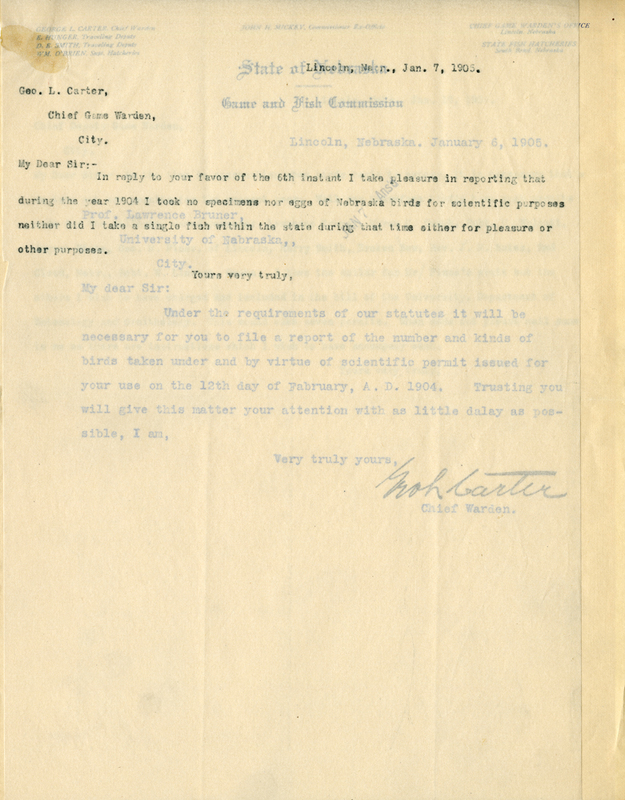
Geo. L. Carter, Chief Game Warden, City.
My Dear Sir:
- In reply to your favor of the 6th in instant I take pleasure in reporting that during the year 1904 I took no specimens nor eggs of Nebraska birds for scientific purposes neither did I take a single fish within the state during that time either for pleasure or other purposes.
Yous very truly,
W.A. Allberry, Vice President
L.W. Gorton, Recording Secretary
C.M. Keith, Treasurer
Railroad Young Men's Christian Association
Harry J. Schley, General Secretary
W.J. Gould, Physical Director
Chadron, Nebraska, Jan 13, 1905
Prof. L. Bruner, - Univ of Nebr. Lincoln, Nebr.
Dear Prof. - Enclosed you will kindly find one dollar in payment for my permit for this current year. Mr. Carter advised me to put it in in this manner.
J. W. Good, President
W. A. Allberry, Vice-President L. W. Gorton, Recording Secretary
C. M. Keith, Treasurer
Railroad Young Men's Christian Association Harry J. Schley, General Secretary
W. J. Gould, Physical Director
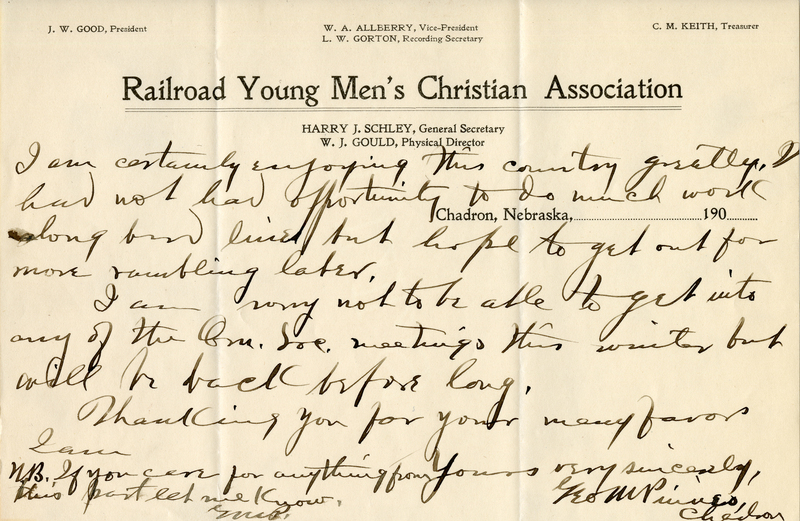
I am constantly enjoying this country greatly. I had not had opportunity to do much work along bird lines but hope to get out for more rambling later. I am sorry not to be able to get into any of the Om. Soc. meetings this winter but will be back before long. Thanking you for your many favors I am Yours very sincerely, Geo M P [illegible] Chadron N.B. If you care for anything from this part let me know. Geo.
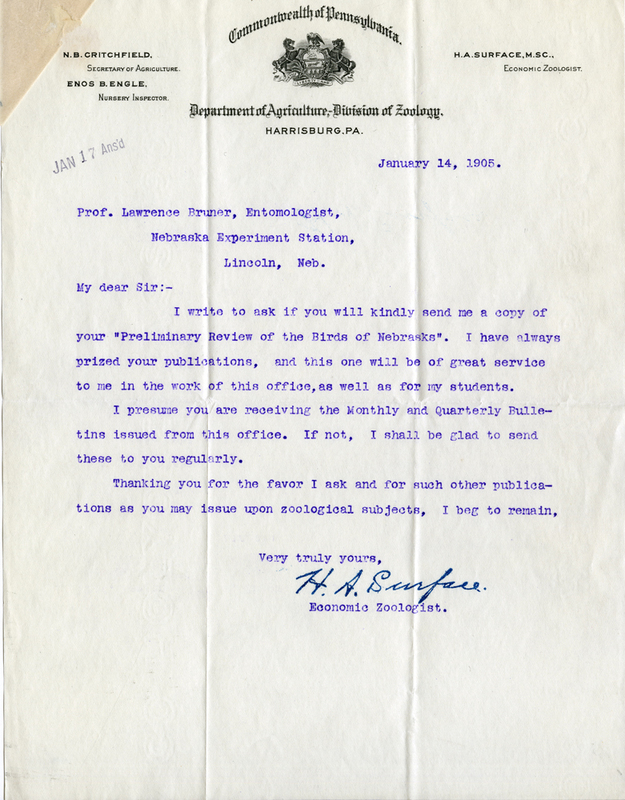
Secretary of Agriculture
Enos B. Engle
Nursery Inspector
H.A. Surface, M.SC.,
Economica Zoologist
Commonwealth of Pennsylvania
Department of Agriculuture Division of Zoology
Harrisburg, PA.
JAN 17 Ans'd
January 14, 1905
Prof. Lawrence Bruner, Entomologist,
Nebraska Experiment Station,
Lincoln, Neb.
My dear Sir:-
I write to ask if you will kindly send me a copy of your "Preliminary Review of the Birds of Nebraska'. I have always prized your publications, and this will be of great service to me in the work of this office, as well as for my students.
I presume you are receiving the Monthly and Quarterly Bulletins issued from this office. If not, I shall be glad to send these to you regularly.
Thanking you for the favor I ask and for such other publications as you may issue upon zoological subjects, I beg to remain.
Very truly yours,
H.A. Surface
Economic Zoologist
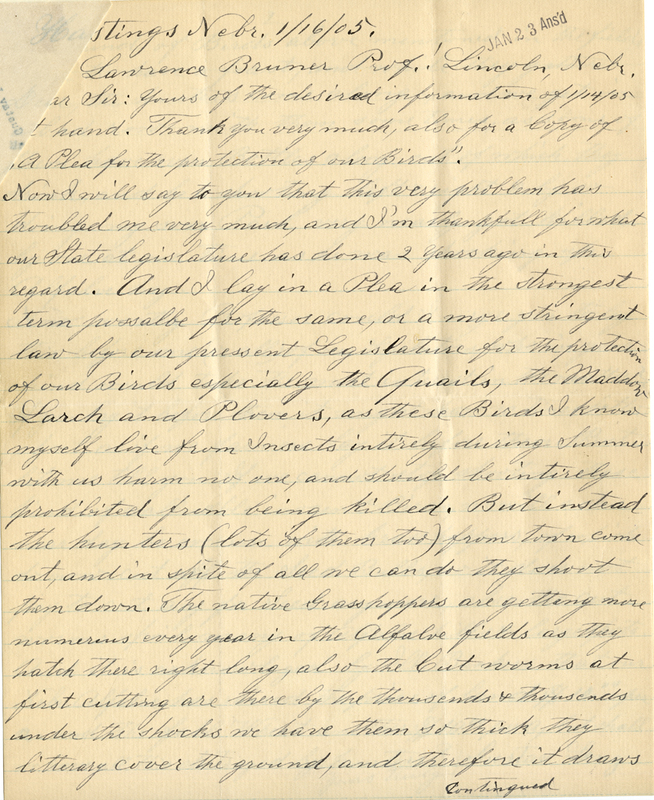
JAN 23 Ans'd
Lawrence Bruner Prof. Lincoln, Nebr.
Dear Sir: Yours of the desired information of 1/14/05 at hand. Thank you very much, also for a copy of "A plea for the protection of our Birds".
Now I will say to you that this very problem has troubled me very much, and I'm thankful for what our State legislture has done 2 years ago in this regard. And I lay in a Plea in the strongest term possible for the same, or a more stringent law by our present Legislature for the protection of our Birds especially the Quails, the Maddow Larck and Plovers, as these Birds I know myself live from insects intirely during Summer with no harm no one, and should be intirely prohibited from being killed. But instead the hunters (lots of them too) from town come out and in spite of all we can do they shoot them down. The native Grasshoppers are getting more numerous every year in the Alfalve fields as they hatch there right long, also the Cut worms at first cutting are there by the thousends & thousands under the shocks we have them so thick they litteray cover the ground, and therefore it draws
Continued
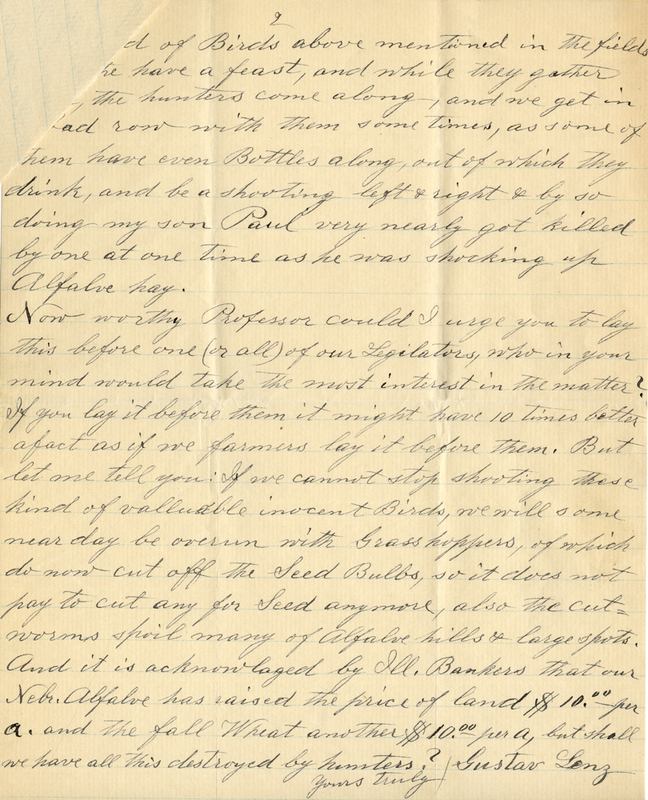
2 d of Birds above mentioned in the fields e have a feast, and while they gather the hunters come along, and we get in ad row with them sometimes, as some of them have even Bottles along out of which they drink and be a shooting left & right & by so doing my son Paul very nearly got killed by one at one time as he was shocking up Alfalve hay.
Now worthy Professor could I urge you to lay this before one (or all) of our Legislators, who in your mind would take the most interest in the matter? If you lay it before them it might have 10 times better afact as if we farmers lay it before them. But let me tell you: If we cannot stop shooting these kind of valluable inocent Birds, we will some near day be overun with Grasshoppers, of which do now cut off the Seed Bulbs, so it does not pay to cut any for Seed anymore, also the cut worms spoil many of Alfalve kills & large spots. And it is acknowlaged by Ill. Bankers that our Nebr. Alfalve has raised the price of land $10.00 per a. and the fall Wheat another $10.00 per a, but shall we have all this destroyed by hunters?
Yours truly Gustav Lonz
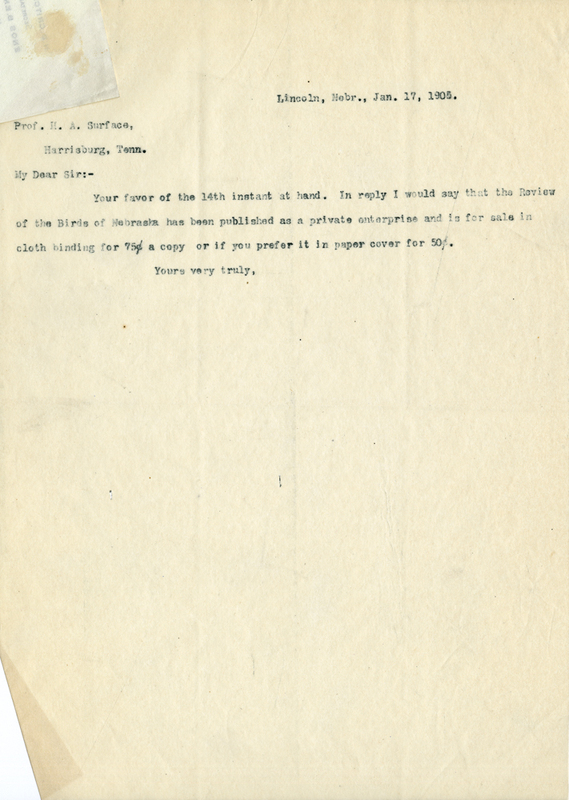
Lincoln, Nebr., Jan. 17, 1905.
Prof. R. A. Surface,
Hrrisburg, Tenn.
My Dear Sir:-
Your favor of the 14th instant at hand. In reply I would say that the Review of the Birds of Nebraska has been published as a private enterprise and is for sale in cloth binding for 75 cents a copy or if you prefer it in paper cover for 50 cents.
Yours very truly,
Executive Department
Cheyenne
Jan 21 Ans'd
Cheyenne, Wyo. Jan. 19th, 1905.
Prof. Lawrence Bruner,
Lincoln, Nebraska.
Dear Sir:-
A number of years ago you were up to my ranch investigating the grass-hopper question, which had grown to be a serious menace to our section of the state owing to the destruction of the range grasses. In my recent message to the Legislature I recommended "owing to the destruction of our ranges by grass-hoppers, and the consequent serious losses to many of our stock growers" that sage chickens be protected for five years. This has raised considerable discussion in the state, and I enclose under separate cover, a copy of the Rawlins Republican containing an article about sage chickens to the effect that they do not and will not eat grass-hoppers.
I would appreciate it very much if you would immediately send me an article on this subject which I could use for publication. Our Legislature is now in session, and I would like a reply from you at the earliest possible moment.
Very truly,
BB Brooks
Secretary of Agriculture
Enos B. Engle
Nursery Inspector H.A. Surface, M. SC..
Economic Zoologist
Commonwealth of Pennsylvania
Department of Agriculture- Division of Zoology
Harrisburg, PA.
Jan 23 Ans'd
January 20, 1905
Sent
Professor Lawrence Bruner,
The University of Nebraska,
Lincoln, Nebraska.
My dear Professor Bruner:-
Enclosed find fifty cents (.50 ¢) in stamps for which please send me a ^paper copy of your "Birds of Nebraska". I desire to thank you very much for the two pamphlets which you sent to me upon entomological and ornithological subjects. I shall be glad to receive all the publications that you issue upon these subjects, and shall keep your name upon our mailing list.
Very truly yours,
H. A. Surface
Economic Zoologist
Enc. 25 two-cent stamps.
Lincoln, Nebr., Jan. 20, 1905.
The following letter received at the University of Nebraska will indicate the general sentiment among the farmers concerning the usefulness of our birds.
Hastings, Nebr., Jan. 16, 1905.
Prof. L. Bruner,
Dear Sir:-
I thank you very much for yours of recent date in reply to certain inquiries also for the copy of the Plea for the Protection of our Birds, which you enclose. Now I will say that this very problem of bird protection has troubled me very much and I am thankful for what the state legislature has done four years ago in this respect. I enter a plea in the strongest possible terms for the same or the enforcement of an even more stringent law by the present legislature for the protection of our birds. I would especially protect the quails, meadow larks and plovers as I myself know that these birds live entirely upon insects during the summer and harm no one and therefore should be entirely prohibited from being killed. Instead of this protection the hunters (lots of them, too) come out from town and in spite of all we can do shoot down the birds. The native grasshoppers are becoming more numerous every year in the alfalfa fields as they hatch there right along; also the cutworms, and at first cutting there are thousands and thousands of them under the shocks. We have had them so plentiful tht they literally covered the ground.
These conditions brought the above mentioned birds to the fields in large numbers to feast upon the pests. While thus gathered the hunters come along and we get into a bad row with them sometimes, since some of them even have bottles along. They begin shooting right and left and by so doing my man was nearly killed by one of them as he was shocking up hay.
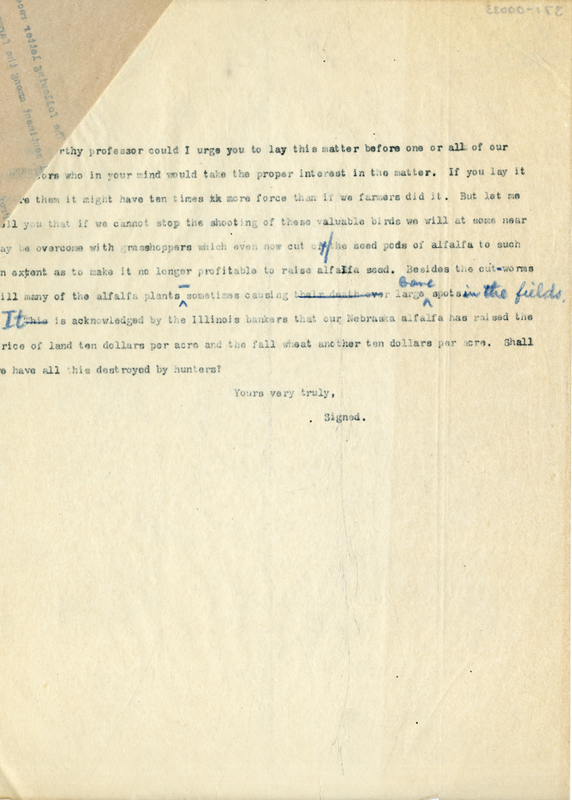
rthy professor could I urge you to lay this matter before one or all of our ors who in your mind would take the proper interest in the matter. If you lay it re them it might have ten times more force than if we farmers did it. But let me tell you that if we cannot stop the shooting of these valuable birds we will at some near day be overcome with grasshoppers which even now cut the seed pods of alfalfa to such an extent as to make it no longer profitable to raise alfalfa seed. Besides the cut-worms kill many of the alfalfa plants - sometimes causing large bare spots in the fields. It is acknowledged by the Illinois bankers that our Nebraska alfalfa has raised the price of land ten dollars per acre and the fall wheat another ten dollars per acre. Shall we have all this destroyed by hunters?
Yours very truly,
Signed.
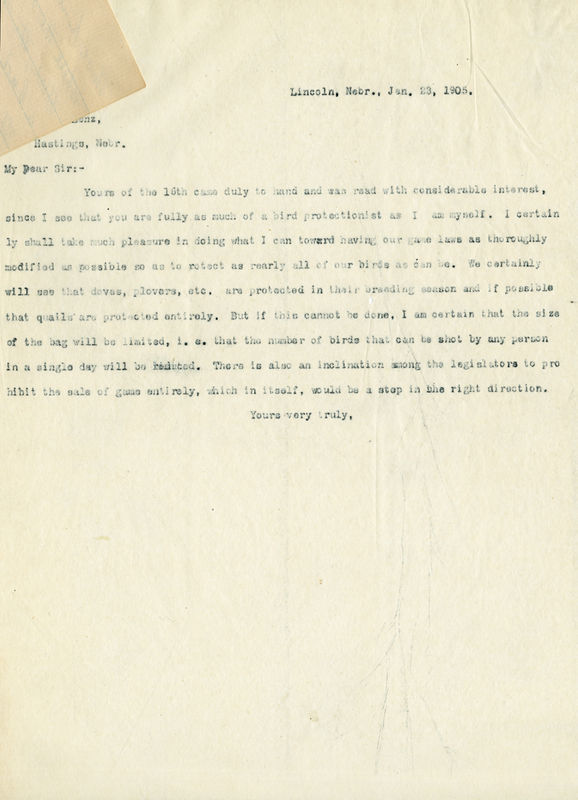
Lincoln, Nebr., Jan. 13, 1905.
nz,
My Dear Sir:-
Yours of the 16th came duly to hand and was read with considerable interest, since I see that you are fully as much of a bird protectionist as I am myself. I certainly shall take much pleasure in doing what I can toward having our game laws as thoroughly modified as possible so as to rotect as nearly all of our birds as can be. We certainly will see that doves, plovers, etc. are protected in their breeding season and if possible that quails are protected entirely. But if this cannot be done, I am certain that the size of the bag will be limited, i. e. that the number of birds that can be shot by any person in a single day will be reduced. There is also an inclination among the legislators to prohibit the sale of guns entirely, which in itself, would be a step in the right direction.
Yours very truly,
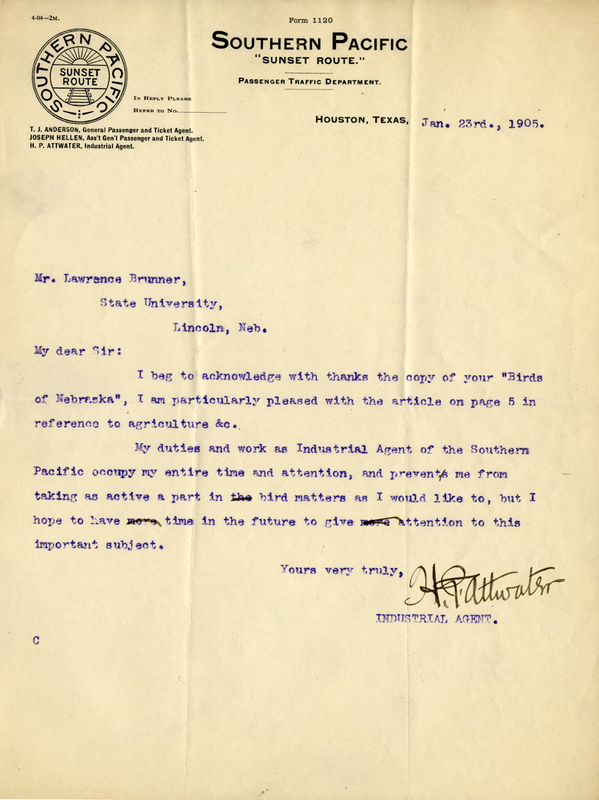
Form 1120
Southern Pacific
Sunset Route
T. J. Anderson, General Passerger and Ticket Agent.
Joseph Hellen, Ass't Gen'l Passenger and Ticket Agent.
H. P. Attwater, Industrial Agent.
Southern Pacific "Sunset Route."
Passenger Traffic Department.
Houston, Texas, Jan. 23rd., 1905.
Mr. Lawrence Brunner,
State University,
Lincoln, Neb.
My dear Sir:
I beg to acknowledge with thanks the copy of your "Birds of Nebraska", I am particularly pleased with the article on page 5 in reference to agricuture &c.
My duties and work as Industrial Agent of the Southern Pacific occupy my entire time and attention, and prevent me from taking as active a part in bird matters as I would like to, but I hope to have time in the future to give attention to this important subject.
Yours very truly,
H. P. Attwater
INDUSTRIAL AGENT. C