Field notes, Myron Swenk, June-Sept. 1911
Field Notes, June-Sept. 1911
- -1911 -
- July 10-12-1909
- Oct 27-29 - 1910
- June 7-10-1911
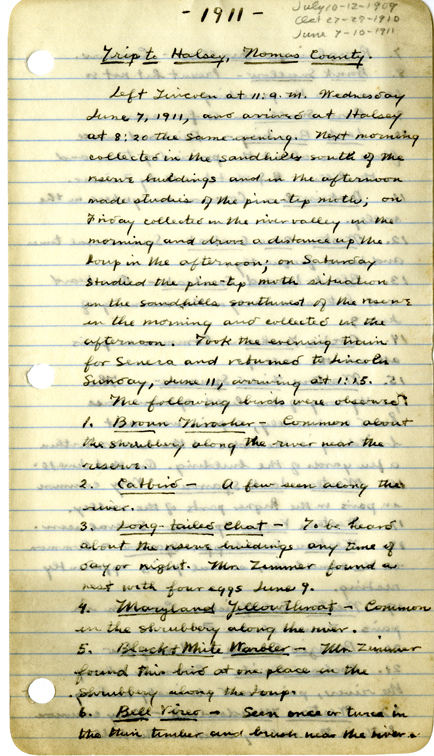
- Trip to Halsey, Thomas County.
- Left Lincoln at 11:a.m. Wednesday June 7, 1911, and arrived at Halsey at 8:20 the same evening. Next morning collected in the sandhills south of the reserve buildings and in the afternoon made studies of the pine-tip moth; on Friday collected in the river valley in the morning and drove a distance up the Loup in the afternoon; on Saturday studied the pine-tip moth situation in the sandhills southwest of the reserve in the morning and collected in the afternoon. Took the evening train for Seneca and returned to Lincoln Sunday, June 11, morning at 1:15.
- The following birds were observed:
- 1. Brown Thrasher - Common about the shrubbery along the river near the reserve.
- 2. Catbird - A few seen along the river.
- 3. Long-tailed Chat - To be heard about the reserve buildings any time of day or night. Mr. Zimmer found a nest with four eggs June 9. 4. Maryland Yellowthroat - Common in the shrubbery along the river.
- 5. Black & White Warbler - Mr. Zimmer found this bird at one place in the shrubbery along the Loup.
- 6. Bell Vireo - Seen once or twice in the thin timber and brush near the river
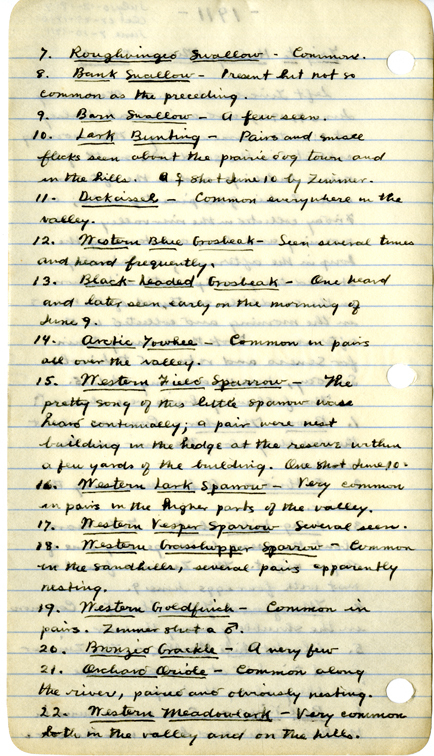
- 7. Roughwinged Swallow - Common.
- 8. Bank Swallow - Present but not so common as the preceding.
- 9. Barn Swallow - A few seen.
- 10. Lark Bunting - Pairs and small flocks seen about the prairie dog town and in the hills. Female shot June 10 by Zimmer.
- 11. Duckeissel - Common everywhere in the valley.
- 12. Western Blue Grosbeak - Seen several times and heard frequently.
- 13. Black-headed Grosbeak - One heard and later seen early on the morning of June 9.
- 14. Arctic Towhee - Common in pairs all over the valley.
- 15. Western Field Sparrow - The pretty song of this little sparrow was heard continually; a pair were nest building in the hedge at the reserve within a few yards of the building. One shot June 10.
- 16. Western Lark Sparrow - Very common in pairs in the higher parts of the valley.
- 17. Western Vesper Sparrow - Several seen.
- 18. Western Grasshopper Sparrow - Common in the sandhills, several pairs apparently nesting.
- 19. Western Goldfinch - Common in pairs. Zimmer shot a male.
- 20. Bronzio Grackle - A very few
- 21. Orchard Oriole - Common along the river, pairs and obviously nesting.
- 22. Western Meadowlark - Very common both in the valley and on the hills.
- [1911]
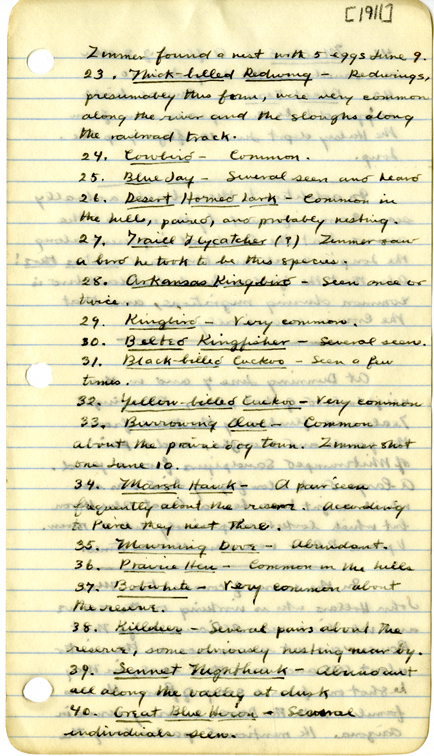
- Zimmer found a nest with 5 eggs June 9. 23. Thick-billed Redwing - Redwings, presumably this form, were very common along the river and the sloughs along the railroad track.
- 24. Cowbird - Common.
- 25. Blue Jay - Several seen and heard
- 26. Desert Horned Lark - Common in the hills, paired, and probably nesting.
- 27. Trail Flycatcher (?) - Zimmer saw a bird he took to be this species.
- 28. Arkansas Kingbird - seen once or twice.
- 29. Kingbird - Very common
- 30. Belted Kingfisher - Several seen.
- 31. Black-billed cuckoo - Seen a few times.
- 32. Yellow-billed cuckoo - Very common.
- 33. Burrowing Dove - Common about the prairie dog town. Zimmer shot one June 10.
- 34. Marsh Hawk - A pair seen frequently about the reserve. According to Pierce they nest there.
- 35. Mourning Dove - Abundant.
- 36. Prairie Hen - Common in the hills.
- 37. Bobwhite - Very common about the reserve.
- 38. Killdeer - Several pairs about the reserve, some obviously nesting near by.
- 39. Sennet Nighthawk - Abundant all along the valley at dusk.
- 40. Great Blue Heron - Several individuals seen.
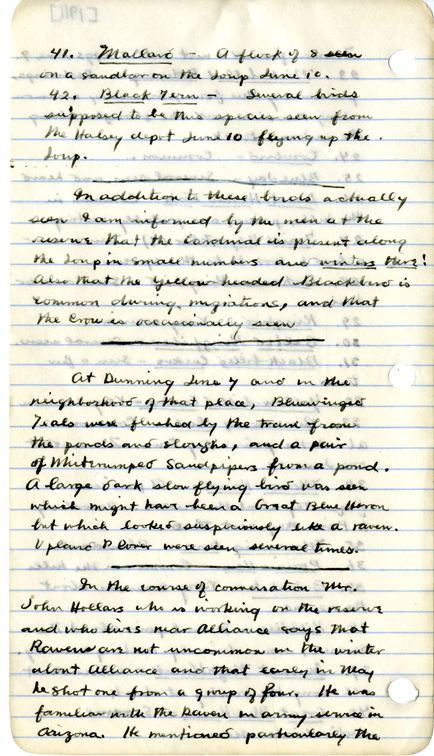
- 41. Mallard - A flock of 8 seen on a sandbar on the Loup June 10. 42. Black Tern - Several birds supposed to be this species seen from the Halsey depot June 10 flying up the Loup.
- In addition to these birds actually seen I am informed by the men at the reserve that the Cardinal is present along the Loup in small numbers and winters there! Also that the yellow headed Blackbird is common during migrations, and that the Crow is occasionally seen
- At Dunning June 7 and in the neighborhood of that pace, Bluewinged Teals were flushed by the train from the ponds and sloughs, and a pair of Whiterumped Sandpipers from a pond. A large dark slow flying bird was seen which might have been a Great Blue Heron but which looked suspiciously like a raven. V plano Plover were seen several times.
- In the course of conversation Mr. John Hollars who is working on the reserve and who lives near Alliance says that Ravens are not uncommon in the winter about Alliance and that early in May he shot one from a group of four. He was famliar with the Raven in Army service in Arizona. He mentioned particularly the
- [1911]
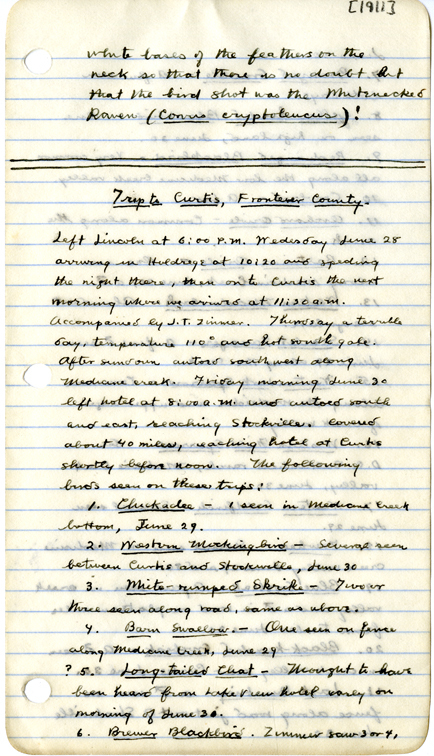
- white bars of the feathers on the neck so that there is no doubt but that the bird shot was the Whitenecked Raven (Corvis cryptoleucus)!
-
- Trip to Curtis, Fronteier County.
- Left Lincoln at 6:00 p.m. Wednesday June 28 arriving in Holdrege at 10:20 and speding the night there, then on to Curtis the next morning where we arrived at 11:30 a.m. Accompanied by J. T. Zimmer. Thursday, a terrible day, temperature 110 degrees and hot south gale. After sundown autoed southwest along Medicine Creek. Friday morning June 30 left hotel at 8:00 a.m. and autoed south and east, reaching Stockville. Covered about 40 miles, reaching hotel at Curtis shortly before noon. The following birds seen on these trips:
- 1. Chickadee - 1 seen in Medicine Creek bottom, June 29.
- 2. Western Mockinbird - Several seen between Curtis and Stockville, June 30.
- 3. White-rumped Skrike - 7 woar twice seen along road, same as above.
- 4. Barn Swallow.- One seen on fence along Medicine Creek, June 29.
- ?5. Long-tailed Chat - Thought to have been heard from Lake View hotel early on morning of June 30.
- 6. Brewer Blackbird. Zimmer saw 3 or 4,
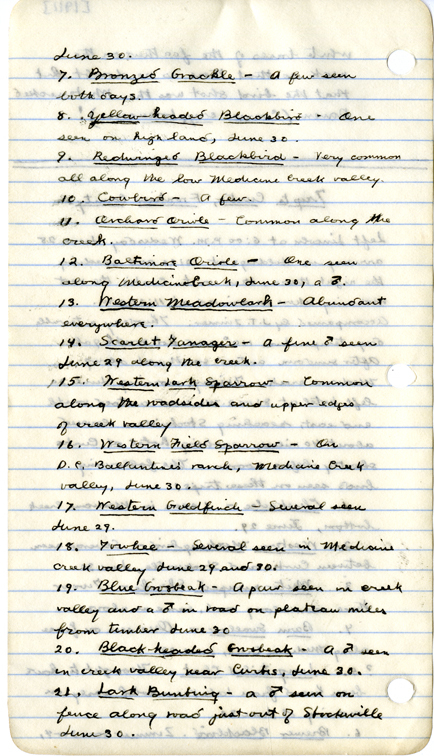
- June 30.
- 7. Bronzed Grackle - A few seen both days.
- 8. Yellow-headed Blackbird - One seen on high land, June 30.
- 9. Redwinged Blackbird - Very common all along the low Medicine Creek valley.
- 10. Cowbird - A few.
- 11. Orchard Oriole - Common along the creek.
- 12. Baltimore Oriole - One seen along Medicine Creek, June 30, a male.
- 13. Western Meadowlark - Abundant everywhere.
- 14. Scarlet Tanager - A fine male seen June 29 along the creek.
- 15. Western Lark Sparrow - Common along the roadsides and upper edges of creek valley.
- 16. Western Field Sparrow - On D. C. Ballantine's ranch, Medicine Creek valley, June 30. 17. Western Goldfinch - Several seen June 29.
- 18. Towhee - Several seen in Medicine Creek valley June 29 and 30.
- 19. Blue Grosbeak - A pair seen in creek valley and a male in road on plateau miles from timber June 30.
- 20. Black-headed Grosbeak - A male seen in creek valley near Curtis, June 30.
- 21. Lark Bunting - a male seen on fence along road just out of Stockville June 30.
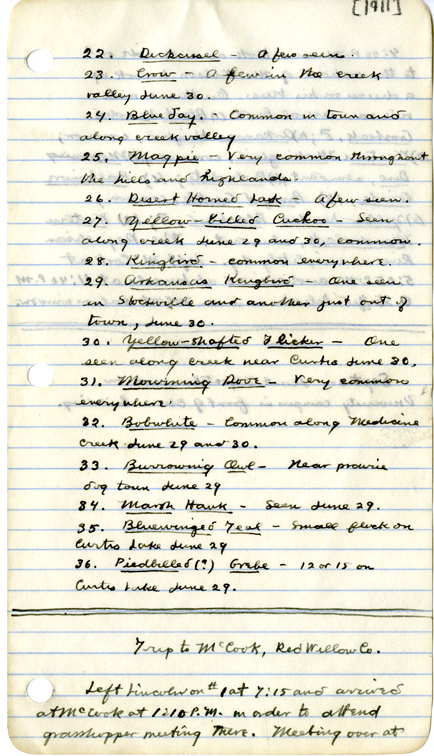
- 22. Dickeissel - A few seen.
- 23. Crow - A few in the creek valley June 30.
- 24. Blue Jay. - Common in town and along creek valley.
- 25. Magpie - Very common throughout the hills and highlands.
- 26. Desert Horned Lark - A few seen.
- 27. Yellow-billed Cuckoo - Seen along creek June 29 and 30, common.
- 28, Kingbird. - common everywhere.
- 29. Arkansas Kingbird - One seen in Stockville and another just out of town, June 30.
- 30. Yellow-shafted Flicker - One seen along creek near Curtis June 30.
- 31. Mourning Dove - Very common everywhere.
- 32. Bobwhite - Common along Medicine Creek June 29 and 30.
- 33. Burrowing Owl - Near Prairie dog town June 29.
- 34. Marsh Hawk - Seen June 29.
- 35. Bluewinged Teal - Small flock on Curtis Lake June 29.
- 36. Piedbilled (?) Grebe - 12 or 15 on Curtis Lake June 29.
- Trip to McCook, Red Willow Co. Left Lincoln on #1 at 7:15 and arrived at McCook at 1:10 P.M. in order to attend grasshopper meeting there. Meeting over at
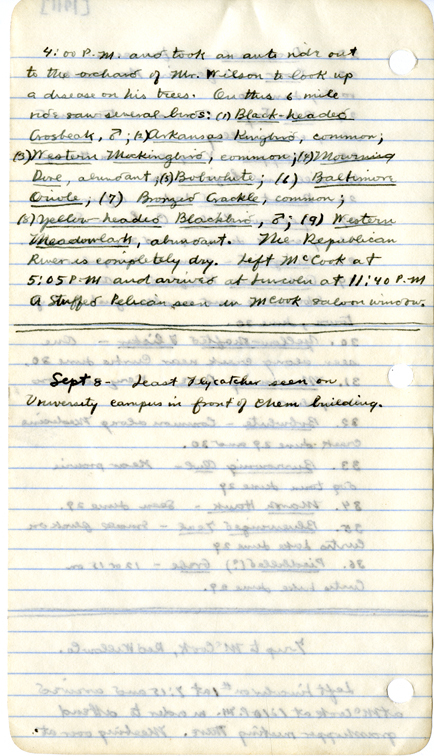
- 4:00 P.M. and took an auto ride out to the orchard of Mr. Wilson to look up a disease on his trees. On this 6 mile ride saw several birds: (1) Black-headed Grosbeak, male; (2) Arkansas Kingbird, common; (3) Western Mockingbird, common; (4) Mourning Dove, abundant; (5) Bobwhite; (6) Baltimore Oriole; (7) Bronzed Grackle, common; (8) Yellow-headed Blackbird, male; (9) Western Meadowlark, abundant. The Republican River is completely dry. Left McCook at 5:05 P..M. and arrived at Lincoln at 11:40 P.M. A stuffed Pelican seen in McCook saloon window.
- Sept. 8 - Least Flycatcher seen on University campus in front of Chem building.
- [1911]
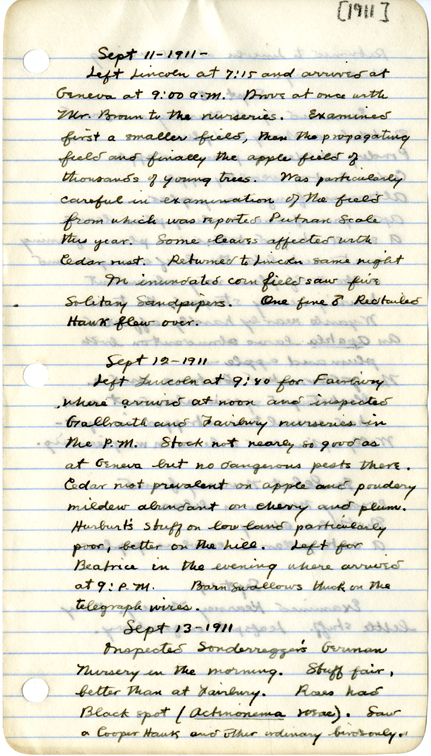
- Sept. 11 - 1911 -
- Left Lincoln at 7:15 and arrived at Geneva at 9:00 am. Drove at once with Mr. Brown to the nurseries. Examined first a smaller field, then the propagating field and finally the apple field of thousands of young trees. Was particularly careful in examination of the field from which was reported Putnan Scale this year. Some leaves affected with Cedar rust. Returned to Lincoln same night.
- The inundated corn field saw five Solitary Sandpipers. One fine male Redtailed Hawk flew over.
-
- Sept. 12 - 1911 Left Lincoln at 9:40 for Fairbury where arrived at noon and inspected Galbraith and Fairbury nurseries in the P.M. Stock not nearly as good as at Geneva but no dangerous pests there. Cedar rust prevalent on apple and powdery mildew abundant on cherry and plum. Harburt's stuff on low land particularly poor, better on the hill. Left for Beatrice in the evening where arrived at 9: P.M. Barn swallows thick on the telegraph wires.
-
- Sept. 13 - 1911 Inspected Sonderregger's German Nursery in the morning. Stuff fair, better than at Fairbury. Roses had Black spot (Actinonema rosae). Saw a Cooper Hawk and other ordinary birds only.
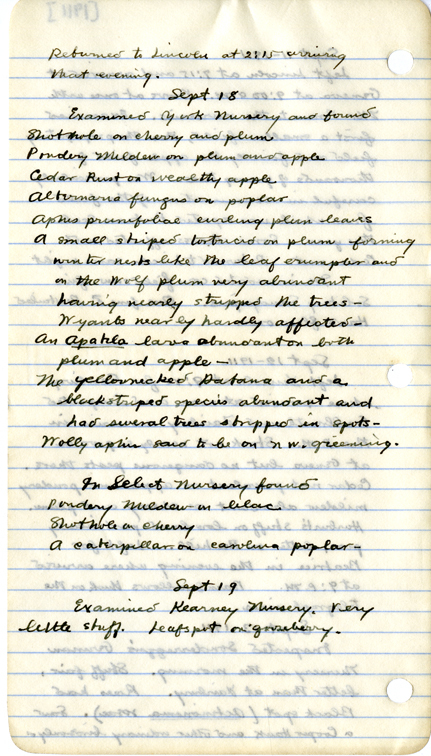
- Returned to Lincoln at 2:15 arriving that evening.
-
- Sept. 18 Examined York Nursery and found Shothole on cherry and plum Powdery Mildew on plum and apple Cedar Rust on wealthy apple Altermana fungus on poplar Aphis prunifoliae curling plum leaves A small striped torbucid on plum forming winter nests like the leaf crumpler and on the Wolf plum very abundant having nearly stripped the trees - Wyants nearby hardly affected. An Apatila larva abundant on both plum and apple -
- The yellownecked Datona and a blackstriped species abundant and had several trees stripped in spots. Wooly aphis said to be on nw. greening.
-
- In Select Nursery found Powdery Mildew on lilac Shothole on cherry A caterpillar on carolina poplar.
-
- Sept. 19 Examined Kearney Nursery. Very little stuff. Leafspot on gooseberry.
- [1911]
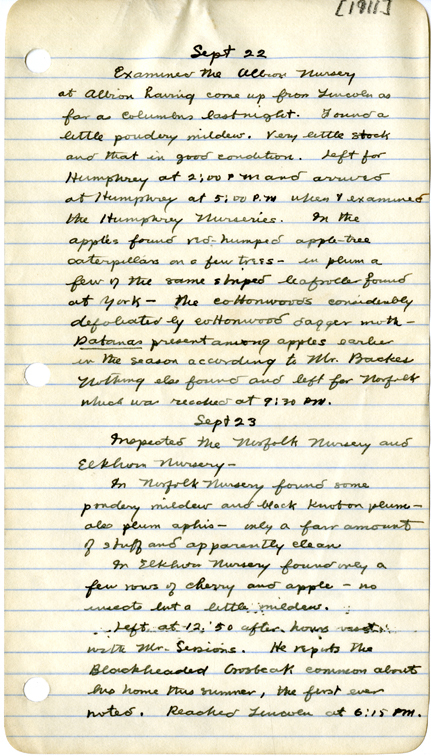
- Sept 22 Examined the Albion Nursery at Albion having come up from Lincoln as far as Columbus last night. Found a little powdery mildew. Very little stock and that in good condition. Left for Humphrey at 2:00 PM and arrived at Humphrey at 5:00 P.M when I examined the Humphrey Nurseries. In the apples found red-humped apple-tree caterpillars on a few trees - in plum a few of the same striped leafroller found at York - the cottonwoods considerbly defoliated by cottonwood dagger moth - Datanas present among apples earlier in the season according to Mr. Backes Nothing else found and left for Norfolk which was reached at 9:30 PM.
- Sept. 23
- Inspected the Norfolk Nursery and Elkhorn Nursery.
- In Norfolk Nursery found some powdery mildew and black knob on plum - also plum aphis - only a fair amount of stuff and apparently clean. In Elkhorn Nursery found only a few rows of cherry and apple - no insects but a little mildew.
- Left at 12:50 after hours visit with Mr. Sessions. He reports the Blackheaded Grosbeak common about his home this summer, the first ever noted. Reached Lincoln at 6:15 PM.
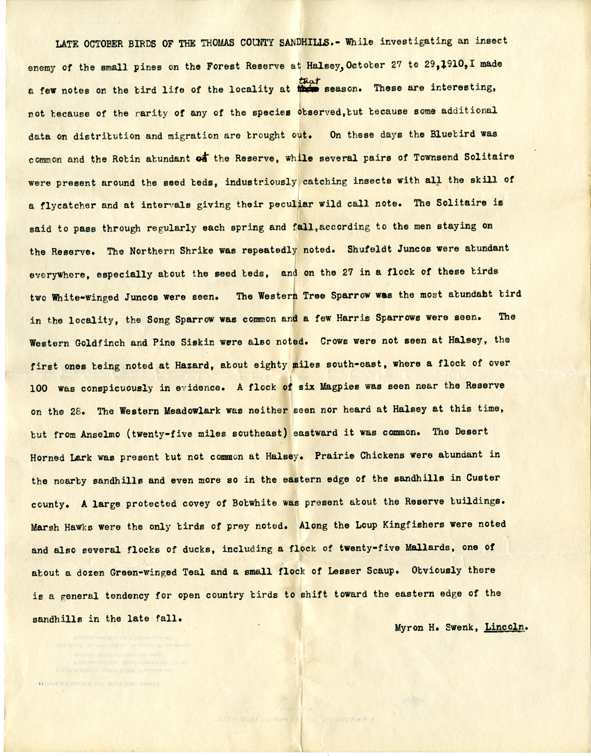
- LATE OCTOBER BIRDS OF THE THOMAS COUNTY SANDHILLS. - While investigating an insect enemy of the small pines on the Forest Reserve at Halsey, October 27 to 29, 1910, I made a few notes on the bird life of the locality at that season. These are interesting, not because of the rarity of any of the species observed, but because some additional data on distribution and migration are brought out. On these days the Bluebird was common and the Robin abundant at the Reserve, while several pairs of Townsend Solitaire were present around the seed beds, industriously catching insects with all the skill of a flycatcher and at intervals giving their peculiar wild call note. The Solitaire is said to pass through regularly each spring and fall, according to the men staying on the Reserve. The Northern Shrike was repeatedly noted. Shufoldt Juncos were abundant everywhere, especially about the seed beds, and on the 27 in a flock of these birds two White-winged Juncos were seen. The Western Tree Sparrow was the most abundant bird in the locality, the Song Sparrow was common and a few Harris Sparrows were seen. The Western Goldfinch and Pine Siskin were also noted. Crows were not seen at Halsey, the first ones being noted at Hazard, about eighty miles south-east, where a flock of over 100 was conspicuously in evidence. A flock of six Magpies was seen near the Reserve on the 28. The Western Meadowlark was neither seen nor heard at Halsey at this time, but from Anselmo (twenty-five miles southeast) eastward it was common. The Desert Horned Lark was present but not common at Halsey. Prairie Chickens were abundant in the nearby sandhills and even more so in the eastern edge of the sandhills in Custer county. A large protected covey of Bobwhite was present about the Reserve buildings. Marsh Hawks were the only birds of prey noted. Along the Loup Kingfishers were noted and also several flocks of ducks, including a flock of twenty-five Mallards, one of about a dozen Green-winged Teal and a small flock of Lesser Scaup. Obviously there is a general tendency for open country birds to shift toward the eastern edge of the sandhills in the late fall.
- Myron H. Swenk, Lincoln