
Nu History
Item set
- Title
- Nu History
Items
-
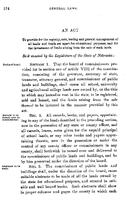 An Act to provide for the registry, sale, leasing and general management of all lands… (section 4)- This brief section stipulates that land sales were not to exceed 40 acres large. This was intended to keep land speculators from buying up large tracts of land.
 -
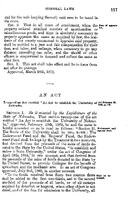 An Act to amend “An Act to establish the University of Nebraska (pages 117-118)- Two years after the original passage of the act to establish the university, this short amendment was created. The legislature wanted to clearly delineate between the regents’ fund and the university fund. Where two thirds of land sale profits would benefit the university fund, and the other third was to supplement the regents’ fund.
 -
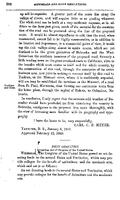 Joint Resolution accepting act of Congress of the United States (pages 308-312)- This is a reprint of the original Morrill Act passed in 1862. The Nebraska legislature printed it in their records verbatim, with the final passage being a complete acceptance of the federal terms.
 -
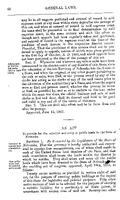 An Act to provide for the selection and entry of public lands… (pages 60-61) This short piece of legislation shows the Nebraska legislature acknowledging their acceptance of 90,000 acres and 72 sections of public land for the purpose of an agricultural college. Additionally the State is clarifying their intent to work within the legal confines of land sales set forth by the federal government.
 -
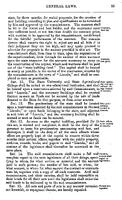 An Act to provide for the location of the seat of government… (Section 11)- This act made the unification of the state college and agricultural college official. It also recognizes that the federally endowed land need still be surveyed.
 -
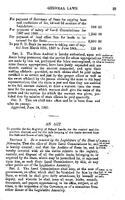 An Act to provide for the Registry of School Lands… (Sections 5, 17, 26, 27)- The state of Nebraska was sure to cover as many points as possible in relation to public land received from the federal government. This act lumps together “general schools”, what would later become public schools, and the university. The act specifies in length the bureaucratic procedures that were to be taken to ensure the value of the lands would forever go “undiminished.” In short, all proceeds from land sales were to be directed to the treasurer of the State. In turn the treasurer would invest the proceeds in United Sates or State securities, which were to bear not less than six per cent annual interest. The annual interest then supplemented the university fund.
 -
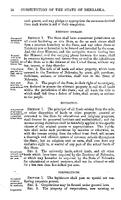 This excerpt comes from the original constitution for the state of Nebraska. Although only mentioned in short, the education sections are important. From the foundation of the state, the government took responsibility for whatever form a university may have taken. Additionally, the state adopted the minimum price of $5 per acres sold from the federally endowed land.
 -
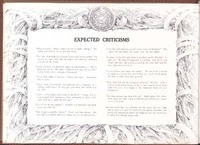 A page of expected criticisms from the 1912 Cornhusker staff.
 -
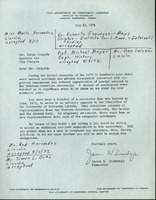 This is a letter that was sent to Grajeda and all other incumbent members of the Chancellor's Advisory Committee on Mexican-American Affairs. In the letter Zumberge asks Grajeda to continue on the committee for a second term. Handwritten at the top and bottom of the page are the names and addresses of the other members who received the same letter. Next to each name there is a notation which indicates the day on which the request was accepted by the individual. Note that the letter was sent in the end of July and all but Grajeda returned affirmative replies to the Chancellor with in a few weeks. Grajeda's reply comes during the secon week of classes and is a long letter detailing the reasons why he is declining.
 -
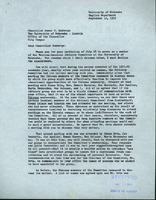 In this letter Professor Grajeda respectfully declines a request by chancellor Zumberge for Grajeda to remain on the Chancellor's Advisory Committee on Mexican-American affairs. Of all the people that are asked to remain or become new members, Grajeda is the only one who declines. He gives his reasoning in a mater-of-fact recall of the happenings of the past two years in the committee (click on thumbnail to enlarge image).
 -
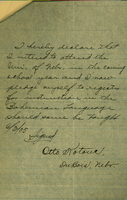 A letter from student Otto Kotouc, pledging to sign up for Bohemian Language courses if the University establishes a program for them.
 -
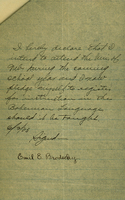 Emil E. Brodecky, a student pledging to register for Bohemian Language classes if a program is created at the University of Nebraska.
 -
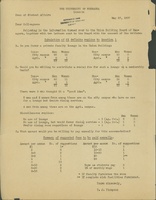 A tabulation from an informal vote of faculty members about how they would feel if they had to pay a fee to rent a lounge in the Student Union. It also details a few other charges that could be assessed within the Student Union pertaining to faculty.
 -
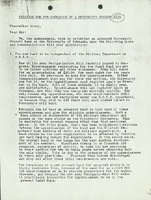 1921: Petition supported by the student body for the formation of a concert band separate from the military department because of complaints with department requirements and band organization.
 -
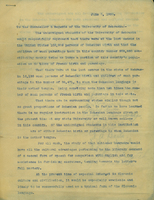 A letter to the Chancellor and Board of Regents asking for a Czech Language program to be established.
 -
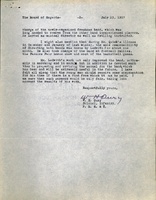 Col Oury writes to the Board of Regents seeking payment for Charles Ledwith, who directed bands and wrote a manual for the freshman band.
 -
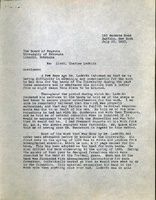 Col. Oury writes a letter to the Board of Regents seeking payment for Charles Ledwith's work for the band as an assistant. The letter describes the type of work he was doing as well as the freshman band manual.
 -
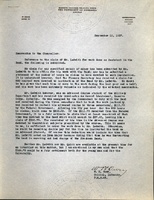 Colonel Oury writes to Chancellor Burnett seeking compensation for the work done by Charles Ledwith as an assistant to the band.
 -
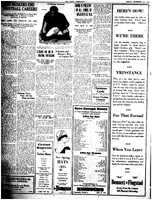 The 1928 Football edition of the Daily Nebraskan highlights the band's many trips accompanying the team.
 -
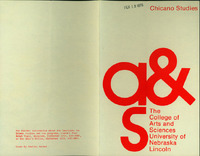 This is a pamphlet which was printed by the College of Arts & Sciences and distributed in 1976 to promote the curriculum in the new Chicano Studies Program. Chicano Studies debuted at the University of Nebraska-Lincoln as a minor field of study. Requirements for the minor are included in the pamphlet. Cover by Shelley Becker. Classes include: Anthropology 250 - Indians of Latin America, English 116D and 245D - Chicano Literature, History 356 - History and Culture of the Mexican-American and Sociology 217 - Nationality and Race Relations, among others (click on thumbnail to enlarge image).
 -
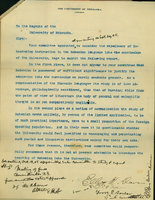 A letter to the regents from the committee to determine whether or not to create a Czech Language Department in 1905.
 -
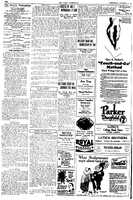 The band's membership increased but the number of uniforms is not sufficient to allow all of the men selected to march.
 -
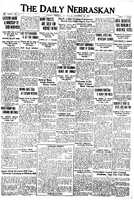 The New York News had many interesting comments to make about the appearance of the Nebraska football team, fans, and R.O.T.C. band after the Nebraska-Army game.
 -
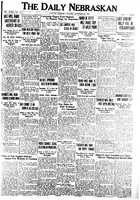 Despite the best fundraising efforts of the community, band, and university, only half of the band will be traveling to West Point.
 -
 Local businessmen and organizations send in money to fund the band's trip to West Point for the Nebraska-Army game.