-
Alternative Title
-
Lawrence Bruner Letters, 1897
-
Creator
-
Lawrence Bruner
-
Identifier
-
081210-1897-059e
-
Transcription
-
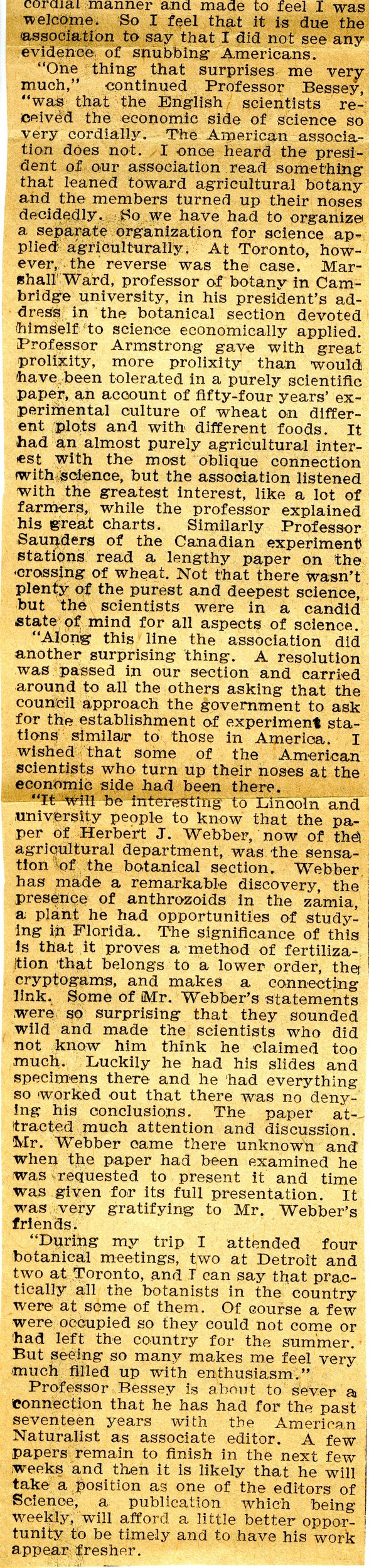
cordial manner and made to feel I was welcome. So I feel that it is due the association to say that I did not see any evidence of snubbing Americans.
"One thing that surprises me very much," continued Professor Bessey, "was that the English scientists recieved the economic side of science so very cordially. The American association does not. I once heard the president of our association read something that leaned toward agricultural botany and the members turned up their noses decidedly. So we have had to organize a separate organization for science applied agriculturally. At Toronto, however, the reverse was the case. Marshall Ward, professor of botany in Cambridge university, in his president's address in the botanical section devoted himself to science economically applied. Professor Armstrong gave with great prolixity, more prolixity than would have been tolerated in a purely scientific paper, an account of fifty-four years' experimental culture of wheat on different plots and with different foods. It had an almost purely agricultural interest with the most oblique connection with science, but the association listened with the greatest interest, like a lot of farmers, while the professor explained his great charts. Similarly Professor Saunders of the Canadian experiment stations read a lengthy paper on the crossing of wheat. Not that there wasn't plenty of the purest and deepest science, but the scientists were in a candid state of mind for all aspects of science.
"Along this line the association did another surprising thing. A resolution was passed in our section and carried around to all the others asking that the council approach the government to ask for the establishment of experiment stations similar to those in America. I wished that some of the American scientists who turn up their noses at the economic side had been there.
"It will be interesting to Lincoln and university people to know that the paper of Herbert J. Webber, now of the agricultural department, was the sensation of the botanical section. Webber has made a remarkable discovery, the presence of anthrozoids in the zamia, a plant he had opportunities of studying in Florida. The significance of this is that it proves a method of fertilization that belongs to a lover order, the cryptogams, and makes a connecting link. Some of Mr. Webber's statements were so surprising that they sounded wild and made the scientists who did not know him think he claimed too much. Luckily he had his slides and specimens there and he had everything so worked out that there was no denying his conclusions. The paper attracted much attention and discussion. Mr. Webber came there unknown and when the paper had been examined he was requested to present it and time was given for its full presentation. It was very gratifying to Mr. Webber's friends.
"During my trip I attended four botanical meetings, two at Detroit and two at Toronto, and I can say that practically all the botanists in the country were at some of them. Of course a few were occupied so they could not come or had left the country for the summer. But seeing so many makes me feel very much filled up with enthusiasm."
Professor Bessey is about to sever a connection that he has had for the past seventeen years with the American Naturalist as associate editor. A few papers remain to finish in the next few weeks and then it is likely that he will take a position as one of the editors of Science, a publication which being weekly, will afford a little better opportunity to be timely and to have his work appear fresher.
-
Rights
-
To inquire about usage, please contact Archives & Special Collections, University of Nebraska-Lincoln Libraries. These images are for educational use only. Not all images are available for publication.
-
Is Version Of
-
081210-1897-059e.jpg

 081210-1897-059e.jpg