-
Title
-
Field Notes, 1912, Part 3_090
-
Alternative Title
-
Field Notes, 1912, Part 3
-
Date
-
1912
-
Creator
-
Raymond J. Pool
-
Description
-
Raymond J. Pool Field Notes
-
Identifier
-
120712
-
Transcription
-
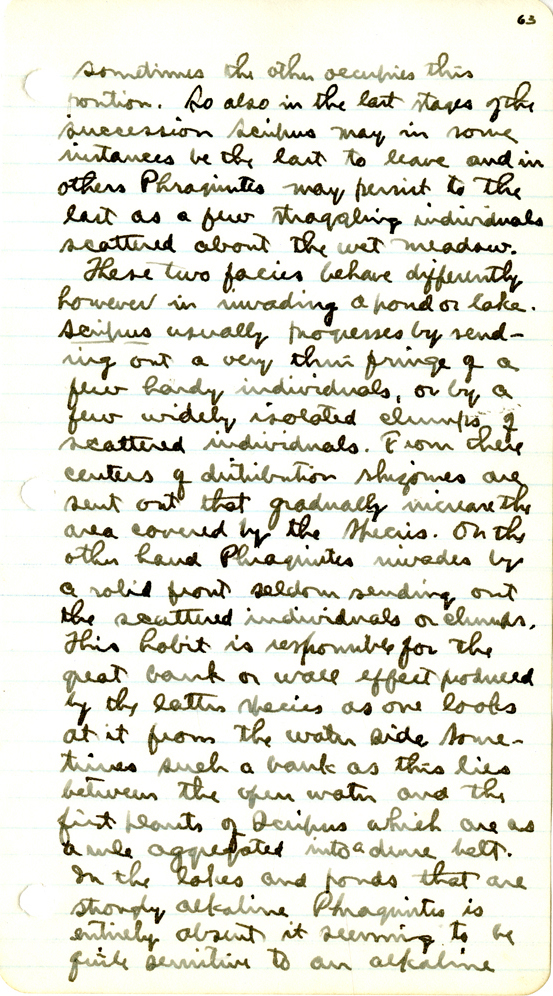
90 63 sometimes the other occupies this position. So also in the last stages of the succession Scirpus may in some instances be the last to leave and in others Phragmites may persist to the last as a few straggling individuals scattered about the wet meadow. These two facies behave differently however in invading a pond or lake Scirpus usually progresses by sending out a very thin fringe of a few hardy individuals, or by a few widely isolated clumps of scattered individuals. From these centers of distribution rhizomes are sent out that gradually increase the area covered by the species. On the other hand Phragmites invades by a solid front seldom sending aout the scattered individuals or clumps. The habit is responsible for the great bank or wall effect produced by the latter species as one looks at it from the water side sometimes such a bank as this lies between the open water and the first plants of Scirpus which are as a rule aggregated into a dense belt. In the lakes are ponds that are strongly alkaline Phragmites is entirely absent it seeming to be quite sensitive to an alkaline
-
Rights
-
To inquire about usage, please contact Archives & Special Collections, University of Nebraska-Lincoln Libraries. These images are for educational use only. Not all images are available for publication.
-
Is Version Of
-
E:\great nebraska\downloads\downloads\scraped_images\raymond_j_pool_notes_1912_part_3\raymond_j_pool_notes_1912_part_3_120712-1912-090.jpg