-
Title
-
Salt Basin Habitat Notes
-
Creator
-
Frank Shoemaker
-
Description
-
Frank Shoemaker - Omaha, Lincoln, and Nebraska Narratives
-
Identifier
-
321301
-
Transcription
-
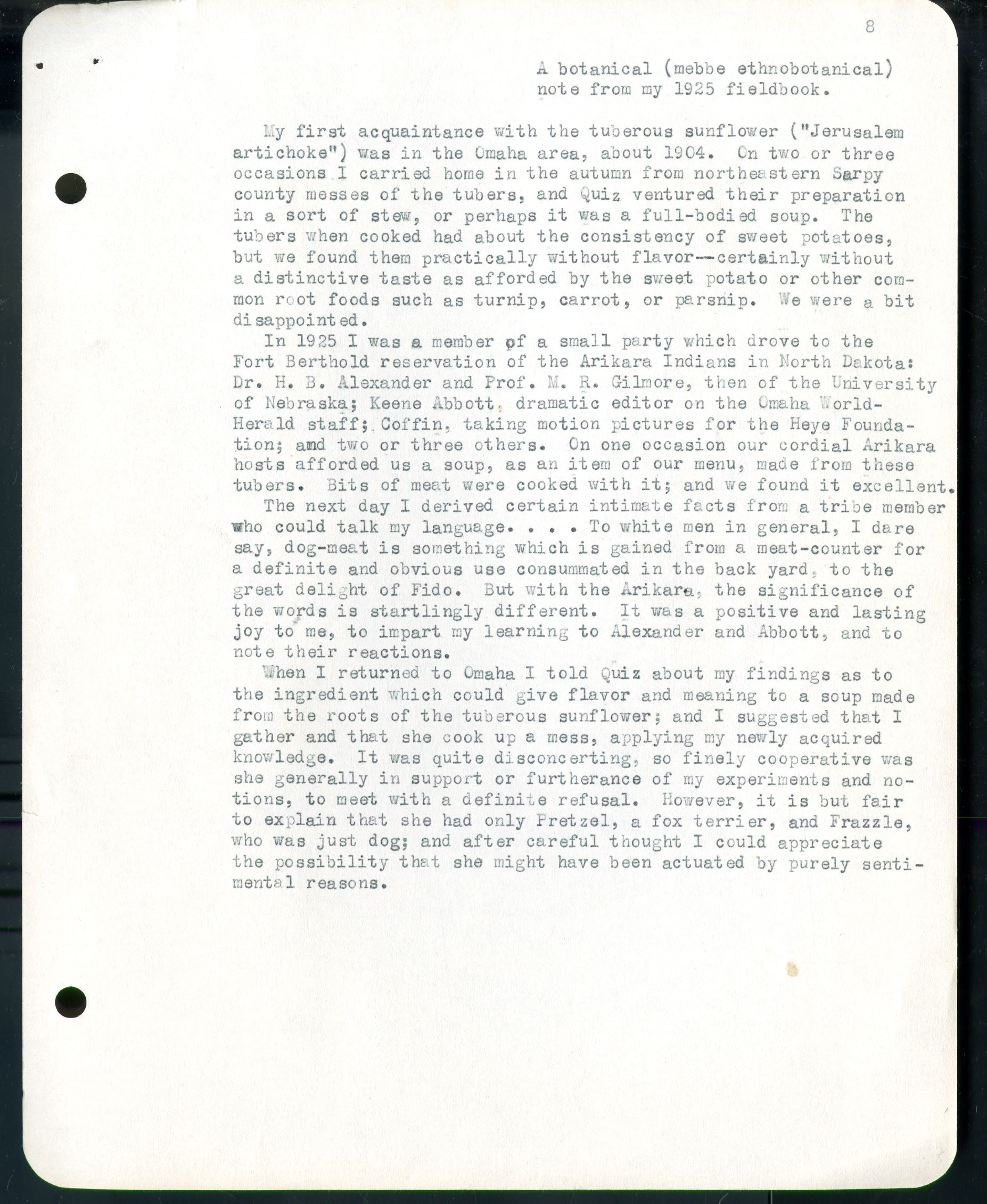
8 A botanical (mebbe ethnobotanical) note from my 1925 fieldbook. My first acquaintance with the tuberous sunflower ("Jerusalem artichoke") was in the Omaha area, about 1904. On two or three occasions I carried home in the autumn from northeastern Sarpy county messes or the tubers, and Quiz ventured their preparation in a sort of stew, or perhaps it was a full-bodied soup. The tubers when cooked had about the consistency of sweet potatoes, but we found them practically without flavor - certainly without a distinctive taste as afforded by the sweet potato or other common root foods such as turnip, carrot, or parsnip. We were a bit disappointed. In 1925 I was a member of a small party which drove to the Fort Berthold reservation of the Arikara Indians in North Dakota: Dr. H. B. Alexander and Prof. M. R. Gilmore, then of the University of Nebraska; Keene Abbott, dramatic editor on the Omaha World-Herald staff; Coffin, taking motion pictures for the Heye Foundation; and two or three others. On one occasion our cordial Arikara tubers. Bits of meat were cooked with it; and we found it excellent. The next day I derived certain intimate facts from a tribe member who could talk my language. . . . To white men in general, I dare say, dog-meat is something which is gained from a meat-counter for a definite and obvious use consummated in the back yard, to the great delight of Fido. But with the Arikara, the significance of the words is startlingly different. It was a positive and lasting joy to me, to impart my learning to Alexander and Abbott, and to note their reactions. When I returned to Omaha I told Quiz about my findings as to the ingredient which could give flavor and meaning to a soup made from the roots of the tuberous sunflower; and I suggested that I gather and that she cook up a mess, applying my newly acquired knowledge. It was quite disconcerting, so finely cooperative was she generally in support or furtherance of my experiments and notions, to meet with a definite refusal. However, it is but fair to explain that she had only Pretzel, a fox terrier, and Frazzle, who was just a dog; and after careful thought I could appreciate the possibility that she might have been actuated by purely sentimental reasons.
-
Rights
-
To inquire about usage, please contact Archives & Special Collections, University of Nebraska-Lincoln Libraries. These images are for educational use only. Not all images are available for publication.
-
Is Version Of
-
image-342.jpg

 Salt Basin Habitat Notes