-
Title
-
Salt Basin Habitat Notes
-
Creator
-
Frank Shoemaker
-
Description
-
Frank Shoemaker - Omaha, Lincoln, and Nebraska Narratives
-
Identifier
-
321301
-
Transcription
-
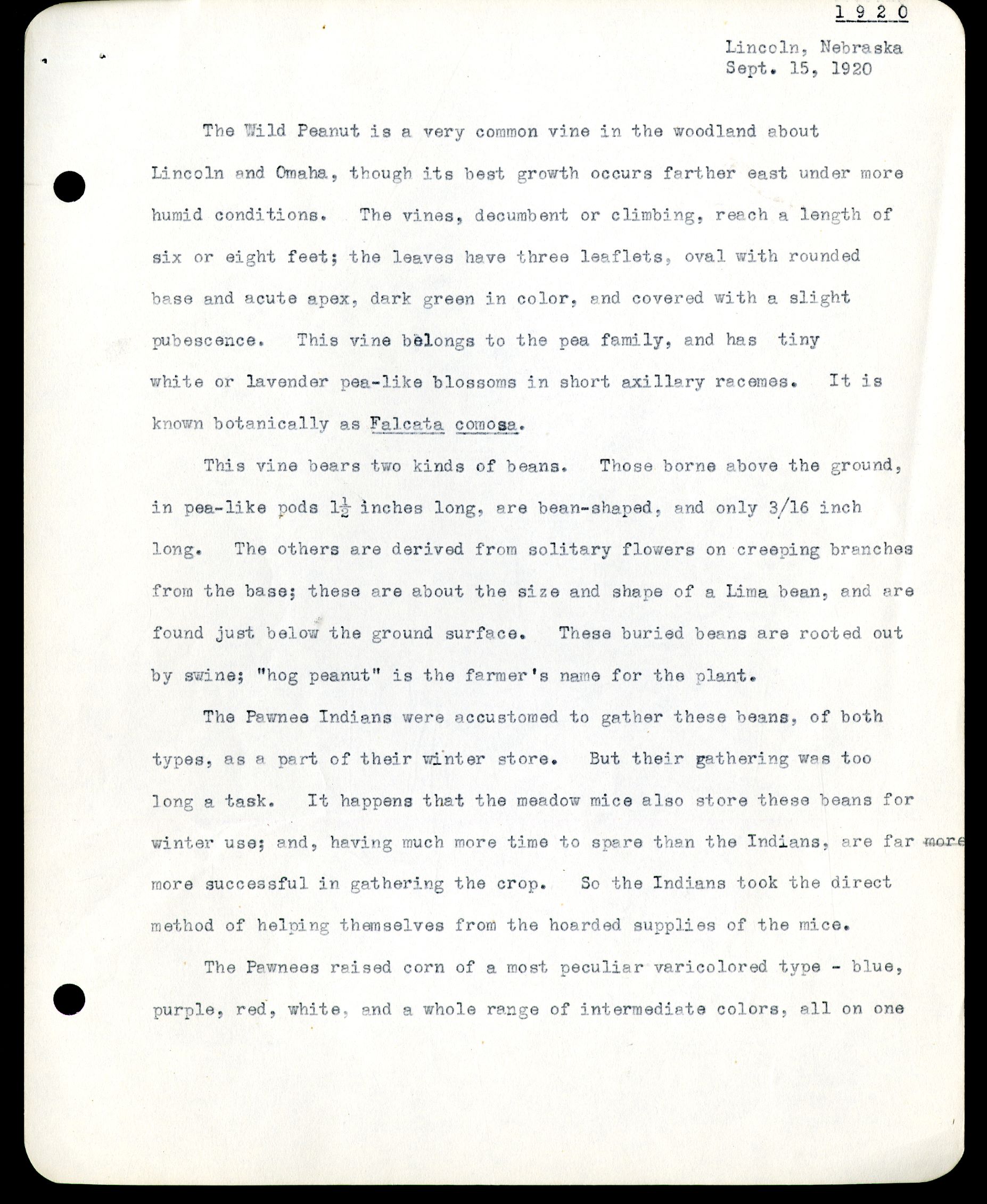
1920 Lincoln, Nebraska Sept. 15, 1920 The Wild Peanut is a very common vine in the woodland about Lincoln and Omaha, though its best growth occurs farther east under more humid conditions. The vines, decumbent or climbing, reach a length of six or eight feet; the leaves have three leaflets, oval with rounded base and acute apex, dark green in color, and covered with a slight pubescence. This vine belongs to the pea family, and has tiny white or lavender pea-like blossoms in short axillary racemes. It is known botanically as Falcata comosa . This vine bears two kinds of beans. Those borne above the ground, in pea-like pods 1½ inches long, are bean-shaped, and only 3/16 inch long. The others are derived from solitary flowers on creeping branches from the base; these are about the size and shape of a Lima bean, and are found just below the ground surface. These buried beans are rooted out by swine; "hog peanut" is the farmer's name for the plant. The Pawnee Indians were accustomed to gather these beans, of both types, as a part of their winter store. But their gathering was too long a task. It happens that the meadow mice also store these beans for winter use; and, having much more time to spare than the Indians, are far more successful in gathering the crop. So the Indians took the direct method of helping themselves from the hoarded supplies of the mice. The Pawnees raised corn of a most peculiar varicolored type - blue, purple, red, white, and a whole range of intermediate colors, all on one
-
Rights
-
To inquire about usage, please contact Archives & Special Collections, University of Nebraska-Lincoln Libraries. These images are for educational use only. Not all images are available for publication.
-
Is Version Of
-
image-340.jpg

 Salt Basin Habitat Notes