-
Title
-
Sidney, Banner County, Scotts Bluff, July 30-Aug. 9, 1911
-
Date
-
July 30-Aug. 9, 1911
-
Creator
-
Frank Shoemaker
-
Description
-
Sandhills Narratives
-
Identifier
-
27133
-
Transcription
-
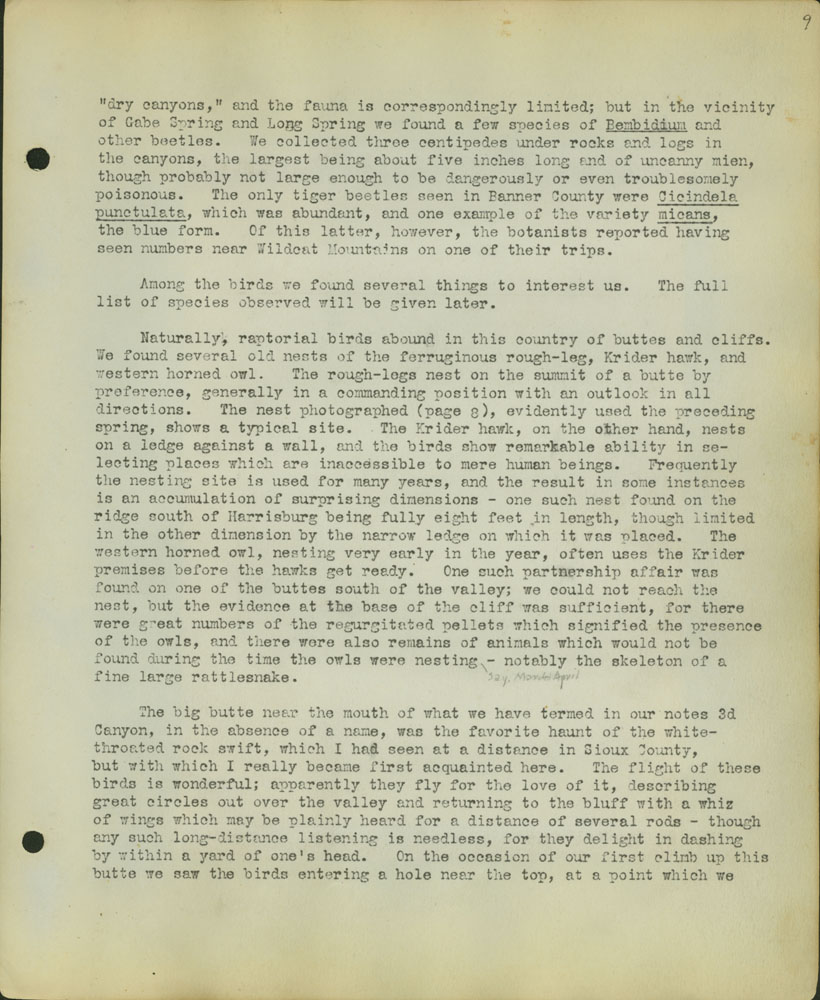
9 “dry canyons,” and the fauna is correspondingly limited; but in the vincinity of Gabe Spring and Long Spring we found a few species of Bembidium and other beetles. We collected three centipedes under rocks and logs in the canyons, the largest being about five inches long and of uncanny mien, though probably not large enough to be dangerously or even troublesomely poisonous. The only tiger beetles seen in Banner County were Cicindela punctulata , which was abundant, and one example of the variety micans, the blue form. Of this latter, however, the botanists reported having seen numbers near Wildcat Mountains on one of their trips. Among the birds we found several things to interest us. The full list of species observed will be given later. Naturally, raptorial birds abound in this country of buttes and cliffs. We found several old nests of the ferruginous rough-legs nest on the summit of a butte by preference, generally in a commanding position with an outlook in all directions. The nest photographed (page 8), evidently used the preceding spring, shows a typical site. The Krider Hawk, on the other hand, nests on a ledge against a wall, and the birds show remarkable ability in selecting places which are inaccessible to mere human beings. Frequently the nesting site is used for many years, and the result in some instances is an accumlation of surprising dimensions – one such nest found on the ridge south of Harrisburg being fully eight feet in length, though limited in the other dimension by the narrow ledge on which it was placed. The western horned owl, nesting very early in the year, often uses the Krider premises before the hawks get ready. One such partnershup affiar was found on one of the buttes south of the valley; we could not reach the nest, but the evidence at the base of the cliff was sufficient, for there were great numbers of the regurgitated pellets which signified the presence of the owls, and there were also remains of animals which would not be found during the time the owls were nesting – notably the skeleton of a fine large rattlesnake. The big butte near the mouth of what we have termed in our notes 3d Canyon, in the absence of a name, was the favorite haunt of the white-throated rock swift, which I had seen at a distance in Sioux County , but with which I really became first acquainted here. The flight of these birds is wonderful; apparently they fly for the love of it, describing great circles out over the valley and returning to the bluff with a whiz of wings which may be plainly heard for a distance of several rods – though any such long-distance listening is needless, for they delight in dashing by within a yard of one’s head. On the occasion of our first climb up this butte we saw the birds entering a hole near the top, at a point which
-
Rights
-
To inquire about usage, please contact Archives & Special Collections, University of Nebraska-Lincoln Libraries. These images are for educational use only. Not all images are available for publication.
-
Is Version Of
-
E:\great nebraska\shoemaker-letters\sidney-banner_010.jpg