-
Title
-
Sidney, Banner County, Scotts Bluff, July 30-Aug. 9, 1911
-
Date
-
July 30-Aug. 9, 1911
-
Creator
-
Frank Shoemaker
-
Description
-
Sandhills Narratives
-
Identifier
-
27131
-
Transcription
-
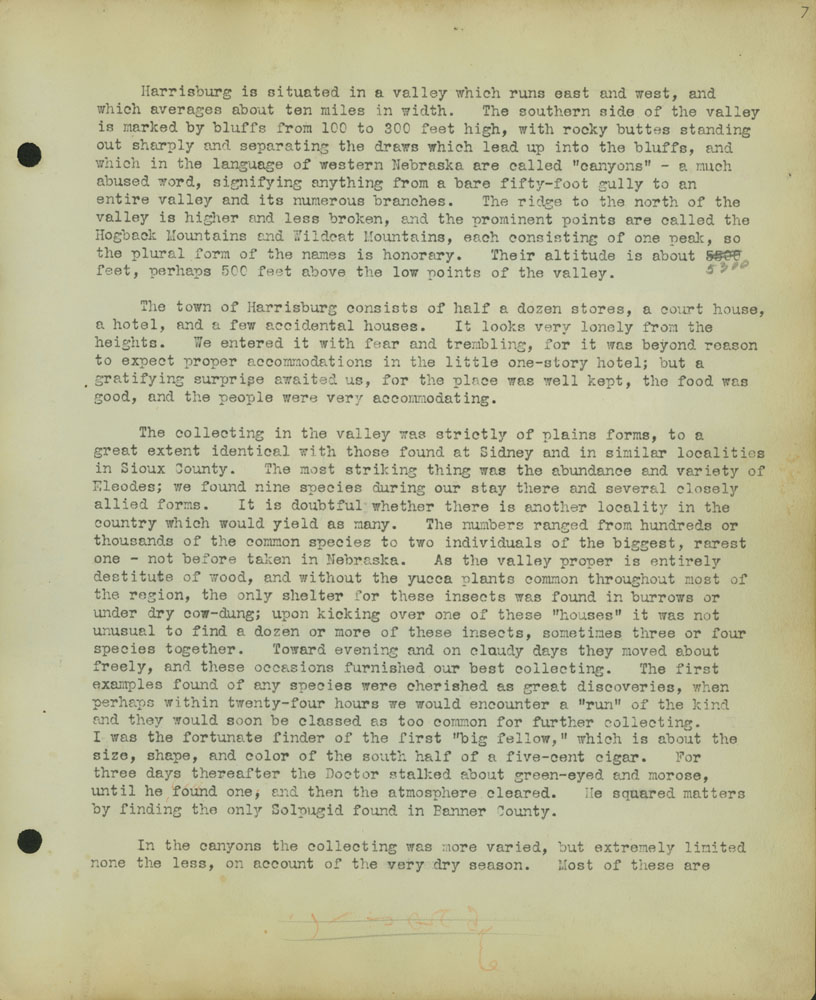
7 Harrisburg is situated in a valley which runs east and west, and which averages about ten miles in width. The southern side of the valley is marked by bluffs from 100 to 300 feet high, with rocky buttes standing out sharply and separating the draws which lead up into the bluffs, and which in the language of western Nebraska are called “canyons” – a much abused word, signifying anything from a bare fifty-foot gully to an entire valley and its numerous branches. The ridge to the north of the valley is higher and less broken, and the prominent points are called the Hogback Mountains and Wildcat Mountains, each consisting of one peak, so the plural form of the names is honorary. Their altitude is about 5300 feet, perhaps 500 feet above the low points of the valley. The town of Harrisburg consists of half a dozen stores, a courthouse, a hotel, and a few accidental houses. It looks very lonely from the heights. We entered it with fear and trembling, for it was beyond reason to expect proper accommodations in the little one-story hotel; but a gratifying surprise awaited us, for the place was well kept, the food was good, and the people were very accommodating. The collecting in the valley was strictly of plains forms, to a great extent identical with those found at Sidney and in similar localities in Sioux County . The most striking thing was the abundance and variety of Eleodes ; we found nine species during our stay there and several closely allied forms. It is doubtful whether there is another locality in the country which would yield as many. The numbers ranged from hundreds or thousands of the common species to two individuals of the biggest, rarest one – not before taken in Nebraska . As the valley proper is entirely destitute of wood, and without the yucca plants common throughout most of the region, the only shelter for these insects was found in burrows or under dry cow-dung; upon kicking over one of these insects, sometimes three or four species together. Toward evening and on cloudy days they moved about freely, and these occasions furnished our best collecting. The first examples found of any species were cherished as great discoveries, when perhaps within twenty-four hours we would encounter a “run” of the kind and they would soon be classed as too common for further collecting. I was the fortunate finder of the first “big fellow,” which is about the size, shape, and color of the south half of a five-cent cigar. For three days thereafter the Doctor stalked about green-eyed and morose until he found one, and then the atmosphere cleared. He squared matters by finding the only Solpugid found in Banner County . In the canyons the collecting was more varied, but extremely limited none the less, on account of the very dry season. Most of these are
-
Rights
-
To inquire about usage, please contact Archives & Special Collections, University of Nebraska-Lincoln Libraries. These images are for educational use only. Not all images are available for publication.
-
Is Version Of
-
E:\great nebraska\shoemaker-letters\sidney-banner_008.jpg