-
Title
-
Thomas County, July 3-11, July 27-30, 1911
-
Date
-
July 3-11, July 27-30, 1911
-
Creator
-
Frank Shoemaker
-
Description
-
Narratives
-
Identifier
-
321301-1911-0148.jpg
-
Transcription
-
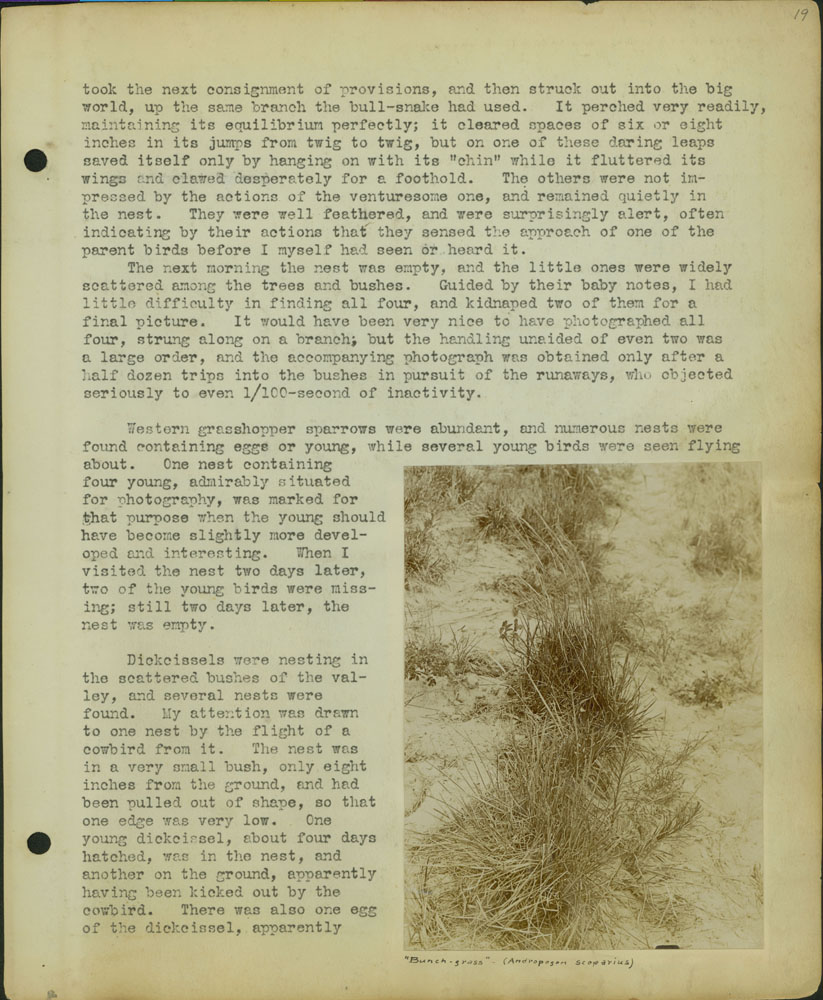
19 … took the next consignment of provisions, and then struck out into the big world, up the same branch the bull-snake had used. It perched very readily, maintaining its equilibrium perfectly; it cleared spaces of six to eight inches in its jumps from twig to twig, but on one of these daring leaps saved itself only by hanging on with its “chin” while it fluttered its wings and clawed desperately for a foothold. The others were not impressed by the actions of the venturesome one, and remained quietly in the nest. They were well feathered, and surprisingly alert, often indicating by their actions that they sensed the approach of one of the parent birds before I myself had seen or heard it. The next morning the nest was empty, and the little ones were widely scattered among the trees and bushes. Guided by their baby notes, I had little difficulty finding all four, and kidnapped two of them for a final picture. It would have been very nice to have photographed all four, strung along a branch; but the handling unaided of even two was a large order, and the accompanying photograph was obtained only after a half dozen trips into the bushes in pursuit of the runaways, who objected seriously to even 1/100-second inactivity. Western grasshopper sparrows were abundant, and numerous nests were found containing eggs or young, while several young birds were seen flying about. One nest containing four young, admirably situated for photography, was marked for that purpose when the young should have become slightly more developed and interesting. When I visited the nest two days later, the nest was empty. Dickcissels were nesting in the scattered bushes of the valley, and several nests were found. My attention was drawn to one nest by the flight of a cowbird from it. The nest was in a very small bush, only eight inches from the ground, and had been pulled out of shape, so that one edge was very low. One young dickcissel, about four days hatched, was in the nest, and another on the ground, apparently having been kicked out by the cowbird. There was also one egg of the dickcissel, apparently
-
Rights
-
To inquire about usage, please contact Archives & Special Collections, University of Nebraska-Lincoln Libraries. These images are for educational use only. Not all images are available for publication.
-
Is Version Of
-
321301-1911-0148_321301-1911-0148.jpg