-
Title
-
Thomas County, July 3-11, July 27-30, 1911
-
Date
-
July 3-11, July 27-30, 1911
-
Creator
-
Frank Shoemaker
-
Description
-
Narratives
-
Identifier
-
321301-1911-0134.jpg
-
Transcription
-
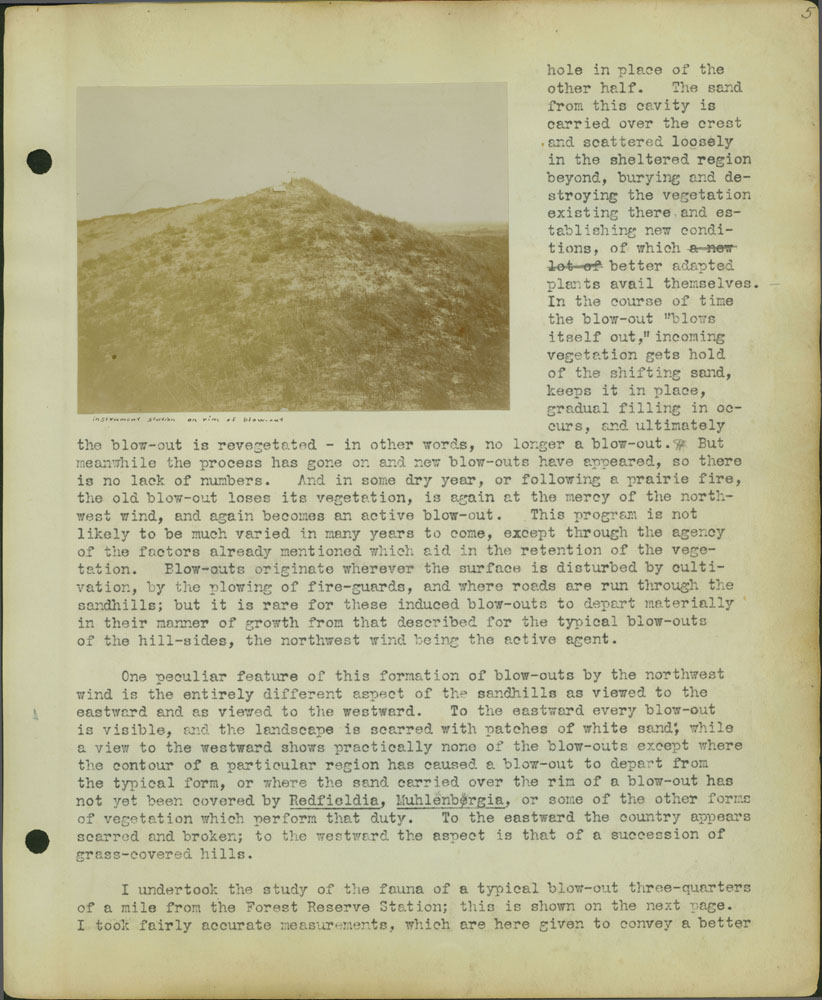
5 … hole in place of the other half. The sand from the cavity is carried over the crest and scattered loosely in the sheltered region beyond, burying and destroying the vegetation existing there and establishing new conditions, of which better adapted plants avail themselves. In the course of time the blow-out “blows itself out,” incoming vegetation gets hold of the shifting, keeps it in place, gradual filling in occurs, and ultimately the blow-out is revegetated – In other words, no longer a blow-out. But meanwhile the process has gone on and new blow-outs have appeared, so there is no lack of numbers. And in some dry year, or following a prairie fire, the old blow-out loses its vegetation, is again at the mercy of the northwest wind, and again becomes an active blow-out. This program is not likely to be much varied in the many years to come, except through the agency of the factors already mentioned which aid in the retention of the vegetation. Blow-outs originate wherever the surface is disturbed by cultivation, by the plowing of fire-guards, and where roads are run through the sandhills; but it is rare for these induced blow-outs to depart materially in their manner of growth from that described for the typical blow-outs of the hill-sides, the northwest wind being the active agent. One peculiar feature of this formation of blow-outs by the northwest wind is entirely different aspect of the sandhills as viewed to the eastward and as viewed to the westward. To the eastward every blow-out is visible, and the landscape is scarred with patches of white sand; while a view to the westward shows practically none of the blow-outs except where the contour of a particular region has caused a blow-out to depart from the typical form, or where the sand carried over the rim of the blow-out has not yet been covered by Redfieldia [grass genus], Muhlenburgia [muhlenbergia, grass genus] or some other forms of vegetation which perform that duty. To the eastward the country appears scarred and broken; to the westward the aspect is that of a succession of grass-covered hills. I undertook the study of the fauna of a typical blow-out three-quarters of a mile from the Forest Reserve Station ; this is shown on the next page. I took fairly accurate measurements, which are here given to convey a better
-
Rights
-
To inquire about usage, please contact Archives & Special Collections, University of Nebraska-Lincoln Libraries. These images are for educational use only. Not all images are available for publication.
-
Is Version Of
-
321301-1911-0134_321301-1911-0134.jpg