-
Title
-
Thomas County, July 3-11, July 27-30, 1911
-
Date
-
July 3-11, July 27-30, 1911
-
Creator
-
Frank Shoemaker
-
Description
-
Narratives
-
Identifier
-
321301-1911-0130.jpg
-
Transcription
-
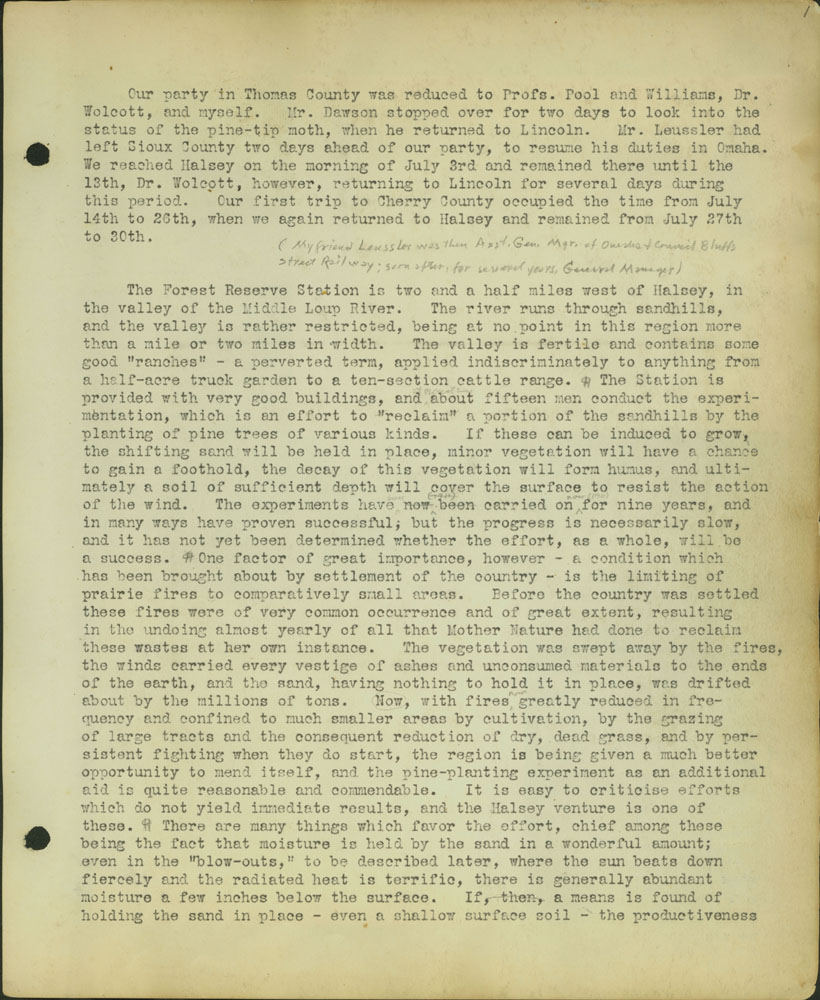
1 Our party in Thomas County was reduced to Profs. Pool and Williams , Dr. Wolcott , and myself. Mr. Dawson stopped over for two days to look into the status of the pine-tip moth, when he returned to Lincoln . Mr. Leussler had left Sioux County two days ahead of our party, to resume his duties in Omaha . We reached Halsey on the morning of July 3rd and remained there until the 13th, Dr. Wolcott , however, returning to Lincoln for several days during this period. Our first trip to Cherry County occupied the time from July 14th to 26th, when we again returned to Halsey and remained from July 27th to 30th. The Forest Reserve Station is two and a half miles west of Halsey , In the valley of the Middle Loup River. The river runs through sandhills, and the valley is rather restricted, being at no point in this region more than a mile or two miles in width. The valley is fertile and contains some good “ranches” — a perverted term, applied indiscriminately to anything from a half-acre truck garden to a ten-section cattle range. The Station is provided with very good buildings, and at present time about fifteen men conduct the experimentation, which is an effort to “ reclaim “ a portion of the sandhills by the planting of pine trees of various kinds. If these can be induced to grow , the shifting sand will be held in place, minor vegetation will have a chance to gain a foothold, the decay of this vegetation will form humus, and ultimately a soil of sufficient depth will cover the surface to resist the action of the wind. The experiments have been (1911) carried on now (1911) for nine years, and in many ways have proven successful; but the progress is necessarily slow, and it has not yet been determined whether the effort, as a whole, will be a success. One factor of great importance, however — a condition which has been brought about by settlement of the country — is the limiting of prairie fires to comparatively small areas. Before the country was settled these fires were of very common occurrence and of great extent, resulting in the undoing almost yearly of all that Mother Nature had done to reclaim these wastes at her own instance. The vegetation was swept away by the fires, the winds carried every vestige of ashes and unconsumed materials to the ends of the earth, and the sand, having nothing to hold it in place, was drifted about by the millions of tons. Now , with fires now greatly reduced in frequency and confined to much smaller areas by cultivation, by the grazing of large tracts and the consequent reduction of dry, dead grass, and by persistent fighting when they do start, the region is being given a much better opportunity to mend itself, and the pine-planting experiment as an additional aid is quite reasonable and commendable. It is easy to criticize efforts which do not yield immediate results, and the Halsey venture is one of these. There are many things which favor the effort, chief among these being the fact that moisture is held by the sand in wonderful amount; even in the “blow-outs,” to be described later, where the sun beats down fiercely and the radiated heat is terrific, there is generally abundant moisture a few inches below the surface. If, then , a means is found of holding the sand in place — even a shallow surface soil — the productiveness
-
Rights
-
To inquire about usage, please contact Archives & Special Collections, University of Nebraska-Lincoln Libraries. These images are for educational use only. Not all images are available for publication.
-
Is Version Of
-
321301-1911-0130_321301-1911-0130.jpg