-
identifier/filename
-
371-00062
-
title
-
Article, Myron H. Swenk, 1919
-
description
-
Typewritten enclosed article, 11 pages, titled "The Economic Value of the Ring-Necked Pheasant."
-
transcription
-
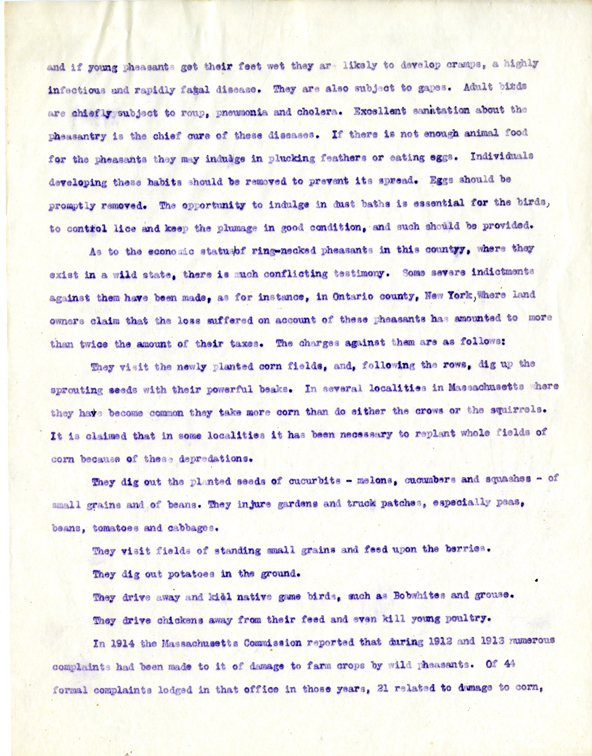
and if young pheasants get their feet wet they are likely to develop cramps, a highly infectious and rapidly fatal disease. They are also subject to gapes. Adult birds are chiefly subject to roup, pneumonia and cholera. Excellent sanitation about the pheasantry is the chief cure of these diseases. If there is not enough animal food for the pheasants they may indulge in plucking featers or eating eggs. Individuals developing these habits should be removed to prevent its spread. Eggs should be promptly removed. The opportunity to indulge in dust baths is essential for the birds, to control lice and keep the plumage in good condition, and such should be provided. As to the economic status of ring-necked pheasants in this country, where they exist in a wild state, there is much conflicting testimony. Some severe indictments against them have been made, as for instance, in Ontario county, New York, where land owners claim that the loss suffered on account of these pheasants has amounted to more than twice the amount of their taxes. The charges against them are as follows: They visit the newly planted corn fields, and, following the rows, dig up the sprouting seeds with their powerful beaks. In several localities in Massachusetts where they have become common they take more corn than do either the crows or the squirrels. It is claimed that in some localities it has been necessary to replant whole fields of corn because of these depredations. They dig out the planted seeds of cucurbits - melons, cucumbers, and squashes - small grains and of beans. They injure gardens and truck patches, especially peas, beans, tomatoes and cabbage. They visit fields of standing small grains and feed upon the berries. They dig out potatoes in the ground. They drive away and kill native game birds, such as Bobwhites and grouse. They drive chickens away from their feed and even kill young poultry. In 1914 the Massachusetts Commission reported that during 1912 and 1913 numerous complaints had been made to it of damage to farm crops by wild pheasants. Of 44 formal complaints lodged in that office in those years, 21 related to damage to corn,
-
date
-
1919
-
source/RG#/MS#
-
MS 0371
-
isPartOf/Collection
-
Nebraska Ornithologists' Union (NOU), Records
-
rights
-
For copyright information, please contact the repository.
-
publisher
-
Archives & Special Collections, University of Nebraska-Lincoln Libraries
-
language
-
English

 371-00062.jpg