-
identifier/filename
-
371-00061
-
title
-
Article, Myron H. Swenk, 1919
-
description
-
Typewritten enclosed article, 11 pages, titled "The Economic Value of the Ring-Necked Pheasant."
-
transcription
-
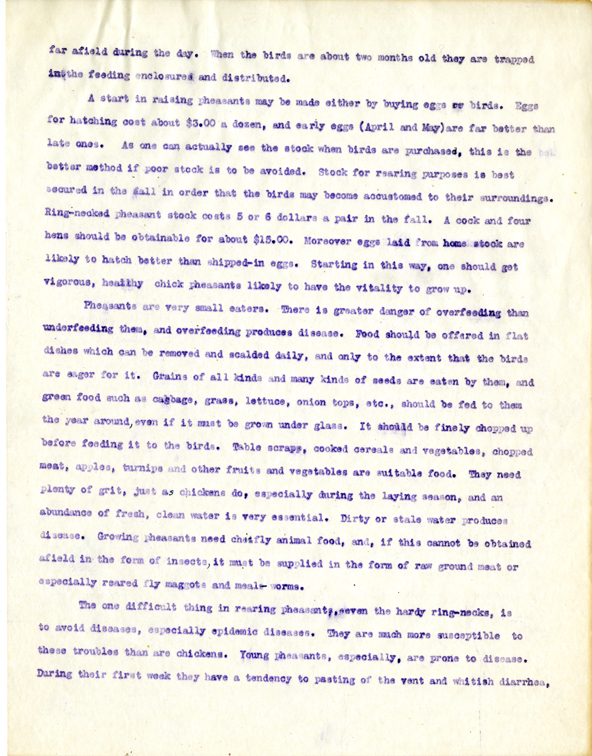
far afield during the day. When the birds are about two months old they are trapped in the feeding enclosures and distributed. A start in raising pheasants may be made either by buying eggs or birds. Eggs for hatching cost about $3.00 a dozen, and early eggs (April and May) are far better than late ones. As one can actually see the stock when birds are purchased, this is the better method if poor stock is to be avoided. Stock for rearing purposes is best secured in the fall in order that the birds may become accustomed to their surroundings. Ring-necked pheasant stock costs 5 or 6 dollars a pair in the fall. A cock and four hens should be obtainable for about $15.00. Moreover eggs laid from home stock are likely to hatch better than shipped-in eggs. Starting in this way, one should get vigorous, healthy chick pheasants likely to have the vitality to grow up. Pheasants are very small eaters. There is greater danger of overfeeding than underfeeding them, and overfeeding produces disease. Food should be offered in flat dishes which can be removed and scalded daily, and only to the extent that the birds are eager for it. Grains of all kinds and many kinds of seeds are eaten by them, and green food such as cabbage, grass, lettuce, onion tops, etc., should be fed to them the year around, even if it must be grown under glass. It should be finely chopped up before feeding it to the birds. Table scraps, cooked cereals and vegetables, chopped meat, apples, turnips and other fruits and vegetables are suitable food. They need plenty of grit just as chickens do, especially during the laying season, and an abundance of fresh, clean water is very essential. Dirty or stale water produces disease. Growing pheasants need chiefly animal food, and, if this cannot be obtained afield in the form of insects, it must be supplied in the form of raw ground meat or especially reared fly maggots and meal-worms. The one difficult thing in rearing pheasants, seven the hardy ring-necks, is to avoid diseases, especially epidemic diseases. They are much more susceptible to these troubles than are chickens. Young pheasants, especially, are prone to disease. During their first week they have a tendency to pasting of the vent and whitish diarrhea,
-
date
-
1919
-
source/RG#/MS#
-
MS 0371
-
isPartOf/Collection
-
Nebraska Ornithologists' Union (NOU), Records
-
rights
-
For copyright information, please contact the repository.
-
publisher
-
Archives & Special Collections, University of Nebraska-Lincoln Libraries
-
language
-
English

 371-00061.jpg