-
identifier/filename
-
371-00060
-
title
-
Article, Myron H. Swenk, 1919
-
description
-
Typewritten enclosed article, 11 pages, titled "The Economic Value of the Ring-Necked Pheasant."
-
transcription
-
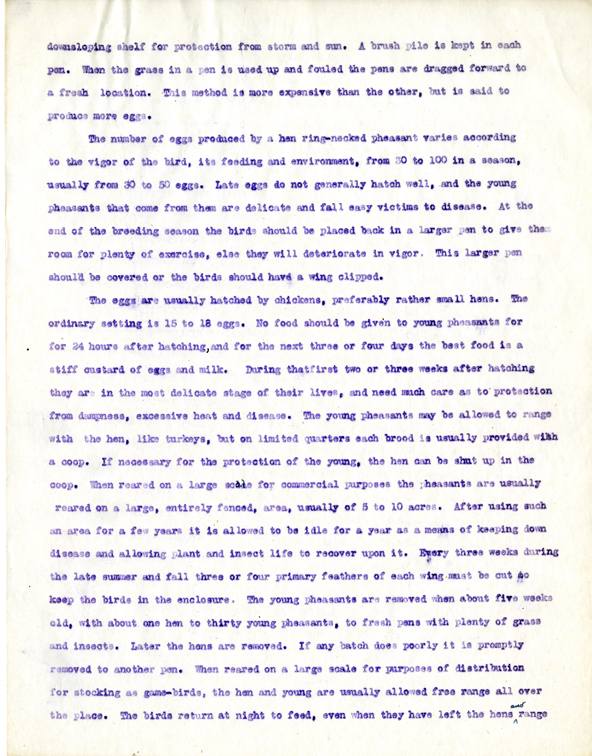
downsloping shelf for protection from storm and sun. A brush pile is kept in each pen. When the grass in a pen is used up and fouled the pens are dragged forward to a fresh location. This method is more expensive than the other, but is said to produce more eggs. The number of eggs produced by a hen ring-necked pheasant varies according to the vigor of the bird, its feeding and environment, from 30 to 100 in a season, usually from 30 to 50 eggs. Late eggs do not generally hatch well, and the young pheasants that come from them are delicate and fall easy victims to disease. At the end of the breeding season the birds should be placed back in a larger pen to give them room for plenty of exercise, else they will deteriorate in vigor. This larger pen should be covered or the birds should have a wing clipped. The eggs are usually hatched by chickens, preferably rather small hens. The ordinary setting is 15 to 18 eggs. No food shold be given to young pheasants for for 24 hours after hatching, and for the next three or four days the best food is a stiff custard of eggs and milk. During that first two or three weeks after hatching they are in the most delicate stage of their lives, and need much care as to protection from dampness, excessive heat and disease. The young pheasants may be allowed to range with the hen, like turkeys, but on limited quarters each brood is usually provided with a coop. If necessary for the protection of the young, the hen can be shut up in the coop. When reared on a large scale for commercial purposes the pheasants are usually reared on a large, entirely fenced, area, usually of 5 to 10 acres. After using such an area for a few years it is allowed to be idle for a year as a means of keeping down disease and allowing plant and insect life to recover upon it. Every three weeks during the late summer and fall three or four primary feathers of each wing must be cut to keep the birds in the enclosure. The young pheasants are removed when about five weeks old, with about one hen to thirty young pheasants, to fresh pens with plenty of grass and insects. Later the hens are removed. If any batch does poorly it is promptly removed to another pen. When reared on a large scale for purposes of distribution for stocking as game-birds, the hen and young are usually allowed free range all over the place. The birds return at night to feed, even when they have left the hens and range
-
date
-
1919
-
source/RG#/MS#
-
MS 0371
-
isPartOf/Collection
-
Nebraska Ornithologists' Union (NOU), Records
-
rights
-
For copyright information, please contact the repository.
-
publisher
-
Archives & Special Collections, University of Nebraska-Lincoln Libraries
-
language
-
English

 371-00060.jpg