-
identifier/filename
-
371-00059
-
title
-
Article, Myron H. Swenk, 1919
-
description
-
Typewritten enclosed article, 11 pages, titled "The Economic Value of the Ring-Necked Pheasant."
-
transcription
-
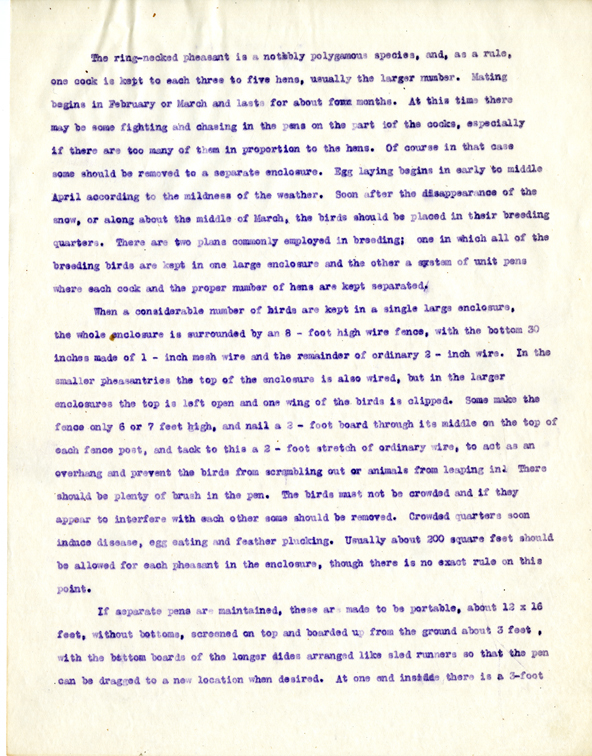
The ring-necked pheasant is a notably polygamous species, and, as a rule, one cock is kept to each three to five hens, usually the larger number. Mating begins in February or March and lasts for about four months. At this time there may be some fighting and chasing in the pens on the part of the cocks, especially if there are too many of them in proportion to the hens. Of course in that case some should be removed to a separate enclosure. Egg laying begins in early to middle April according to the mildness of the weather. Soon after the disappearance of the snow, or along about the middle of March, the birds should be placed in their breeding quarters. There are two plans commonly employed in breeding: one in which all of the breeding birds are kept in one large enclosure and the other a system or unit pens where each cock and the proper number of hens are kept separated. When a considerable number of birds are kept in a single large enclosure, the whole enclosure is surrounded by an 8 - foot high wire fence, with the bottom 30 inches made of 1 - inch mesh wire and the remainder of ordinary 2 - inch wire. In the smaller pheasantries the top of the enclosure is also wired, but in the larger enclosures the top is left open and one wing of the birds is clipped. Some make the fence only 6 or 7 feet high, and nail a 2 - foot board through its middle on the top of each fence post, and tack to this a 2 - feet stretch of ordinary wire, to act as an overhang and prevent the birds from scrambling out or animals from leaping in. There should be plenty of brush in the pen. The birds must not be crowded and if they appear to interfere with each other some should be removed. Crowded quarters soon induce disease, egg eating and feather plucking. Usually about 200 square feet should be allowed for each pheasant in the enclosure, though there is no exact rule on this point. If separate pens are maintained, these are made to be portable, about 12 x 16 feet, without bottoms, screened on top and boarded up from the ground about 3 feet, with the bottom boards of the longer sides arranged like sled runners so that the pen can be dragged to a new location when desired. At one end inside there is a 3-foot
-
date
-
1919
-
source/RG#/MS#
-
MS 0371
-
isPartOf/Collection
-
Nebraska Ornithologists' Union (NOU), Records
-
rights
-
For copyright information, please contact the repository.
-
publisher
-
Archives & Special Collections, University of Nebraska-Lincoln Libraries
-
language
-
English

 371-00059.jpg