-
identifier/filename
-
371-00058
-
title
-
Article, Myron H. Swenk, 1919
-
description
-
Typewritten enclosed article, 11 pages, titled "The Economic Value of the Ring-Necked Pheasant."
-
transcription
-
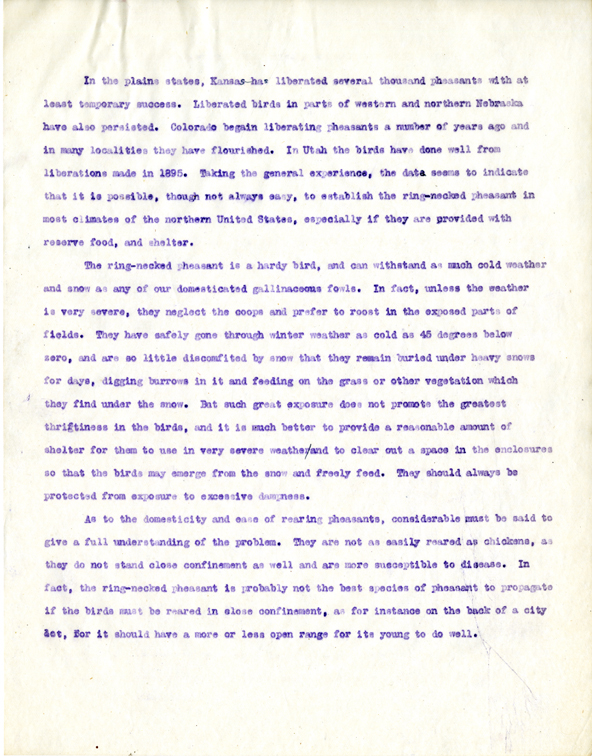
In the plains states, Kansas has liberated several thousand pheasants with at least temporary success. Liberated birds in parts of western and northern Nebraska have also persisted. Colorado begain liberating pheasants a number of years ago and in many localities they have flourished. In Utah the birds have done well from liberations made in 1895. Taking the general experience, the data seems to indicate that it is possible, though not always easy, to establish the ring-necked pheasant in most climates of the northern United States, especially if they are provided with reserve food, and shelter. The ring-necked pheasant is a hardy bird, and can withstand as much cold weather and snow as any of our domesticated gallinaceous fowls. In fact, unless the weather is very severe, they neglect the coops and prefer to roost in the exposed parts of fields. They have safely gone through winter weather as cold as 45 degrees below zero, and are so little discomfited by snow that they remain buried under heavy snows for days, digging burrows in it and feeding on the grass or other vegetation which they find under the snow. But such great exposure does not promote the greatest thriftiness in the birds, and it is much better to provide a reasonable amount of shelter for them to use in very severe weather and to clear out a space in teh enclosures so that the birds may emerge from the snow and freely feed. They should always be protected from exposure to excessive dampness. As to the domesticity and ease of rearing pheasants, considerable must be said to give a full understanding of the problem. They are not as easily reared as chickens, as they do not stand close confinement as well and are more susceptible to diseases. In fact, the ring-necked pheasant is probably not the best species of pheasant to propagate if the birds must be reared in close confinement, as for instance on the back of a city lot, for it should have a more or less open rage for its young to do well.
-
date
-
1919
-
source/RG#/MS#
-
MS 0371
-
isPartOf/Collection
-
Nebraska Ornithologists' Union (NOU), Records
-
rights
-
For copyright information, please contact the repository.
-
publisher
-
Archives & Special Collections, University of Nebraska-Lincoln Libraries
-
language
-
English

 371-00058.jpg