-
identifier/filename
-
371-00057
-
title
-
Article, Myron H. Swenk, 1919
-
description
-
Typewritten enclosed article, 11 pages, titled "The Economic Value of the Ring-Necked Pheasant."
-
transcription
-
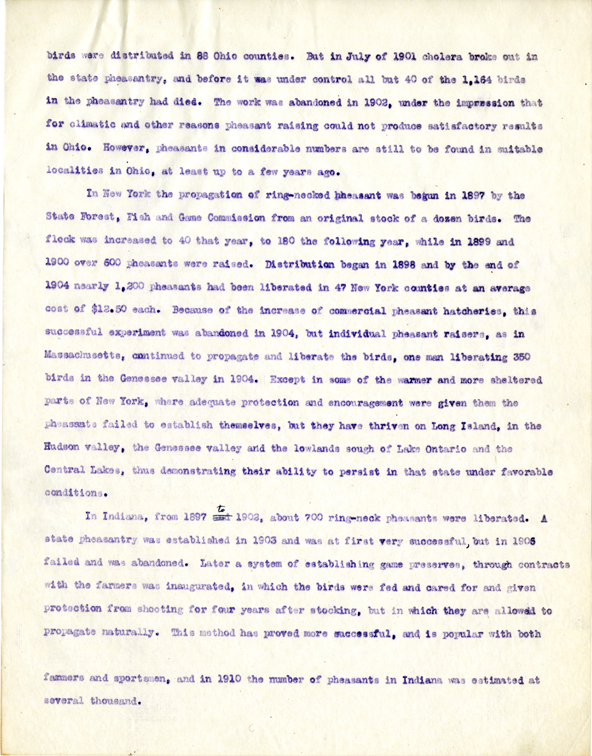
birds were distributed in 88 Ohio counties. But in July of 1901 cholera broke out in the state pheasantry, and before it was under control all but 40 of the 1,184 birds in the pheasantry had died. The work was abandoned in 1902, under the impression that for climatic and other reasons pheasant raising could not produce satisfactory results in Ohio. However, pheasants in considerable numbers are still to be found in suitable localities in Ohio, at least up to a few years ago. In New York the propagation of ring-necked pheasant was begun in 1897 by the State Forest, Fish and Game Commission from an original stock of a dozen birds. The flock was increased to 40 that year, to 180 the following year, while in 1899 and 1900 over 600 pheasants were raised. Distribution began in 1898 and by the end of 1904 nearly 1,200 pheasants had been liberated in 47 New York counties at an average cost of $12.50 each. Because of the increase of commercial pheasant hatcheries, this successful experiment was abandoned in 1904, but individual pheasant raisers, as in Massachusetts, continued to propagate and liberate the birds, one man liberating 350 birds in the Genessee valley in 1904. Except in some of the warmer and more sheltered parts of New York, where adequate protection and encouragement were given them the pheasants failed to establish themselves, but they have thriven on Long Island, in the Hudson valley, the Genessee valley and the lowlands sough of Lake Ontario and the Central Lakes, thus demonstrating their ability to persist in that state under favorable conditions. In Indiana, from 1897 to 1902, about 700 ring-neck pheasants were liberated. A state pheasantry was established in 1903 and was at first very successful, but in 1905 failed and was abandoned. Later a system of establishing game preserves, through contracts with the farmers was inaugurated, in which the birds were fed and cared for and given protection from shooting for four years after stocking, but in which they are allowed to propagate naturally. This method has proved more successful, and is popular with both farmers and sportsmen, and in 1910 the number of pheasants in Indiana was estimated at several thousand.
-
date
-
1919
-
source/RG#/MS#
-
MS 0371
-
isPartOf/Collection
-
Nebraska Ornithologists' Union (NOU), Records
-
rights
-
For copyright information, please contact the repository.
-
publisher
-
Archives & Special Collections, University of Nebraska-Lincoln Libraries
-
language
-
English

 371-00057.jpg