-
identifier/filename
-
371-00056
-
title
-
Article, Myron H. Swenk, 1919
-
description
-
Typewritten enclosed article, 11 pages, titled "The Economic Value of the Ring-Necked Pheasant."
-
transcription
-
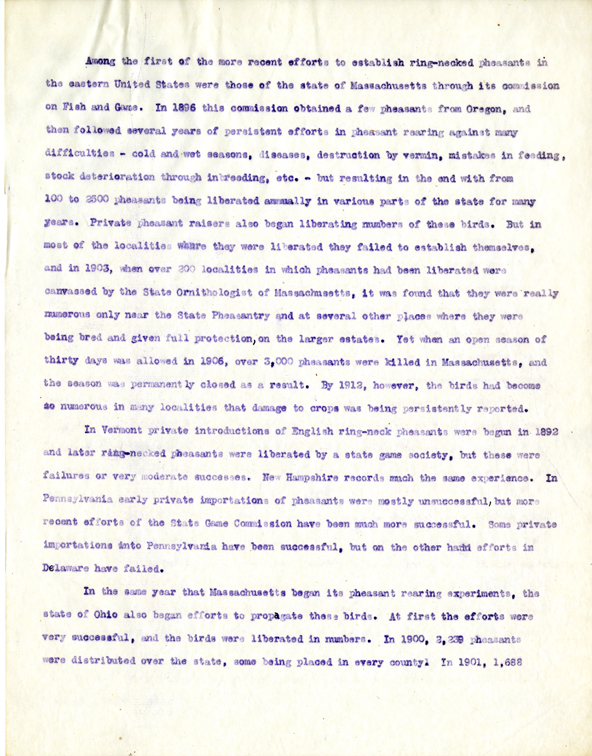
Among the first of the more recent efforts to establish ring-necked pheasants in the eastern United States were those of the state of Massachusetts through its commission on Fish and Game. In 1896 this commission obtained a few pheasants from Oregon, and then followed several years of persistent efforts in pheasant rearing against many difficulties - cold and wet seasons, diseases, destruction by vermin, mistakes in feeding, stock deterioration through inbreeding, etc. - but resulting in the end with from 100 to 3500 pheasants being liberated annually in various parts of the state for many years. Private pheasant raisers also began liberating numbers of these birds. But in most of the localities where they were liberated they failed to establish themselves, and in 1903, when over 200 localities in which pheasants had been liberated were canvassed by the State Ornithologist of Massachusetts, it was found that they were really numerous only near the State Pheasantry and at several other places where they were being bred and given full protection, on the larger estates. Yet when an open season of thirty days was allowed in 1906, over 3,000 pheasants were killed in Massachusetts, and the season was permanently closed as a result. By 1912, however, the birds had become so numerous in many localities that damage to crops was being persistently reported. In Vermont private introductions of English ring-neck pheasants were begun in 1892 and later ring-necked pheasants were liberated by a state game society, but these were failures or very moderate successes. New Hampshire records much the same experience. In Pennsylvania early private importations of pheasants were mostly unsuccessful, but more recent efforts of the State Game Commission have been much more successful. Some private importations into Pennsylvania have been successful, but on the other hand efforts in Delaware have failed. In the same year that Massachusetts began its pheasant rearing experiments, the state of Ohio also began efforts to propagate these birds. At first the efforts were very successful, and the birds were liberated in numbers. In 1900, 2, 239 pheasants were distributed over the state, some being placed in every county. In 1901, 1,688
-
date
-
1919
-
source/RG#/MS#
-
MS 0371
-
isPartOf/Collection
-
Nebraska Ornithologists' Union (NOU), Records
-
rights
-
For copyright information, please contact the repository.
-
publisher
-
Archives & Special Collections, University of Nebraska-Lincoln Libraries
-
language
-
English

 371-00056.jpg