-
identifier/filename
-
371-00055
-
title
-
Article, Myron H. Swenk, 1919
-
description
-
Typewritten enclosed article, 11 pages, titled "The Economic Value of the Ring-Necked Pheasant."
-
transcription
-
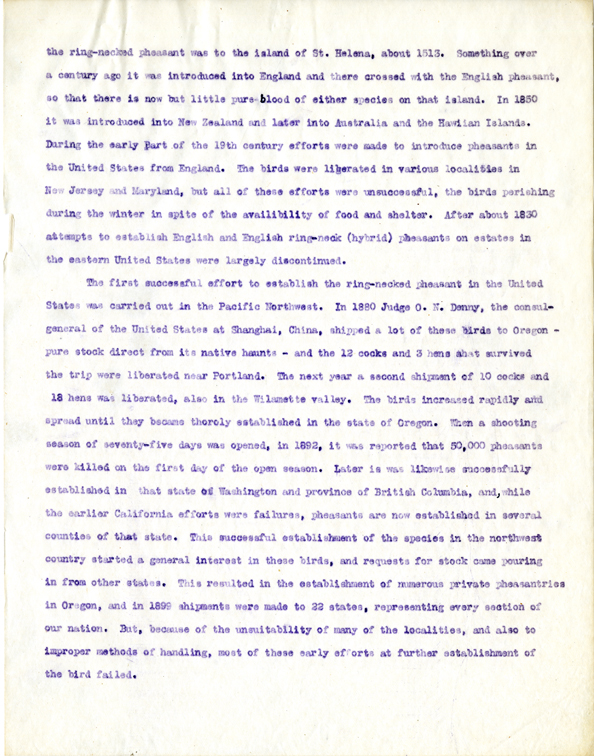
the ring-necked pheasant was to the island of St. Helena, about 1513. Something over a century ago it was introduced into England and there crossed with the English pheasant so that there is now but little pure blood of either species on that island. In 1930 it was introduced into New Zealand and later into Australia and the Hawiian Islands. During the early part of the 19th century efforts were made to introduce pheasants in the United States from England. The birds were liberated in various localities in New Jersey and Maryland, but all of these efforts were unsuccessful, the birds perishing during the winter in spite of the availability of food and shelter. After about 1830 attempts to establish English and English ring-neck (hybrid) pheasants on estates in the eastern United States were largely discontinued. The first successful effort to establish the ring-necked pheasant in the United States was carried out in the Pacific Northwest. In 1880 Judge O. N. Denny, the consul-general of the United States at Shanghai, China, shipped a lot of these birds to Oregon - pure stock direct from its native haunts - and the 12 cocks and 3 hens ahat survived the trip were liberated near Portland. The next year a second shipment of 10 cocks and 18 hens was liberated, also in the Wilamette valley. The birds increased rapidly and spread until they became thoroly established in the state of Oregon. When a shooting season of seventy-five days was opened, in 1892, it was reported that 50,000 pheasants were killed on the first day of the open season. Later is was likewise successfully established in that state of Washington and province of British Columbia, and, while the earlier California efforts were failures, pheasants are now established in several counties of that state. This successful establishment of the species in the northwest country started a general interest in these birds, and requests for stock came pouring in from other states. This resulted in the establishment of numerous private pheasantries in Oregon, and in 1899 shipments were made to 22 states, representing every section of our nation. But, because of the unsuitability of many of the localities, and also to improper methods of handling, most of these early efforts at further establishment of the bird failed.
-
date
-
1919
-
source/RG#/MS#
-
MS 0371
-
isPartOf/Collection
-
Nebraska Ornithologists' Union (NOU), Records
-
rights
-
For copyright information, please contact the repository.
-
publisher
-
Archives & Special Collections, University of Nebraska-Lincoln Libraries
-
language
-
English

 371-00055.jpg