-
identifier/filename
-
371-00051
-
title
-
Letter, Myron H. Swenk to C. W. Pugsley, 1918, Oct. 1
-
description
-
Typewritten letter, 3 pages, from Myron H. Swenk to C.W. Pugsley, "I am in receipt of your letter of September…"
-
transcription
-
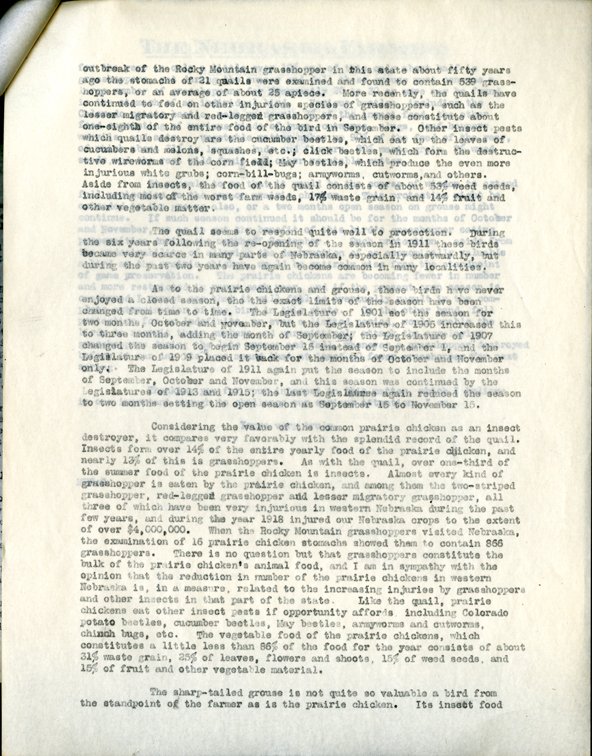
outbreak of the Rocky Mountain grasshopper in this state about fifty years ago the stomachs of 21 quails were examined and found to contain 539 grasshoppers, or an average of about 25 apiece. More recently, the quails here continued to feed on other injurious species of grasshoppers, such as the lesser migratory and red-legged grasshoppers, and these constitute about one-eighth of the entire food of the bird in September. Other insect pests which quails destroy are the cucumber beetles, which eat up the leaves of cucumbers and melons, squashes, etc.; click beetles, which form the destructive wireworms of the corn field; May beetles, which produce the even more injurious white grubs,; corn-bill-bugs; armyworms, cutworms, and others. Aside from insects, the food of the quail consists of about 53% weed seeds, including most of the worst farm weeds, 17% waste grain adn 14% fruit and other vegetable matter. The quail seems to respond quite well to protection. During the six years following the re-opening of the season in 1911 these birds became very scarce in many parts of Nebraska, especially eastwardly, but during the past two years have again become common in many localities. As to the prairie chickens and grouse, these birds have never enjoyed a closed season, tho the exact limits of the season have been changed from time to time. The Legislagture of 1901 set the season for two months, October and November, but the Legislature of 1905 increased this to three months, adding the month of September; the Legislature of 1907 changed the season to begin September 15 instead of September 1, and the Legislature of 1909 placed it back for the months of October and November only. The Legislature of 1911 again put the season to include the months of September, October and November, and this season was continued by the Legislatures of 1913 and 1915; the last Legislature again reduced the season to two months setting the open season as September 15 to November 15. Considering the value of the common prairie chicken as an insect destroyer, it compares very favorably with the splendid record of the quail. Insects form over 14% of the entire yearly food of the prairie chicken, and nearly 13% of this is grasshoppers. As with the quail, over one-third of the summer food of the prairie chicken is insects. Almost every kind of grasshopper is eaten by the prairie chicken, and among them the two-striped grasshopper, red-legged grasshopper and lesser migratory grasshopper, all three of which have been very injurious in western Nebraska during the past few years, and during the year 1918 injured our Nebraska crops to the extent of over $4,000,000. When the Rocky Mountain grasshoppers visited Nebraska, the examination of 16 prairie chicken stomachs showed them to contain 856 grasshoppers. There is no question but that grasshoppers constitute the bulk of the prairie chicken's animal food, and I am in sympathy with the opinion that the reduction in number of the prairie chickens in western Nebraska is, in a measure, related to the increasing injuries by grasshoppers and other insects in that part of the state. Like the quail, prairie chickens eat other insect pests if opportunity affords including Colorado potato beetles, cucumber beetles, May beetles, armyworms and cutworms, chinch bugs, etc. The vegetable food of the prairie chickens, which constitutes a little less than 86% of the food for the year consists of about 31% waste grain, 25% of leaves, flowers and shoots, 15% of weed seeds, and 15% of fruit and other vegetable material. The sharp-tailed grouse is not quite so valuable a bird from the standpoint of the farmer as is the prairie chicken. Its insect food
-
date
-
10/1/1918
-
source/RG#/MS#
-
MS 0371
-
isPartOf/Collection
-
Nebraska Ornithologists' Union (NOU), Records
-
rights
-
For copyright information, please contact the repository.
-
publisher
-
Archives & Special Collections, University of Nebraska-Lincoln Libraries
-
language
-
English

 371-00051.jpg