
Frank H. Shoemaker, "Omaha Bird Records"
Frank H. Shoemaker "Omaha Bird Records," Feb-May, 1903
Feb. 1903
Lincoln, Nebraska
Elizabeth and I attended the annual meeting of the Nebraska Ornithologists’ Union at Lincoln. The Omaha attendance was very fair, for which we are glad, as it is really Omaha’s year to have the meeting, and it was virtually offered to us, but a careful survey of the local situation convinced the few active workers here (Omaha) that a more successful session could be held at Lincoln, and we voted accordingly.
The sessions were very interesting and we disposed of considerable business. We are in good financial condition, and at the close of this session number almost two hundred members, of which about 40% are active. We spent some time in discussion of the attitude of our society towards the Audubon Society, and laid out a plan which I believe will put us on a harmonious basis. I was elected president for the ensuing year, an honor which I surely appreciate.
At the public sessions the papers were interesting and varied. I regretted the absence of Carriker, who was to have given a talk on the observations of himself and others in Costa Rica.
Elizabeth was entertained by Prof. Bruner’s family, while I went with my good friend Wolcott, who impresses and enthuses me more every time I meet him.
We went hurriedly over a few cases of Prof. Bruner’s wonderful collection of Orthoptera, which were a revelation to us.
I was given a beautiful pendant nest of a Costa Rican oriole (Eucorystes wagleri Gray) — a mass of Villandsia four feet in length, taken from a tree in which there were
about two dozen nests.
We returned to Omaha Sunday afternoon.
Conditions in the bird-room are good; all the birds healthy and happy, and nothing striking to record. Of course things are never just the same; I can spend fifteen minutes in the room any day and see things worthy of note.
The rose-breasted grosbeaks now have the full spring plummage – bright rose breasts, black heads, and the white much purer and better defined than in the winter.
Linus, the 13-stripped spermophile is active and healthy. He runs swiftly about the room time and time again, just for the pleasure of the activity. We frequently let him out and he runs all over the rooms, exploring every new thing. He is full of curiousity, and has an odd, faltering way of edging up to a new object of interest, apparently half afraid to advance, yet impelled by that great curiousity. He has lost some weight, but has plenty left.
The chipmunk is active, but still with much of his winter reserve, remaining in his box most of the time, though he emerges almost every day.
Pixie, the bat, seems to be having trouble with his eyes. The right is very weak and watery, and at times we have feared that he would lose his sight. The left is also affected, but not so seriously. He seems otherwise as well an active as ever, and eats freely. Now and then he essays a flights of a few inches, but the winter inertia is still on, and he can not support his weight in the air.
March 5
Despite the fact that Scamper, the chipmunk, has seems so well, we found the little fellow dead in his nest of cotton this morning. There was nothing to indicate what was the trouble; he was peacefully curled up as though asleep. We are sorry to lose him, yet we have always felt that of all our pets he was the least contented. He was mature when
captured, and we never could get the wildness out of him. He had a great store of husked seeds, each “face-ful” impacted in a little mass by his saliva, hidden under the cotton. In lieu of an epitaph, I produce the note recording his arrival in our family:
April 14, 1901.—Several days ago (the date has escaped; it was about April 10) we heard of a chipmunk in the possession of a boy in the neighborhood, and Elizabeth at once negotiated for its possession; this she accomplished for 75 cents. When the chipmunk was brought to us we found to our surprise and delight that it [sic] of a western, mountain species, and inquiries disclosed that it had been brought by a traveling man from Colorado, who had been forced to dispose of it because he could not care fir it in his many hotels. Since then it had passed through numerous hands; we are the fifth Omaha “owners.” It is a beautiful little creature, little larger than a white-footed mouse.
March 8
Yesterday and today have been ideal spring days, warm and bright. Had the ground been dry I would have undertaken a trip of some kind, but it was very wet and the walking bad. I therefore contented myself at home, with the exception that I made two trips to the wooded lot in search of tiger beetles, which I had hoped to see on their earliest emergence from their tunnels. They were very much in evidence today, skipping about the perpendicular face of the loess bank and peaking over clods like old times. I captured nine with my net.
I spent a half hour in one spot, as nearly motionless as possible, watching three holes, not over nine inches apart, each with a beetle willing and anxious to emerge, but not daring to do so with that large, strange object in their front year. My face was less than two feet from the holes, and many times
they half emerged, but would come no farther. I remained perfectly quiet, but they were very suspicious, and without any movement on my part they would back away from the entrances and disappear. A minutes later I could see their white mandibles in the recess, and the antennae feeling cautiously of the side of the tunnel, but after reaching the entrance they invariably stopped. I removed to a distance of six feet, but they would not come out. The breeze occasionally loosed particles of black earth which overlies the loess, and when these passed their front doors they retreated precipitately, only to come again to the entrances in a moment. A black and white wasp, a honey bee, box-elder bugs, and various flies were active. I also saw or heard robins, bluejays, chickadees, crows, and a downy woodpecker. The robins have been about for some time, the first record for this year, so far as I know, having been on February 26th, when Alice Burnett saw one.
March 19
Bluebirds and robins plentiful. The weather has been in the main quite mild, but a snow-storm or two, which melted rapidly, made things interesting for the earliest arrivals.
Mr. Van Sant has been getting acquainted with Linus, of late, and the little fellow shows a confidence in him which is lacking toward Elizabeth and myself. Almost every day Linus has been given the run of the dining room and the front room, an privilege which he has grown to enjoy and to expect, and now it is not uncommon for him to sneak out of the room when the screen door is opened by some one entering with food for the birds. He has adopted a particular nook in the typewriter desk as his own, and when our attentions become objectionable he retires to this haven. It is accessible by removing the bottom drawer, and he will allow Mr. Van Sant to reach in and rub the sides of his jaws, an atten—
tion which he seems to thoroughly enjoy. He will even come to Mr. Van Sant’s hand and crowd under it. It is surprising how he has responded to a little effort toward making his acquaintance; we have heretofore regarded Linus as rather a morose little dub. However, so far as Elizabeth and myself are concerned, we have made no effort at any time to “tame” our various birds and animals, preferring to enjoy such confidence as was offered us, without making any special bid for it.
It is interesting to contrast this winter, when Linus was not given a box of earth and remained active all winter, with last year, when he was given such a box, promptly burrowed into it, and spent 155 days asleep! — or at least not receiving company. We know positively that last year during the period names he had not one drop of water; this winter he has been frequently drinking from the pan of water which is kept in the bird-room.
March 22
Snow again; but is is rapidly disappearing.
March 25
Flickers and mourning doves are here.
March 27
First purple martins; and in the evening we hear the first frogs of the season.
March 29
A beautiful Sunday, and one with lots of natural history. My first effort in the direction was the capture of nine tiger beetles; they are common on the south loess bank.
Next on the list was a series of observations on a pair of skunks — fancy that! — which have made our cow-shed and apparently our whole premises their home, quite unknown to use. Clark was moving some bales of hay in the shed when he saw one of them, and called me. The skunk had run under a board which supported a pile of bales in the corner of
the shed, and when Clark removed these and lifted the board the skunk ran out and along the little surface drain to a hole in the ground thirty feet away. Clark shouted to me to head him off; but I declined to be a party to any such experience as heading off a skunk.
I went back to the house, and in a little while Clark announced that he had found another skunk. This one had run into the drain-pipe leading from the shed, and Clark had stopped the exit with bricks. The skunk stayed at the upper end of the drain, and we could see two shining eyes surveying us from the darkness. Clark removed the bricks and poured in a pail of water, and the skunk, instead of retreating, bolted past Clark and across the yard for the house, and took refuge under the back porch, in the enclosure where we store the garden tools. It then developed that they had made a hole near the foundation, which was unquestionably their home!
The skunk did not get into this hole, and when disturbed ran along the side of the house to the front porch, under which he went; we watched him through the lattice-work for some time as he moved about. He was very deliberate, and did not seem afraid of us, nor did he at any time seem inclined to avail himself of his infinite resources, for which we are and should be grateful. We had no wish to kill the creatures, though we could probably have got both of them. Possibly we may later have cause to regret this forbearance.
At two o’clock I went to Trostler’s home, and together we went to the fields not far away to hunt for a nest of the prairie horned lark, of which we are anxious to get photographs. We started to explore the first likely field which we entered, a patch of ground used for oats last year. We had not taken a dozen steps when we hear a lark, and soon saw it on the ground a hundred feet away. We squatted
on our heels and watched its movements, and presently it began to pick up grasses. It came toward us, gathering more and more material, until finally it was within thirty feet of us, apparently not caring at all for our presence; then it stopped, put down its load, and flew away, after a moment of arrangement. We went forward and found the nest, almost completed. We paid ourselves and each other many impressive compliments, all bearing upon how good we were. We were careful not to remain long at the nest. Of course we had our cameras with us, but had no occasion to use them today.
From there we followed the Belt Line to The Tangle which was literally alive with robins, juncoes, Harris sparrows, tree sparrows, bluebirds; there were also present a Carolina nuthatch and a downy woodpecker. Following the strip of woods to the County Farm, we amused ourselves gathering galls from a small oak stump surrounded with sprouts, and examining them. Most of them were empty; some had one large maggot-like occupant; others had a dozen small maggots.
One of the striking events of the day was in the woods south of Poppleton, where we chanced to see an albino tree sparrow, pure white except for a feather or two in the tail and a little about the head. It is almost invariable for traces of the black spot in the breast to persist in albinism of this species, but I was unable to see a suspicion of it in this bird. The white was pure; there was no gray or dirtiness about it. It was in a flock of normal birds of its species, foraging among the bushes.
Trostler ventured an experiment which he says is a favorite with him. Finding a resonant place on an oak — a dead, dry surface — he tapped upon it vigorously with the end of small pocket knife. After a few repetitions of this a downy woodpecker came charging through the tree-tops looking for
trouble. He alighted in the top of the tree, and as the tapping continued came half-way down, looking for the rival drummer. After a little he gave it up as an obvious afraid, and busied himself foraging. It was very interesting to me. There was not a sign of a downy in the neighborhood when the tapping began, though later we found a tree at no great distance where there was evidence of the work of this species.
At the dinner table tonight, Mr. Van Sant, looking as solemn as an owl, made a suggestion. Here we had been, he said, for over two years in this house without giving it a name. It ill became, he said, a house with thirteen rooms, with slate roof and plate-glass windows — he enumerated other virtues — to go without a name. And the name, in keeping with our biological leanings, should have a touch of the wilderness about it. So now, as its placement and quality had attracted a beautiful wild creature to edge in on possession, why not recognize the fact by name the place accordingly? He proposed “Skunk Ridge” as a name quite out of the ordinary, and in obvious keeping with facts.
And Elizabeth said no word.
Blithely I acquiesced, emphasizing the beauty and grace of the little creature, his noble dependence upon himself along for his needs, and citing South Carolina’s state seal — a rattlesnake with the motto, “Don’t tread on me!” And a skunk is as untreadable as a rattlesnake, and far more handsome. There was the printing-office down stairs, I would fix up some real snappy stationary.
And Elizabeth said no word. But she had a bearing which shouted “Try an’ do it!” Something about the idea evidently did not please her, so we let the subject drop.
March 30
Chipping sparrow. Wallace says that towhees and phoebes have been here for two weeks.
April 1
The birds in the house are singing quite freely now, though none of them have got tuned up to the limit of their voices. Our female cardinal grosbeak, has a very pretty minor song, wonderfully rich and varied. She is still the one firm friend of the Japanese robin. An interesting development of the past month is the friendship between the Jap and the chickadee, the latter actually condescending to preen the former, but making such rough work of it that, much as the Jap likes attentions of this kind, she can not stand it for many minutes.
Linus is very friendly.
Pixie has apparently recovered from the trouble with his eyes, though they still seem a little weak and watery. He ventures no flight as yet, aside from a few jerky flutters. His staple food all winter, without exception, has been beef, pulped by scraping a knife-edge, and it has seems to agree with him perfectly. He does not tire of it, and he retains a fine digestion.
April 3
Found and brought home three cocoons of the cecropia moth.
April 4
Trostler telephoned that the nest of the prairie horned lark contained four eggs yesterday.
April 5
A slaty sky, a persistent south breeze.
Trostler and I went to the nest at 2 p.m. There were four eggs, and the old birds were poking around near by. The temperature was mild enough that the eggs would not chill, so we took more time than otherwise we would have dared in getting photographs of the bird on or near the nest. We then took photographs of the nest and eggs in detail. My photos of
the bird were not successful, only one being passable and that with some movement. The poor light made too long an exposure necessary.
A disagreeable feature of the occasion was the attention bestowed upon us by seven or eight small boys, ranging from 7 to 12 years of age. Unavoidably they found out what we were doing, and though they all promised to leave the eggs, so that we might photograph the young, I think the chances are very slim. Another bad feature of the case is that fact that plowing commenced on adjacent fields, and it is not likely that this field will escape for a sufficient period to permit the raising of the young to the point of leaving the nest.
The actions of the birds were very interesting. They invariably approached the nest from the north, whether we were near or distant. When frightened the female bird flew sometimes over a hundred yards, and was absent on one occasion for a half hour, spending most of the time in sight, apparently feeding. We saw the male on one occasion only. He flew from the north and gradually approached the nest. When he reached it the lady chased him a hundred yards to the west. He betook himself over the hill whence he had come, murmuring “Wot a life!” and the lady returned. We saw the female many times at a distance of less than twenty feet. She did not mind us or our cameras much at first, but gradually became more wary. She is a beautiful bird, and even without a successful photograph of her the afternoon was profitably spent.
April 8
Took a flying trip this noon to Riverview Park. The buds are bursting and the woodland taking on just a suspicion of a green tone. Erythronium in full leaf, but no flowers yet.
April 12
Trostler and I left at 11 o’clock for Riverview, not intending to go far, but we extended our trip to
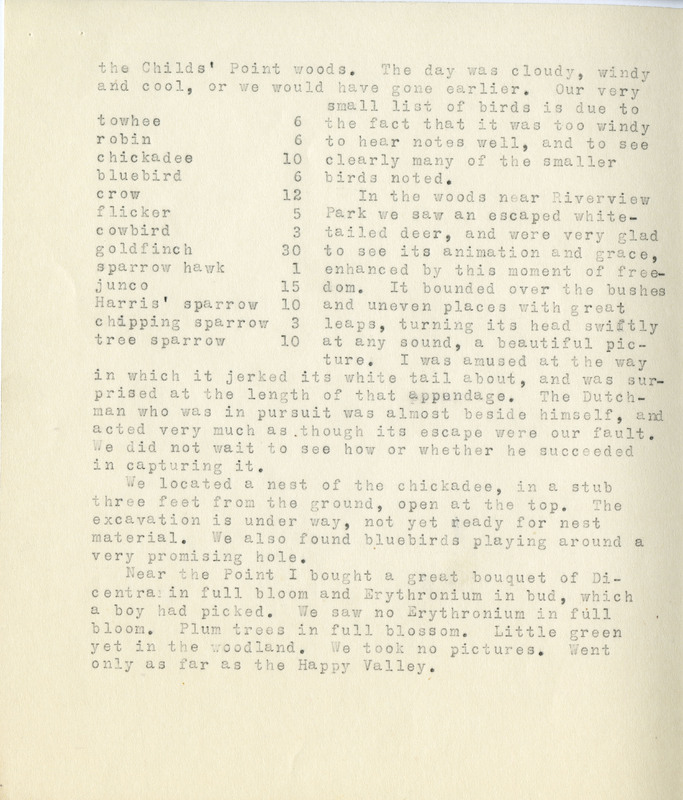
the Childs’ Point woods. The day was cloudy, windy and cool, or we would have gone earlier. Our very
towhee 6
robin 6
chickadee 10
bluebird 6
crow 12
flicker 5
cowbird 3
goldfinch 30
sparrow hawk 1
junco 15
Harris' sparrow 10
chipping sparrow 3
tree sparrow 10
small list of birds is due to the fact that it was too windy to hear notes well, and to see clearly many of the smaller birds noted. In the woods near Riverview Park we saw an escaped white-tailed deer, and were very glad to see its animation and grace, enhanced by this moment of freedom. It bounded over the bushes and uneven places with great leaps, turning its head swiftly at any sound, a beautiful picture. I was amused at the way in which it jerked its white tail about, and was surprised at the length of that appendage. The Dutchman who was in pursuit was almost beside himself, and acted very much as though its escape were our fault. We did not wait to see how or whether he succeeding in capturing it.
We located a nest of the chickadee, in a stub three feet from the ground, open at the top. The excavation is underway, not yet ready for nest materials. We also found bluebirds playing around a very promising hole.
Near the Point I brought a great a great bouquet of Dicentra in full bloom and Erythronium in bud, which a boy had picked. We saw no Erythronium in full bloom. Plum trees in full blossom. Little green yet in the woodland. We took no pictures. Went only as far as the Happy Valley.
April 14
Trostler hopped off the Farnam car tonight to tell us that he is advised by the boy “helpers" that the lark’s eggs have hatched! The nest was building on March 29, had four eggs on the 4th of April, and four young birds on the 14th. This indicates not over twelve days’ incubating period, which is shorter than we had supposed.
April 15
Elizabethand I met Trostler at 5:30 and went to the lark’s nest. He and I took several pictures of each, while Elizabeth herded the kids at the edge of the field. The wind was troublesome and the light rather weak, but we got fair pictures.
The little ones are covered with gray down; their great yellow mouths are peculiarly marked with several small spots of black. Elizabeth was delighted to see the young birds and get a close view of the mother, who remained neaer by without a sign of protest of uneasiness.
I had made a quick trip to the nest at noon to see that everything was all right, as the plowing of the field is the imminent danger.
I feel inin duty bound to express my surprise and appreciation of the attitude of the small boys in that region toward the nest. Probably twenty of them know about it, and it is a matter of amazement to me that the eggs, or some of them, were not taken. We hope for more pictures.
April 18
Took supper and spent the evening with Trostler. We had intended to take some more pictures of the young larks, but I was late and the light was poor, the evening being threatening and windy.
April 19
When Trostler and I went to the lark’s nest this morning we found that plowing had commenced, two
furrows having been thrown up around the field. As we had no idea when plowing would be resumed, we took photographs — he one and I two — and then moved the nest. Fortunately, this is Sunday, and our time is our own.
Every youngster in the neighborhood knows of the nest, and the ground is worn bare around it. Trostler surprised two sweet little idiots cramming bread down the babies’ throats yesterday with a stick, and told them several things which this did not know, and doubtless would not remember.
We moved the nest three or four feet first, and waited for the parent birds to come back to feed the young. The mother bird soon came back from a distance, going first to the hole where the nest had been, which she examined with great care, and then proceeded to the nest. She did not know what to think of the changed situation. Having
been accustomed to a nest flush with the surface, she did not know what was the matter with it, and walked several times around it, while we watched from a distance. Finally she climbed up on top and feed the young.
As soon as she left we moved the nest about eight feet. When the mother returned she went directly to the nest and fed the young without delay, and thee thereafter paid no attention to the original site of the nest. We moved the nest eight times, the distance of each removal depending upon the character of the surface, the total distance being over eighty feet. Both the female and the male fed the young and carried away the excreta, which they removed to distances varying from twenty feet to fifty yards. The nest was finally sunk flush with the surface among short dead grass, off the threatened area, and was very inconspicuous.
The birds were not at all alarmed over our presence and attentions. But here came a surprise;
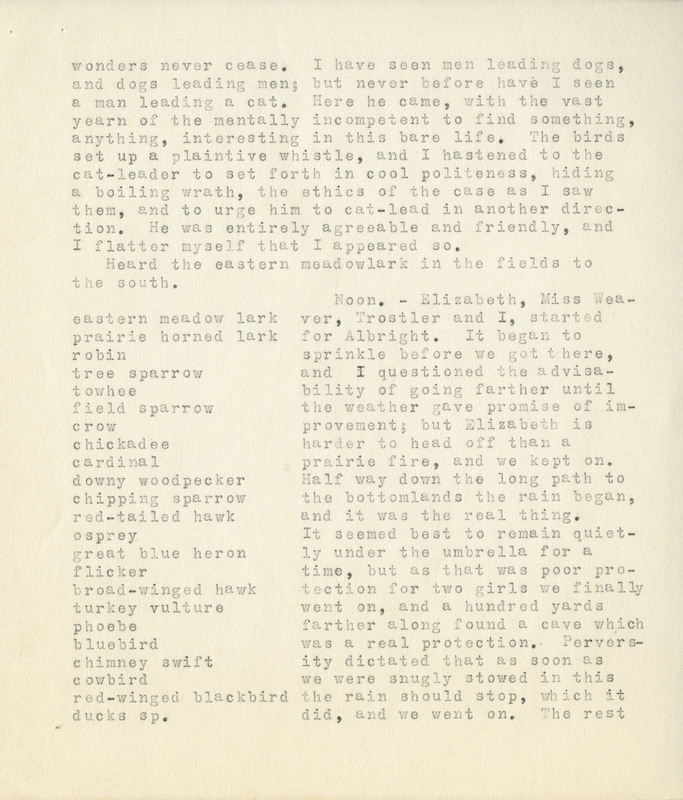
wonders never cease. I have seen men leading dogs and dogs leading men; but never before have I seen a man leading a cat. Here he came, with the vast yearn of the mentally incompetent to find something, anything, interesting in this bare life. The birds set up a plaintive whistle, and I hastened to the cat-leader to set forth in cool politeness, hiding a boil of wrath, the ethics of the case as I saw them, and to urge him to cat-lead in another direction. He was entirely agreeable and friendly, and I flatter myself that I appeared so.
Heard the eastern meadowlark in the fields to the south.
eastern meadow lark
prairie horned lark
robin
tree sparrow
towhee
field sparrow
crow
chickadee
cardinal
downy woodpecker
chipping sparrow
red-tailed hawk
osprey
great blue heron
flicker
broad-winged hawk
turkey vulture
phoebe
bluebird
chimney swift
cowbird
red-winged blackbird
ducks sp.
Noon. - Elizabeth, Miss Weaver, Trostler and I, started for Albright. It began to sprinkle before we got there, and I questioned the advisability of going farther until the weather gave promise of improvement; but Elizabeth is harder to head off than a prairie fire, and we kept on. Half way down the long paht to the bottomlands the rain began, and it was the real thing. It seemed best to remain quietly under the umbrella for a time, but as that was poor protection for two girls we finally went on, and a hundred yards farther along found a cave which was a real protection. Perversity dictated that as soon as we were snugly stowed in this the rain should stop, which it did, and we went on. The rest
of the day was cloudy and fair by turns, rather too cool, and with too much wind.
Leaves are unfolding rapidly, and many wild flowers are in bloom — Dicentra, Erythronium, blue and yellow violets, claytonia, phlox, plum, cherry, and redbud. We also found two blood-roots, which are not at all common here.
We took no pictures, but had an all-around good time, and got a lot of fresh air and exercise.
April 20
We went to the lark’s nest this evening, where a calamity awaited us. Two of the young birds have disappeared. The others are all right and have grown remarkably. Both parents were feeding the two young which remain.
April 21
The work of destruction is completed now. Trostler phoned me today that the other young larks and the nest have been taken. I must cancel all feelings of gratitude and pleasure earlier expressed, and revert to my former attitude toward the immature biped denominated by Plato “the most vicious of wild beasts.” It is sickening to think of those downy darlings starving and caressed to death. Oh damn!
April 22
First brown thrasher
April 26
Our party of four left for Childs’ Point at 11 o’clock. The weather was mild, clear, and windy.
First nest observed was that of a robin, admirably placed for photography, but so near to a house that we did not dare to direct attention to it.
We had a rather quiet day, loafing in Mill Hollow. Trostler and I went up this valley to its head. We found a nest of the chickadree, in a fence post at the side of the ravine. The excavation was evidently the work of a downy woodpecker, to the hole being about
five feet from the gound, and eight inches deep. There were six eggs, which we counted by inserting a narrow mirror and reflecting into it the sunlight by means of the metal cover of my drinking-cup. The bird was on the nest, and bit our fingers plenty when we put them into the hole.
Not over a hundred and fifty yards farther along we found a second nest, exactly similar in location, with five eggs.
Three hundred yards farther we found a third nest, four feet up, in a natural cavity of a small oak, the hole being not more than four inches deep. This nest was finished, but contained no eggs, bu the birds were about scolding us. I had never before found a nest of this species in a natural cavity. I got photographs of it later.
Three chickadees’ nests in a row, and within a linear 450 yeards, is the best Trostler or I have ever done. As usual, we were very complimentary to each other. — Tros is a good eggs; we have bully times when we go out together.
May 3
We four left Omaha at 10:30 this moring for Childs’ Point, returning at 7:30. The morning was fair, cool, and windy; afternoon warmer, wind diminished; gray sky and light cool showers after 5:00.
Robin’s nest unmolested.
Dicentra almost past blooming. Violets and Erythronium blooming in profusion. Flowers of the redbud entirely gone, apparently killed by frost. Claytonia still in bloom.
The three chickadee’s nests found April 26th are unmolested, and contain respectively six, five, and five eggs. We found the bird on the nest in each case, and had a lot of fun getting our fingers bitten. The third nest is so shallow that we could reach in and stroke the bird on thenest. In each
case we could plainly see the bird on the nest by means of two mirrors; it is a great scheme. We took photographs, detail and site, of the third nest, the one in the natural cavity.
At the second nest we had a very unusual experience. When we first passed the nest and examined it the bird shot out like a bullet. I had occasion a half hour later to pass the nest alone, and when I thrust my fingers into the entrance there arose the most uncanny sound imaginable — a peculiar hissing and thumping, very hard to describe, and not at all of a character to reassure one who did not konw the identity of the inmate. I applied the two mirrors to see how it was done, and saw the bird strike the resonant sides of the cavity with its bill, at the same time emitting a hissing sound which was prolonged for two seconds after the stroke. It did this repeatedly, perhaps fifty times while I was at the nest. When I remained quiet the sound would cease, but if I touched the bark or put my fingers in the hole the sound would begin. I can not describe the peculiar effect of the sound, but it surely was well adapted to drive away a large class of intruders.
Three quarters of an hour later our party again visited the nest, and the same program was repeated. The bird would not leave the nest. I have never before observed this peculiarity of the chickadee, nor has Trostler, though we have examined many nests.
On moist ground near a spring I found a very prett little beetle, a quarter of an inch long, apparently rather a plain blackish when viewed casually, but under a glass this resolves itself into a marvel of violet and bronze and green. The wing-covers are pitted, and these foveae under the glass are burnished craters. The legs are geen, and it is a good runner, but weak of flight. (Found this to be Elaphrus ruscarius.)
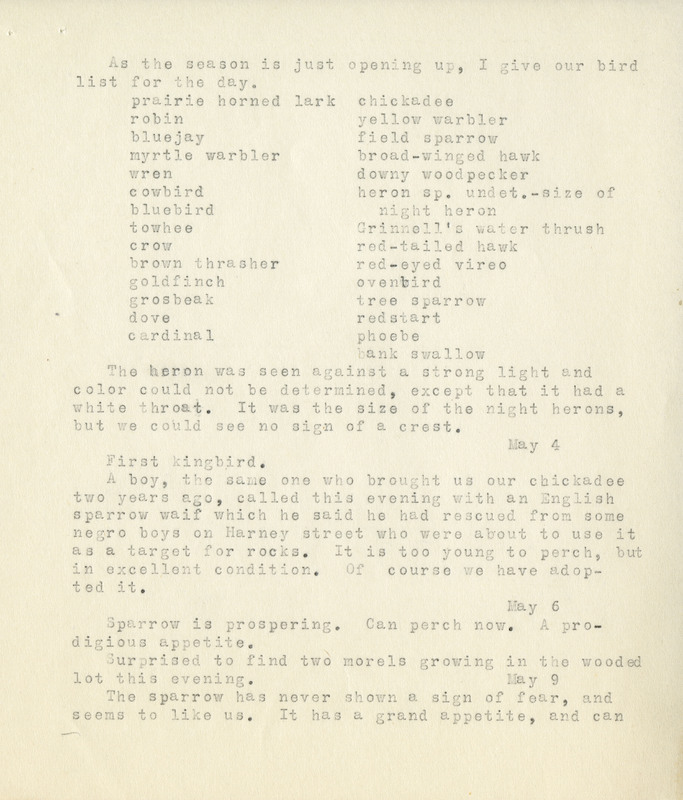
As the season is just opening up, I give our bird list for the day.
prairie horned lark chickadee
robin yellow warbler
bluejay field sparrow
myrtle warbler broad-winged hawk
wren downy woodpecker
cowbird heron sp. undet. - size of
bluebird night heron
towhee Grinnell's water thrush
crow red-tailed hawk
brown thrasher red-eyed vireo
goldfinch ovenbird
grosbeak tree sparrow
dove redstart
cardinal phoebe
bank swallow
The heron was seen against a stong light and color could not be determined, except that it had a white throat. It was the size of the night herons, be we could see no sign of a crest.
May 4
First kingbird.
A boy, the same one who brought us our chickadee two years ago, called this evening with an English sparrow waif which he said he had rescued from some negro boys on Harney street who were about to use it as a target for rocks. It is too young to perch, but in excellent condition. Of course we have adopted it.
May 6
Sparrow is prospering. Can perch now. A prodigious appetite.
Surprised to find two morels growing in the wooded lot this evening.
May 9
The sparrow has never shown a sign of fear, and seems to like us. It has a grand appetite, and can
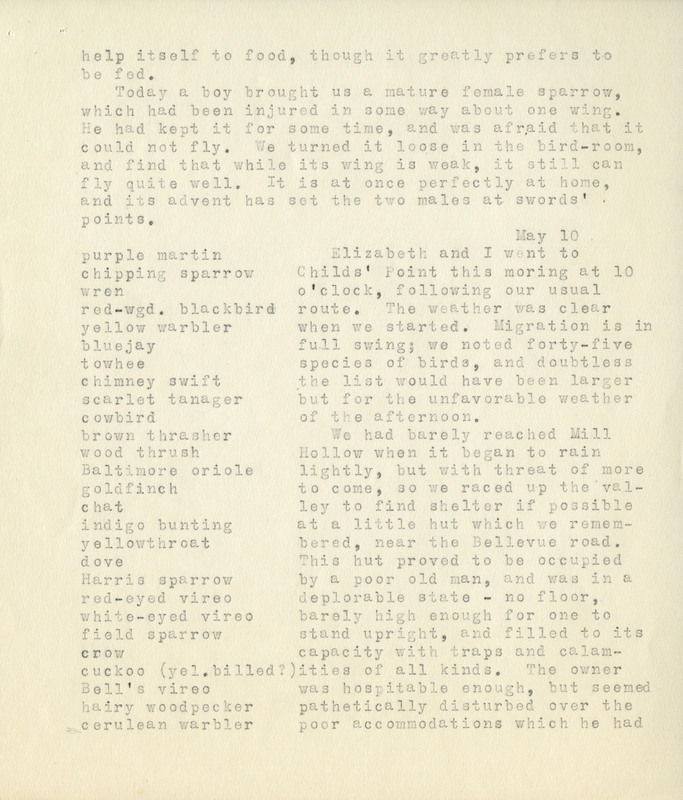
help itself to food, though it greatly prefers to be fed.
Today a boy brought us a mature female sparrow which had been injured in some way about one wing. He had kept it for sometime, and was afraid that it could not fly. We turned it loose in the bird-room, and find that while it is weak, it still can fly well. It is at once perfectly at home, and its advent has set the two males at swords’ points.
purple martin
chipping sparrow
wren
red-wgd. blackbird
yellow warbler
bluejay
towhee
chimney swift
scarlet tanager
cowbird
brown thrasher
wood thrush
Baltimore oriole
goldfinch
chat
indigo bunting
yellowthroat
dove
Harris sparrow
red-eyed vireo
white-eyed vireo
field sparrow
crow
cuckoo (yel. billed?)
Bell's vireo
hairy woodpecker
cerulean warbler
May 10
Elizabeth and I went to Childs' Point this moring [sic] at 10 o'clock, following our usual route. The weather was clear when we started. Migration is in full swing; we noted forty-five species of birds, and doubtless the list would have been larger but for the unfavorable weather of the afternoon.
We had barely reached Mill Hollow when it began to rain lightly, but with threat of more to come, so we raced up the valley to find shelter if possible at a little but which we remembered, near the Bellevue road. This hut proved to be occupied by a poor old man, and was in a deplorable state - no floor, barely high enough for one to stand upright, and filled to its capacity with traps and calamities of all kinds. The owner was hospitable enough, but seemed pathetically disturbed over the poor accommodations which he had
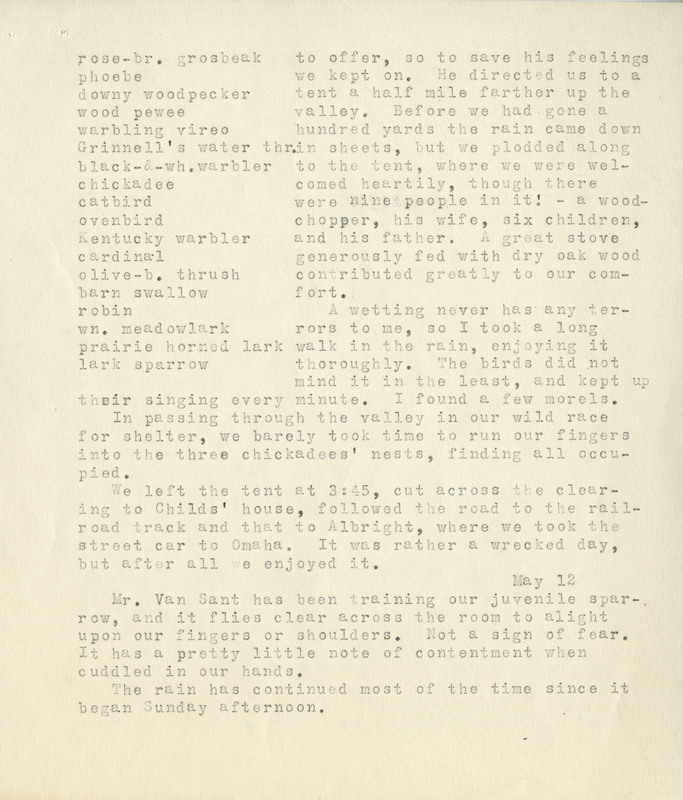
rose-br. grosbeak
phoebe
downy woodpecker
wood pewee
warbling vireo
Grinnell's water thr.
black-&-wh. warbler
chickadee
catbird
ovenbird
Kentucky warbler
cardinal
olive-b. thrush
barn swallow
robin
wn. meadowlark
prairie horned lark
lark sparrow
to offer, so to save his feelings we kept on. He directed us to a tent a half mile farther up the valley. Before we had gone a hundred yards the rain come down in sheets, but we plodded along to the tent, where we were welcomed heartily, though there were nine people in it! - a woodchopper his wife, six children, and his father. A great stove generously fed with dry oak wood contributed greatly to out comfort. A wetting never has any terrors to me, so I took a long walk in the rain, enjoying it thoroughly. The birds did not mind it in the least, and kept up their singing every minute. I found a few morels.
In passing through the valley in our wild race for shelter, we barely took time to run our fingers into the three chickadees’ nests, finding all occupied.
We left the tent at 3:45, cut across the clearing to Childs’ house, followed the road to the railroad track adn that to Albright, where we took the street car to Omaha. It was rather a wrecked day, but after all we enjoyed it.
May 12
Mr. Van Sant has been training our juvenile sparrow, and it flied clear across the room to alight upon our fingers or shoulders. Not a sign of fear. It has a pretty little note of contentment when cuddled in our hands.
The rain has continued most of the time since it began Sunday afternoon.