
Letter, Frank H. Shoemaker to I.S. [Isador] Trostler, 1904, Sept. 23
September 23, 1904
![Typewritten letter, 2 pages, from unknown (likely Frank H. Shoemaker) to I.S. [Isador] Trostler, "Your prescription joggled me out of my leathery, and though I modestly decline to take the pen and ink, I shall take the paper and go ahead anyhow."](https://archives-spec.unl.edu/files/large/d5b1b577f3ad6e4061eed32fb3adcb5768808396.jpg)
Omaha, Sept. 23, 1904.
My dear Trostler:
Your prescription joggled me out of my leathergy, and
though I modestly decline to take the pen and ink, I shall
take the paper and go ahead anyhow. The only extenuaching
circumstance I can plead for not writing you earlier in the
game is that I have been exceedingly busy, in the railroad
office days and in the printing office nights. The chart
business is lively, and our stock has run very low, so I
have been having a lively time, and there is plenty of the
same kind ahead.
I returned from San Ffrancisco August 10th, contrary to
plans, as Mr. Young was called home by the death of Mrs.
Young's sister. He has now gone West again, leaving me
here this time, most opportunely, for I can use the even-
ings this time of year to the best advantage.
Your two boxes of Cicindelidae were received in good
order, and called forth more ejaculations than those included
in your forecast. They are beauties, and I assure you are
much appreciated. My western trips have been very unsuc-
cessful from the bug standpoint, for I have found very few
tigers, though I have done a lot of close hunting for them.
I collected a nice series of oregona, at Dale Creek, Wyo.,
Salt Lake City, and near Ketchum, Idaho, and four specimens
taken by Elizabeth at Idaho Springs two years ago prove to
be of the same species. Oregona is the western representa-
tive of repanda, and the variation in altitude is interest-
ing - from 3000 to 8500 feet. Another of Elizabeth's takes,
one specimen only, proves quite a rarity - Laurentii; there
is not a specimen in the University collection. I sspent a
Sunday with Wolcott, as delightfully as usual, about a month
ago, and we put in most of the day on the Salt Basin, col-
lecting togata, fulgida, vulgaris, vulgaris var. obliquata (a
rarity for that place), circumpicta, splendida, leconteii,
repanda, punctulata, and two specimens of an undescribed
black form of fulgida; ten of the twelve kinds which have
been found there. How is that for a record? I took down
individuals of all our species and Professors Wolcott and
Bruner identified the lot, and tried to put me next to the
p'ints of distinction, in which they succeeded fairly well.
I bought a pretty good kind of a glass while there, yclept
an aplanatic triplet; though why a triplet is beyond me, un-
less they count the handle, for there are only two lenses
visible to the nude optic. It brings out the fuzz on the
![Typewritten letter, 2 pages, from unknown (likely Frank H. Shoemaker) to I.S. I.S. [Isador] Trostler, "Your prescription joggled me out of my leathery, and though I modestly decline to take the pen and ink, I shall take the paper and go ahead anyhow."](https://archives-spec.unl.edu/files/large/211f0ede3d44172dac75ac555af6d97ebbf0d30e.jpg)
[1904, Sept. 23]
calves of their legs in great shape, and one look at their
countenances, with those compound ice tongs as sharp as
needles, makes me mighty glad they are not put up in the
same bulk as certain representatives of the Pachydermata.
As you are aware, I am quite daffy on the Sighsindeedledies,
and have put an ad. in the Oologist, with a view to adding
to our collection by means of both exchange and purchase.
I am counting you in, you bet, and to that end it might not
be a bad idea for you to round up any more which come your
way, for they are good exchange for the eastern collectors.
My main reliance for exchange rests in the three species
fulgida, togata, and splendida, of which I have stored up
quite a number. Those big fellows you sent (formosa) will
make splendid exchange if you can round up some more;
though I imagine they are hard to find in any numbers, and
I know they are hard to get, for I got well acquainted with
them in Cherry County. Those slim edition de luxe chaps are
all right too - the ones with the white border racing up
where the spine ought to be; I do not recall the name, and
have mislaid my bible on the subject. I do not mean that
I have mislaid it, either; I know that it is in either the
eleventh or twelfth stratum in the pile on the north-east
corner of my table, but I have not time to get it. A
place for everything and everything in that place, is my
motto; and that place is my room. Nothin' could be more
orderly.
Well, you see I do not run to paragraphs when I get
started on tiger beetles; so for the sake of managing to
stop I must change the subject. We are getting along about
the same as usual; lots to keep us busy, and plenty of things
to fill the rest of the time with, if there is any rest,
which there isn't for the wicked, so I don't get much. Miss
Weaver has gone to Los Angeles to put in a year studying and
to benefit by the climate, which I earnestly hope will be
kind to her. We miss her very much. She is a quiet little
body, but with lots of excellent qualities; rather moody a
good deal of the time, but as jolly as a circus when she
is so inclined.
I still persist in the habit of going to bed, for I
need rest on the condensed order almost every night. I know
you differ with me on that subject, but I positively insist
on getting plenty of rest in spite of you, and I am going to
have some now. It is a fine idea that a fellow can't be al-
lowed to have - but I won't work myself up over it; my hart
won't stand it; it is week.
Best wishes from Elizabeth and Adam.
Geoponically,
Letter, Frank H. Shoemaker to Robert Wolcott, 1904, Sept. 30
September 30
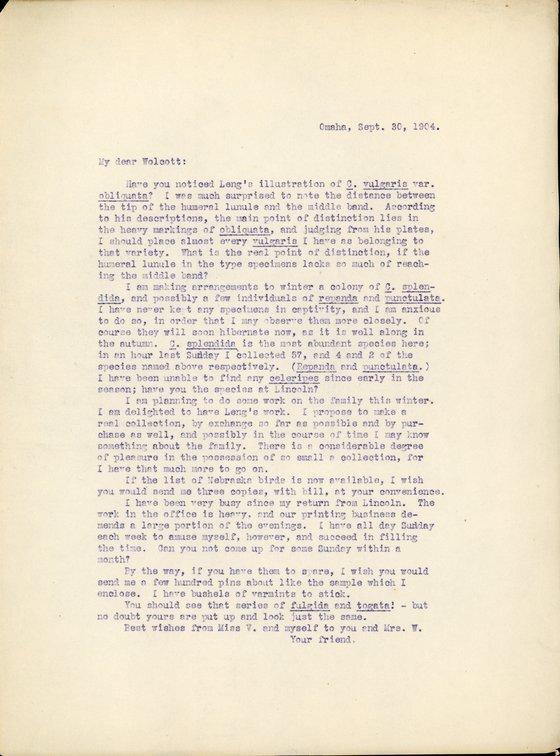
Omaha, Sept. 30, 1904.
My dear Wolcott:
Have you noticed Leng's illustration of C. vulgaris var.
obliquata? I was much surprised to note the distance between
the tip of the humeral lunule and the middle band. According
to his descriptions, the main point of distinction lies in
the heavy markings of obliquata, and judging from his plates,
I should place almost every vulgaris I have as belonging to
that variety. What is the real point of distinction, if the
humeral lunule in the type specimens lacks so much of reach-
ing the middle band?
I am making arrangements to winter a colony of C. splen-
dida, and possibly a few individuals of repanda and punctulata.
I have never kept any specimens in captivity, and I am anxious
to do so, in order that I may observe them more closely. Of
course they will soon hibernate now, as it is well along in
the autumn. C. splendida is the most abundant species here;
in an hour last Sunday I collected 57, and 4 and 2 of the
species named above respectively. (Repanda and punctulata.)
I have been unable to find any celeripes since early in the
season; have you the species at Lincoln?
I am planning to do some work on the family this winter.
I am delighted to have Leng's work. I propose to make a
real collection, by exchange so far as possible and by pur-
chase as well, and possibly in the course of time I may know
something about the family. There is a considerable degree
of pleasure in the possession of so small a collection, for
I have that much more to go on.
If the list of Nebraska birds is now available, I wish
you would send me three copies, with bill, at your convenience.
I have been very busy since my return from Lincoln. The
work in the office is heavy, and our printing business de-
mands a large portion of the evenings. I have all day Sunday
each week to amuse myself, however, and succeed in filling
the time. Can you not come up for some Sunday within a
month?
By the way, if you have them to spare, I wish you would
send me a few hundred pins about like the sample which I
enclose. I have bushels of varmints to stick.
You should see that series of fulgida and togata! - but
no doubt yours are put up and look just the same.
Best wishes from Miss V. and myself to you and Mrs. W.
Your friend,