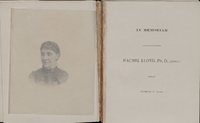
In Memoriam: Rachel Lloyd, Ph.D
Item set
- Title
- In Memoriam: Rachel Lloyd, Ph.D
Items
-
 so much enjoyed. Her influence over young people was wonderful. Accordingly, her greatest work was that of a teacher. Many are the alumni and former students of this University who stand ready to bear loving tribute to her memory. On coming here she had hoped to continue certain original investigations begun in Zurich where she took her Doctor's degree shortly before coming to Nebraska. But the work of instruction was so great that she was not able to carry this plan into effect. She did, however, a great deal of analytical work in addition to her teaching. She was joint author with Professor Nicholson of the first three bulletins on the sugar beet, published by the University[.] I well remember her giving a paper at the beginning of this study before one of the meetings of a Farmers' Institute held in chapel, and of hearing Professor Nicholson tell with a touch of pride in his voice of the surprise depicted on the faces of the farmers, as they saw a woman beginning a paper on the sugar beet, and then how intense interest took the place of surprise as she continued her reading. Some time during the winter of '92 Prof. Nicholson was given a leave of absence to go to Europe to make a further study of the sugar beet problem. During his absence Dr. Lloyd was at the head of the Department of Chemistry, with all that means, The following summer she took charge of the Chemistry in the summer school. Although the most of her time and energy was expended at the University, she found some time for other things. In the Spring of '89 she was elected to a place on the Board of Directors of the Haydon Art Club, which position she held for about a year and a half. She was very much interested in art and was a valuable member of the Board of Directors of that Club. Socially she was a great favorite and had many warm friends among the people of Lincoln[.] She was very kind and thoughtful of the welfare of others, even though such kindness might mean the sacrifice of her own comfort. Dr. Lloyd was a very pleasing speaker. She had a deep, rich voice with good carrying qualities[.] She spoke distinctly
 -
 ROSA BOUTON'S ADDRESS. Dr. Rachel Lloyd was appointed Associate Professor of Analytical Chemistry in the University of Nebraska in May, 1887. In recognition of her excellent work, the Regents later gave her the title of Professor of Analytical Chemistry. She served the University faithfully for seven years, and then resigned on account of failing health in June, 1894. She came to Lincoln first some time during the summer of '87, several weeks before the opening of the fall term. She began her work at once in the chemical laboratory in order that everything should be in readiness for the students at the beginning of the school year. This early coming was characteristic of all her work. She was always on time. I used sometimes to think that she would rather be two hours early than two minutes late. During her seven years' stay here I never knew her to be a moment late anywhere. Dr. Lloyd was neatness personified[.] In her dress, in the arrangement of her lecture table, in her laboratory, everything was exceptionally neat and orderly. She believed that whatever was worth doing at all was worth doing well. Whatever she undertook, and she undertook many things, she did it in the best way. I think I never knew anyone who took more care of the details than she; consequently everyone knew that whenever she did a piece of work it would be well done in every particular. And since she did so much work it necessarily follows that she was an indefatigable worker. Eight o'clock in the morning usually found her at the laboratory, and she seldom left at night before six, many times returning in the evening to continue her labors. She loved her work and succeeded in getting her students to do the same. Her personality was very strong, and at the same time very attractive. One recognized her at once as a woman of broad culture and refinement. Dr. Lloyd had the power of making personal friends of her students and of awakening in them an enthusiasm akin to her own for the study she
 -
 Inaugural Dissertation for the degree of Doctor of Philosophy: On the conversion of some of the homologues of benzolphenol into primary and secondary amines. Umwandlungen u. Homolgend. penols in prima u second, Amine, Ber, Deutsch, Chem, Gesellsch, 22 491. The same paper was published in University Studies, University of Nebraska. CHARLES F. MABERY. Also a short note from Prof. H. H. Nicholson of the University of Nebraska at Lincoln, with whom she worked for several years and who had the opportunity of knowing her well both professionaliy and socially, who enclosed a sketch of her work while there, by Miss Rosa Bouton, which I also quote in full, showing how her work and life were looked upon there by both students and friends. April 22d, 1900. My dear Mr. Lloyd: The death of Mrs. Lloyd has been to us like the loss of one of our own family. Not only in my immediate family, but through the University circle has her loss been an almost personal loss. One of her former students and a close personal friend, Miss Rosa Bouton, prepared and read before our Chemical Society a sketch of her work here, and with Miss B,'s permission I send it. We are considering now the project of placing in the chemical laboratory a tablet commemorating her life and work here. With my kindest regards to yourself and to your people, I am Your, sincerely H. H. NICHOLSON.
 -
 Laude, was conferred upon her. This distinction is evident, since the degree of Doctor of Philosophy had been conferred in chemistry on a woman but once before in a continental university, and then on a Russian lady. Soon after completing her work at Zurich, Dr. Lloyd returned home and was elected assistant professor of chemistry in the University of Nebraska. This position she held until her health failed from the effects of overwork and too severe mental strain. While in Switzerland, Dr. Lloyd became interested in the culture of the sugar beet, and [t]hrough some friends whom she interested in the possibilities of beet sugar for Nebraska, experiments were made which led to the development of the industry which has attained vast proportions in Nebraska[.] Professor Lloyd was a remarkable woman in many respects, even in this age of notable women. To a natural refinement and sweetness of character, she united the dignity of a highly cultured and intellectual mind. With a deeply cordial and sympathetic nature, she made friends without effort and those who were admitted to her intimate friendship discovered a loyalty and generous devotion that knew no limits. But with all her attainments incident to extended foreign travel and the refinement of the best social life, Prof. Lloyd was extremely modest and unassuming, always cheerful, and ready with aid and suggestion to those who needed a word of encouragement. The high position which Prof. Lloyd attained in her chosen profession was due to her great mental ability enforced hy her untiring energy and great force of character. Her contributions to science include the following publications: With W.F. Mabery — On Diiodbromacrylic and Chlorbromacrylic Acids; On Dibromiodacrylic and Chlorbromiodacrylic Acids; On Alpha and Beta-Chlordibromacrylic Acids. These papers were published in the Proceedings of the American Academy of Arts and Science, and later in the American Chemical Journal.
 -
 I have received from Prof. Charles F. Maybery, formerly of Harvard University, a short sketch of their work together at the Harvard Annex, which I thought best to publish verbatim, as it speaks for itself, of her work and character. PROFESSOR RACHEL LLOYD. My first acquaintance with Mrs. Rachel Lloyd was in the Summer of 1875, when she came from Philadelphia with several other ladies to attend the summer course of instruction in chemistry given under my direction at Harvard University. She was then engaged in teaching science to the well known young ladies school of the Misses Bonney and DeLaye. Mrs. Lloyd became so deeply interested in chemistry that she continued her attendance at these summer courses until 1884. She mastered very thoroughly general, analytical, theoretical, and organic chemistry, and for several years devoted her time to original investigations in organic chemistry. Mrs. Lloyd's great ambition was to fit herself for teaching chemistry in a college or university. As she extended her knowledge, shc was promoted from one position to another until she was elected professor of chemistry in the Hampton Female College, Louisville, Ky. After two years she resigned this position, and in 1885 went to Zurich, Switzerland, for the purpose of continuing her studies in the University. She was desirous of securing an advanced degree as an evidence of her attainments, and with this object in view she had sought in vain for some encouragements from the colleges and Universities in this country and ahroad, to enter an advanced course of study. But the university at Zurich was the only institution that she could enter with the hope of securing a degree. She immediately availed herself of the opportunity, and applied herself so closely that at the end of two semesters, after rigid examinations, the degree of Philosophiae Doctor, Cum
 -
 At a meeting of the Regents in June, 1894, the following resolution was adopted: RESOLVED That the members of the Board express their high appreciation of the faithfulness, the ability, the energy, and the unquestioned successes which have marked Professor Lloyd's work in the University. They learn with sympathetic regret of her failing health, and they follow her departure from the University with the warmest wishes for her future welfare and the expression of kindest personal regret. [Taken from the Regents' records.] But she found in Wisconsin that she would have to give up at last, so she relinquised all school duties and came back to Philadelphia, where she continued to reside, although continuing to get more feeble, and only attempting to do some church work among the poor. At the last she made her home with a friend of the family at Beverly, N. J., Mrs. Anna Scattergood, to whom she became much attached, and to whom the family are much indebted for the good care and constant attention she gave her until her death, which occurred March 7th, 1900, thus ending a life of labor and usefulness. I might here state that the motive that prompted Mrs. Lloyd to take up the study of chemistry as her life work was because her husband having been a fine chemist, she felt that she could not honor his memory better than to follow in his footsteps, believing, as she told the writer, she had his approval.
 -
 Because of ill health, Dr. Lloyd has decided to resign her position as professor of chemistry in the University. We ought to be used by this time to losing our chosen ones, but we don't seem to be. Dr. Lloyd has been with us now seven years, and it seems impossible that things can go just right without her. Dr. Lloyd's work must be more satisfactory to her than anything we can say of it. She has seen develop, largely by her efforts and under her eye, one of the largest chemical laboratories in the West. She has seen her lecture rooms crowded by enthusiastic students of all courses and departments. She leaves in Lincoln many warm, social friends, but it is by the students that her absence will be most keenly felt. She has always had a strong personal influence over her students, and possessed the power to awaken that within which passeth show. She is one of those instructors who stand not only for a science or a language, but for ideals and all higher culture. We can ill afford to lose one of these, for their name is by no means legion. Wherever Dr. Lloyd may go, she takes with her the gratitude of an institution and of a state where she has helped not only to fashion chemists, but to inspire and kindle earnest young men and women to that culture which society most needs.
 -
 Indeed, it was while working so assiduously at these matters, that she experienced her first break down, which came in an attack of partial paralysis, which affected her right side, and from that time on, she never fully recovered her former health and usefulness. But her indomitable will would not let her give up for more than a year until at last realizing her inability to properly fulfil all the requirements of her position, she resigned and undertook less arduous duties in a smaller school in Wisconsin. These few lines, clipped from the Lincoln papers, help to show the public regard for her. Mrs. Rachel Lloyd left Sunday for Chicago, where she will make her home in the future. Dr. Lloyd is one of the few professors who has the gift of always seeming to take a personal interest in each one of the pupils and in consequence there is not a student who has had work in the Chemical department who will not feel a sense of loss at Mrs. Lloyd's departure. In the long time she has been connected with the University, Mrs Lloyd has done a wonderful work in building up the Chemical department; how large a place she has filled will only be realized when she is gone[.] The love and good wishes of all her pupils go with her to her new home.
 -
 goings out ceased. The comings in were amusing; a burly granger would pull the door open with a jerk; hearing a new voice, he would glance to the platform; for a moment he would appear petrified with astonishment, then suddenly re-collecting himself, he would snatch off his headgear and gently, very gently, pull the door to and tip toe across the room, casting furtive glances at every step of the way to the lady on the stage as if expecting her to hurl some missile at him if he made the slightest sound. I imagined that he was suddenly called back to his boyhood days in the "deestrict school," and intuitively took up the school boys' stealthy tiptoe that serves so well to attract attention. I tell this all to their credit. It was the manner that was most amusing. At the close of the paper they applauded to the echo — none of the rest of us received that, and before the day was over, Mrs. Lloyd had been requested to read her address in another city. What will a business man think of a five-page letter? I must tell you that we have had a lovely winter, our first snow having just arrived and even now is taking its leave. We feel like extending our sympathies to the dwellers in the far East who are afflicted with cyclones and blizzards. Mrs. Lloyd is quite well and doing a splendid work here with enthusiastic students. Remember me to your wife and the children. Although a little out of season, I wish you all a happy and prosperous New Year. Very sincerely yours, H. H. NICHOLSON. The sugar beet culture has become one of the leading industries of the State as the climate and soil were both found to be adapted to that purpose, and there are several sugar beet factories now established throughout the State.
 -
 Chemical Laboratory, UNIVERSITY OF NEBRASKA Lincoln January 20th, 1889. My dear Mr. Lloyd: I have, many times, thought to write you, but as many times has something interfered. I often recall the very pleasant visit that Edward and I had with yourself and family, and Edward is sometimes unpatriotic enough to wish that he could live in Philadelphia. But the immediate cause and purpose of this letter is to record a bit of history and to tell you something of your sister. Both Mrs. Lloyd and myself are often called upon for addresses on different occasions. During the last week the State Agricultural Society has been in session in one of our buildings. Mrs. Lloyd, myself, and several of the other University professors read papers before them. Mrs. L's paper was on the "Sugar Beet Industry," and has been spoken of as the best paper read before the Society. It is in regard to this that I have to speak. You can imagine a large room filled with farmers, trying to sit 'at ease.' As I read my paper, the President was reclining on four chairs at the back of the platform and the audience, well, your imagination can tell you best, not all of them had their feet on the backs of the chairs in front. They took the infliction as easily as they could. Mrs[.] Lloyd followed me. Now I suppose that some of those men labored under the impression that a woman and a wash tub ought to be inseparable. At any rate they seemed surprised that a woman could calmly walk up on the platform and read a scientific paper. You should have seen the thrill of life that ran through the assembly; the President sat bolt upright in only one chair; the feet sought places inconspicuous; interest came into faces and eyes, and a perfect silence and deep attention followed where a moment before had been conversations and — I may be mistaken — but I thought I had lulled some of them to sleep[.] Then, before the lady appeared on the platform, the goings out and comings in had been both frequent and noisy. The
 -
 On returning to America she was offered and accepted the position of assistant professor of chemistry at the University of Nebraska at Lincoln, under Prof. H. H. Nicholson of that institution, who was also at the head of the Experimental Station of Nebraska, located at the University. Having, while abroad, looked into the subject of beet sugar, she determined to give that matter attention in her own country, when she should return, and so when appointed to the University of Nebraska, she took up the subject of sugar beet culture in that state. Here, in addition to her duties in college, by working hard in extra hours for four years in the Experimental Station, analyzing beets, and improving the quality of the seed sent out yearly to the farmers over the State, she was largely instrumental in introducing the the culture of the sugar beet in Nebraska, and the establishing of sugar beet factories over that State, of which the Oxnard Sugar Factory of Grand Island was the first. Several pamphlets were published by the Station descriptive of the work accomplished under the joint direction of Prof. H. H. Nicholson and Prof. Rachel Lloyd, and Prof. Nicholson said to me that although he had the honor of being the head, yet the success of the work was largely due to Prof. Rachel Lloydas she had done most of the laborious work, and deserved the credit. A letter received from Prof. Nicholson at this time is appropriate here.
 -
 We remembered absent friends and drank to their healths in crystal dear water. The tree was pretty. You know it is the custom here to have a tree whether there are children in the family or not. This was tastefully decorated. The younger members of the party danced, thcn we played games, and so came to an end my first Christmas dinner in Switzerland. Harry and Estelle remembered me with "Stedman's American Poets," and many friends with cards. Jennie Valentine sent a handsome gold pin. Your box had been opened by the mail authorities to see it there was anything written, and the box was without string and the paper thrown around the box. Nothing inside was injured, even your cards remained safe. A gentleman who is here from Prague received a pack of playing cards; they were opened, but reached him in safety. To show how fussy they are, there came one day a letter directed Rachel H. Lloyd, with all the rest of my long address, and there was great questioning to know if I should haye the letter or not. Because of the fussiness of the post officials I sent you small cards as letters, thinking that in this way they would be sure to reach you[.] It is now five o'clock, and you are just thinking about having dinner. I wish you a most hearty "Guten appetit," and I could enjoy with you a piece of mince pie and a slice of plum pudding, also some nuts. My sincere wishes are yours for a happy and prosperous New Year. Yours, affectionately, CHELLIE. Dec 27 — The Greenaway Almanac just here; very many thanks for it and for Louis' pleasant letter.
 -
 They had decided that all their instructors must be able to write a title after their names, and never having taken a degree, for the reason that up to that time no degrees were conferred upon women in this country, she was refused the position. This so piqued her that she resolved she would have her degree, and she went abroad to Zurich, Switzerland, where she studied two years longer, and received her degree of Ph.D. from the University of Zurich. One of her letters to us at this time, Christmas, 1886, is interesting and characteristic of her. PLATTE~STRASSE 29, FLUNTERN, ZURICH. Christmas Day, '86. My dear Clem and Irene: Your beautiful card of wild flowers, with the sweet verses, added much to my Christmas pleasure[.] Our dinner to day was very grand for a Swiss pension. We had soup, then boiled beef with potatoes, this followed by roast turkey and salad; the dessert, apple pie and coffee. We Americans gave the landlady the turkey. From this extra dinner you can judge that our daily food is not remarkable. We tried to season the food with wit and merriment. We were at table six Americans, four Swiss, one German, and one Italian. After dinner, Dr. Gifford, an American, brought his guitar and sang "Sweet and Low" and some other negro melodies. Then the entire party sang "America;" some sang English words, some French, and some German — they all knew the tune. Miss Mitchell gave each guest a bunch of violets and a dinner card[.] My card had on it a chemist's retort, pipette and tongs, and the words: "Her voice was ever soft. Gentle. and low, an excellent thing in woman."
 -
 Are we not girls together this one night at least, Though a paradox, still it is true, All the single ones present at this noble feast, And all of us double ones, too. But somewhat of sorrow would cloud our delight. And much of our bliss be destroyed, Were it not for the presence among us to-night Of our very dear friend, Mrs. Lloyd. For in spite of the changes which come with the years Our hearts are the same as of yore; And with happiness blended of laughter and tears We greet one another once more Old time is as nothing, nay, hardly as much, Let him say we're not young, if he dare: He thinks we'll admit it, because of the touch Of his sly powder puff on our hair. The fetters which bind us were never more dear, And their velvet strength never was greater Than to-night when we meet, in the June of the year, In the halls of our old Alma Mater. Alma Mater? Ah, yes to be sure, but in place Of this title we'll give her another, And christen them over again, by your grace With the dear name. "Our Own Foster Mother." She had previously spent seven summers at the Annex of Harvard College, perfecting herself in chemistry, and in 1885, applied for the position of Professor of Chemistry at the Taylor College at Bryn Mawr, Pa., when that college for young ladies was opened[.] Thoroughly equipped for this work, with high testimonials from the professors at Harvard, she was acceptable to Taylor College, but for one exception.
 -
 And the good name of Thompson was laid on the shelf By Gertrude, our golden-haired joy. She has taken four syllables unto herself, And is bossed by two girls and a boy. And the new Laura Hyde, from the old what a change, Her face I can dimly recall. How wonderful truly, this miracle strange; She is now ouly twelve inches tall [Foote.] And a lassie from Clearfield, my own native town, By the way, she was one of its belles. Her name of Kate Weaver laid willingly aside, And became Mrs. Theodore Welles. And a maiden there was by name Lillie Hoyt; She was one of the class of '83, Who changed her surname by a method adroit, And is now Lillie Barnard, M. D. Emma Cochran, a name to each one of us dear; Though the blue seas roll swiftly between, Let us drink to her health, with a hearty good cheer, The fair Madame Ponafidine. And one from away in the Green Mountain State Has come to be with us again; Christmas Norton she was, but she is at this date The Darling she always has been. And what has become of Jennie P. Betts? Why, from morning till evening begins She is ordered about by two sunny-haired boys, Who might just as well have been twins. There are others who've walked to the altar of fate, Who should have a place in this rhyme, But my muse is exhausted, I grieve to relate, And so, I'm afraid, is the time. But theme was Old Maids, aud you'll think, I am sure, That I from my subject have strayed; But is it not true that each one of us here Is a really and truly Old Maid?
 -
 The Foster School at Clifton Springs, N. Y., held a " Reunion" June 22-25, 1897, to which they kindly invited their former Principal, Prof. Lloyd, to attend as guest of the school. This she accepted with great pleasure and thoroughly enjoyed meeting her former pupils and friends, and the following lines read at that Reunion as a "Toast to Old Maids," containing such pleasant reminiscenses, shows what a jolly time they all had. TOAST — "OLD MAIDS." I wish to respond to this eloquent theme With a willingness perfect and pure; Its subject I hold in the highest esteem, For Old Maids are a God send, I'm sure. But if in these sentences of diffident rhyme A halt should occur, or a pause, Pray pity the speaker and just give her time, Or fill up the break with applause. The damsels who've clung to their maiden estate In spite of persuasion galore, How proud should they be to appear at this fete With their names just the same as before. So the books of the school, so renowned in its day, Bear inscribed all the names of our youth; But could we examine all those records to day 'Twould seem that they tell not the truth For on one of their pages behold, we should see — If yesterday only were now — A name, Eva Loomis; alas, where is she? She has turned herself into a Howe. And the trio of Thompsons deserted the ranks. Save one, who retains the old name, For which act of loyalty, Martha, our thanks. Her sister a Hunter became.
 -
 In 1872, she again went abroad for her health and to be benefitted by the German waters, and these lines, found amongst her papers, show her feelings while on the great deep: "The ticket for Bremen is bought, our letter of credit and passport prepared, and we are off "in the 'Trave' for Bremen. Now the waves rise into a grand sweep, row they rush again as the vessel plunges into an enormous wave, up and down, up and down, forging ahead to the unceasing, tremulous jar of the machinery[.] A look around on the vast expanse, and the ship which at the pier seems so huge, so unyielding, becomes an atom in comparison, is tossed like a feather upon old ocean's bosom, and one realizes how little is between him and eternity. There seems to be no place that to my mind brings man so visibly in the presence of Almighty God as in the midst of the ocean during a storm or amid the grand and lofty peaks of the Alps. All other feelings are swallowed up in mute acknowledgment of God's majesty and man's insignificance. If ten days ever seem long to man or woman, it is during their first or second voyage across the Atlantic[.] But it is over now, and we have arrived at the port, and have been taken into Bremen on a train which runs direct from the tug. We secured good seats on the train and are once more glad to be on land." On her return to Philadelphia, she taught for several years in Miss Bonney and Dellaye's school for young ladies at 1615 Chestnut Street; afterward was lady principal of Foster School at Clifton Springs, N. Y., for two years, and then went to Louisville, Ky., to be at the head of the Women's College of Pharmacy, and was also Professor of Literature in Hampton College of the same place.
 -
 It was while boarding on Fourth Street that she became acquainted with two gentlemen, Mr. George Jervis and Mr. A. Howard Merritt, who remained her life-long friends, and I take pleasure to here quote from one of Mr. Jervis's letters concerning her: "Becoming a widow and childless, she devoted her time to church work, and was for some years Superintendent of the infant Sunday-School of Old St. Peter's, Philadelphia, where she devoted herself not only to the spiritual welfare of the children, but to their physical condition, visiting and ministering to them in the worst parts of the city, even at great personal risk. Owing to ill health, she was obliged to visit Germany for the benefit of the waters. "She was first engaged as a teacher at Bonney & Dillaye's boarding school for young girls, and during the summer vacation attended the courses of lectures at Harvard on chemistry, securing the Harvard certificate. Resigning from Bonney & Dillaye's, she was appointed Principal of the Foster School at Clifton Springs, N. Y., and after being there some years, accepted the position of head of the Women's College of Pharmacy in Louisville, Ky., as well as that of Prufessor of Literature in the Hampton College in the same city; but wishing to take a degree, she began the study of German and sailed for Zurich, where entering the Polytechnic, she continued her studies in chemistry, meeting with opposition from some of the professors and students yet came off triumphantly with the degree of Ph.D. Being sent for by Prof Frankland, of South Kensington, to experiment with him, she visited London, and it was while there she received notice that she had been appointed Assistant Professor of Chemistry in the University of Nebraska in Lincoln."
 -
 ianity, rather of deeds than of words, his earliest care was to introduce among the rough elements of a new settlement the moulding institutions of the gospel. His own efforts established and maintained the Sabbath school, and the preaching of the Word found in him a zealous supporter. The tearful tribute of that commmunity, after only two years' acquaintance, claiming to mingle in the grief of his life-long friends, has in it an eloquence of testimony which heroes might envy. R. Bowed down with grief, Mrs. Lloyd returned, and soon after left for Europe, where she traveled for a couple of years trying to recover her strength and went to the springs to get rid of rheumatism and neuralgia from which she had suffered, at intervals, for years. On her return to Philadelphia, she resided on Fourth Street near Spruce and became actively interested in St. Peter's P. E. Church, Third and Pine Streets, then in charge of Rev. Thomas F. Davies, D. D., now Bishop, whose beautiful tribute to her memory I feel it proper to here insert. DETROIT, MICH, May 19, 1900. Dear Sir: Thirty-two years ago when I became rector of St. Peter's Church, Philadelphia, I found Mrs. Lloyd acting as the Superintendent of the Infant Sunday School. In that position her work was wonderful. She knew each child by name, maintained perfect order without the slightest show of authority, and imparted her instructions so as to win all their hearts. I shall always remember her and her noble work with thankfulness and admiration. It is many years since I have had the privilege of meeting her. I am glad that you are preparing a tribute to her memory. Very truly yours, THOMAS F. DAVIES.
 -
 were few and difficulties many. It was very touching to see the marks of love and appreciation from the whole town when his remains left for Philadelphia. All those who knew Dr. Lloyd will be interested in this tribute to her hushand's memory, written by one of his life-long friends, at the time of his death: AT Bangor, Michigan, on the 6th inst., FRANKLYN LLOYD, formerly of Philadelphia, in the 34th year of his age. The Dread Archer has chosen a shining mark. He has added another to the list of his noble victims. To our shortsighted human vision, every circumstance conspires to make this bereavement more cruel, and our grief more poignant. A mind singularly gifted with those qualities which commend the admiration of men, and tempered by that training in the school of Christ which makes them the blessing of society, might seem fitly to demand long years of usefulness. A judgment so clear and just, an integrity so unflinching, a heart so generous and tender, an energy so untiring, would appear entitled in the economy of human progress, to the fullest scope for their benign influences on the world. But "God seeth not as man seeth," and we record, submissively, our sorrow for one of the truest of men. Every relation of life bears him grateful witness. As a son and brother, always thoughtful and affectionate; as a friend, of well-tried, never-failing constancy; and as a husband, the tenderness with which his first vows were breathed, seemed to be only deepened and ripened by the lapse of time. At a sacrifice of self, he chose deliberately that position, in a comparatively unbroken country, which afforded the largest field for his industry and talent. With undaunted resolution, he met and conquered every difficulty of a new aud untried enterprise, and at an age when the names of most men are scarcely heard in an active community, this young stranger was acknowledged and respected as a leading spirit. With a Christ
 -
 Charles D. Cooper, and went to housekeeping at 731 Green Street, where their daughter Fanny was born, who died in infancy. My brother soon after went into business on the old Rowlett property at Nicetown, making brick and retailing coal, and lived in a neat frame house on the property fronting on Germantown Road. From there, in 1863, they moved to Bangor, Michigan — across the river from Bay City, where he had charge of a large saw mill, salt works, barrel factory, etc., the property of Samuel Bolton & Co., lumber merchants of Philadelphia, whom he represented. They lived in a one-story frame office here on the property, which served for both home and office, until he could build himself a dwelling, and it was here that their son Willie was born, who also died in infancy. They were both untiring workers, but overwork and the exposure incident to a new country told upon them both, and they were destined to enjoy the new dwelling which he had built less than two years. Once there were as many as seventy of the mill men in the town down with fever at one time, and in the fall of 1865 her husband was stricken down and died of bilious fever October 6 — a great loss to the community, for he was heloved by all his workmen, as he had been their true friend and taken a great interest in their welfare, a missionary pioneer on the borders of civilization; and they had started a Sunday School and Church service, where the opportunities
 -
 RACHEL LLOYD. Ph. D. (ZURICH.) RACHEL ABBIE HOLLOWAY, the subject of this sketch, was born at Flushing, Ohio, January 26, 1839. She was the daughter of Robert S. Holloway, of Flushing, and Abigail Taber, of New Bedford, Mass., both of them members of the Society of Friends. We have little record of her early life, except that she attended Friends summer school at Flushing, Ohio, when about twelve years of age, and her teacher of that period, Isaac Hall, writes me that she was by far his brightest pupil. From here she was sent to Friends Westtown Boarding School, in Chester County, Pennsylvania, in 1853, where the writer was also a pupil in the Primary School under the afore-mentioned Isaac Hall, but little did I dream that this young girl was afterward to become my sister-in-law. After leaving Westtown, she was first a pupil and then a teacher in Miss Margaret Robinson's School for Young Ladies on Franklin Street above Race Street, Philadelphia, and while there met my brother, Franklin Lloyd, who was employed by Powers & Weightman, chemists of Philadelphia. They were married May 11, 1859, in St. Phillips P. E. Church, Vine Street below Eighth, by Rev.
 -
 her credit as well as to that of her sex, and entitles her to recognition as a benefactor of her country and race. Well might we all emulate her entire devotion to the one object in her life, her wonderful will power that enabled her to surmount difficulty, her integrety, punctuality, and reliability, and also her business ability which was equal to that of most men, yet with it all retaining those feminine charms of manner and deportment which bespoke the true woman, and made everyone who knew her a friend. Modest and extremely sensitive as she was to all praise and publicity, yet I am sure with her love of doing good, she would not object to these lines if they might be the means of stimulating others to duty and helping her young friends to succeed in life. Though dead, she yet liveth, and her works do follow her for good. CLEMENT E. LLOYD
 -
 PREFACE Although conscious of his inability to do full justice to the memory and character of Prof. Rachel Lloyd, the writer of this brief sketch of her life attempted its preparation for two reasons. He thought it due to her memory and worth, that recognition should be made of the value to the com- munity of her life work, and that in departing this life, attention should be called to her useful career, high character and lovely disposition, to which so many attest. Secondly, the poet ha id “Lives of great men all remind us, we can make our lives sublime,”’ and | believe that lives of great women are just as encour- aging, although, as is often the case, the same achievement which in a man is heralded far and wide, if accomplished by a woman, does not get its proper recognition. Prof. Lloyd was a remarkably success- ful teacher, owing no doubt to her ability to win the love and esteem of her pupils, and by securing their confidence, she was enabled to impart the knowledge she possessed. Her determination to excel in chemistry and to obtain a degree, in spite of all opposition both at home and abroad (simply because she was a woman), and her success in introducing the culture of the Sugar Beet into the State of Nebraska, redound greatly to
 -