
Willa Cather Memorials: How UNL Remembers Her
This project explores the ways in which the University of Nebraska-Lincoln commemorates the legacy of Willa Cather on campus and some possible reasons behind it.
Credits
Editors: Jesse Sladky and Nina Pickrel, History 189H: Memory, Memorials, and History, Fall 2010
Cather's Life
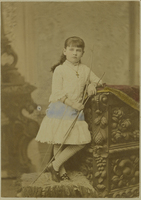
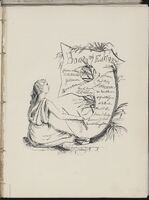
Early Days
Willa Cather was born Wilella Sibert Cather near Winchester, Virginia on December 7 in 1873. She was born in the home of her maternal grandmother, as the first child of seven to Charles Cather and Mary Virginia Boak Cather. In her childhood, the family moved to Nebraska, eventually settling in Red Cloud, the town made famous by her writings. The nine-year-old had trouble adjusting to her new life on the prairie, but after a year, Cather had developed a fierce passion for the land, something that would remain at the core of her writing. She was homeschooled at first, but later went to elementary and secondary school in Red Cloud. After high school she attended a preparatory school in Lincoln. [21] Her writings were always influenced most by her time living in the prairies and in Lincoln.
University Days
In September 1890, Cather moved to Lincoln to continue her education at the University of Nebraska, initially planning to study science and medicine. She had had a childhood dream of becoming a physician and had become something of an apprentice to the local Red Cloud doctor, but within months her essays were published in local papers and her direction was set. The young writer became managing editor of the school newspaper, The Hesperian, the author of short stories, and a theater critic and columnist for the Nebraska State Journal as well as for the Lincoln Courier. Her experience in journalism and criticism would take her many places. [15, 2, 19, 11-12]
Her experience in journalism and criticism took her first to Pittsburgh and then to New York, where she served as managing editor for McClure's Magazine. Cather had a long writing career, over which she became nationally acclaimed and internationally respected. [11-12, 14] She is most remembered for My Ántonia, A Lost Lady (1923) and Death Comes for the Archbishop (1927). Cather received the Pulitzer Prize in 1923 for One of Ours. She was given honorary degrees from Yale, Princeton and Berkeley, and was awarded the Prix Femina Américain by the French for her depiction of French culture within North America. Her writing earned her a spot on the cover of Time Magazine as well as the gold medal from the National Institute of Arts and Letters. [15, 21]
The NFWC Plaque and It's Abduction
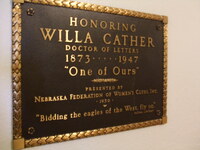
On the second floor of Andrews Hall, a plaque mounts a wall outside the main office. The plaque looks to be in fairly good condition, despite being sixty years old, and especially it's history. [13, 14] It honors "Willa Cather, Doctor of Letters", and is marked with the years of her life, and the title of one of her books, "One of Ours". It also includes a quotation from poet Vachel Lindsay, unfortunately misspelled on the plaque itself. The plaque, as a whole, honors the literary work of Willa Cather after going to the University, and celebrates her life. The meaning of "One of Ours" on the plaque and the reasoning behind it are unknown. It could be a reference to her days at the university, making her literally "One of Ours," if the "we" refers to the university. However, it could also refer to Nebraska in general, or to the NFWC as an organization.
The plaque is marked for 1950, though it didn't come to the University right away. It was dedicated by the Nebraska Federation of Women's Clubs at their 55th Annual State Convention in March of 1951 (the convention went from the 28th until the 30th). In the Love Library Auditorium, Mrs. E. A. Creighton, the State Chairman of Art, directed the presentation and acceptance of two plaques, one of which being the Cather plaque. Mrs. Mildred R. Bennett of Red Cloud, NE, Cather's childhood home. [6] Since the plaque was dedicated only four years after Cather's death, it is likely that it was intedned to commemorate not only Cather's death but also her years of work as a prominant author. The fact that it was a women's club likely suggests that the club was serving its purpose in honoring prominent women.
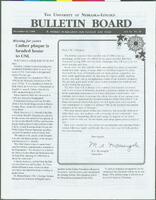
The plaque stayed in Andrews Hall untill 1969, the year Andrews Hall was renovated. During this renovation period, the plaque mysteriously went missing. It remained lost until late October nearly twenty years later when it was found along a creek in Barton County, Kansas by a detective of the Barton county sheriff's office. Through their research, the detectives found an organization dedicated to Cather, situated in Red Cloud. A notice was placed in the Willa Cather Pioneer Memorial and Educational Foundation newspaper in Red Cloud Nebraska. It just so happened that the notice was seen by Dr. Robert Knoll of the University of Nebraska, who remembered it going missing years earlier. The plaque was then brought back to the University in 1989 where it sits in Andrews Hall, after a restoration of the bronze. [13, 14]
Cather Garden
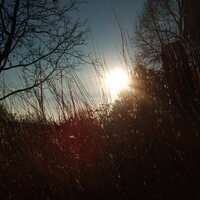
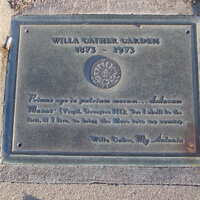
Cather Garden is located just to the West of the Love Library. It was designed and built to unify the core of the University of Nebraska-Lincoln City Campus. The idea was concieved in the centennial year of Willa Cather's birth, 1973, and completed only three years later. It is very unique and distinguished in that the plants are all native plants and materials that would have been famiailiar to Cather and to the Nebraska area. These materials include Birch, Black Hills Sruce, and Cottonwood trees, along with native roses well known to her. In the garden there is also a plaque commemorating the garden to Cather.
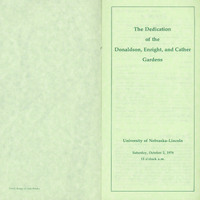
Cather Garden was dedicated along with the Donaldson and Enright Gardens on Saturday, October 2, 1976 by Chancellor Roy A. Young who was the master of ceremonies for the dedication. It was named after Cather in recognition of her rich contribution to the heritage of NE. In the words of NU Buisness Manager Dr. Ronald W. Wright, "It recieves the last rays of the setting sun, symbolizing the rich traditions of the University of Nebraska, its alumni, and former students." [1]
Cather Hall
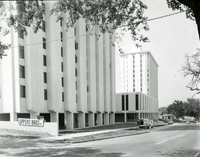
Late in 1963, two multi-story dormitories finished construction as an addition to the Neihardt dormitory, creating the Cather-Pound-Neihardt (CPN) grouping of dormitories, lounges, and a dining hall. The buildings are located on 17th street, Cather Hall being the northern building and Pound Hall being the southern. The Cather dormitory iwas the first multi-storied building to be constructed on city campus. The buildings were named such at the Board of Regents meeting of February 2 in 1963. [7, 12] Only two years later, the nearby Abel/Sandoz dorm complex completed construction. [4] It is very likely that the choice to name each of these buildings as they were was arbitrary at best. Cather dormitory was built because of the rising need for additional housing at the university which explains why Cather's name was "thrown" on it.
There are plans that in a couple of years both the Cather and Pound dormitories have the possibility of being knocked down. Considering they are both very old droms, repairing them would be incredibily expensive. These two dorms would be replaced with more suite-style resident halls. [18] Whether these new resident halls would take on the names of Cather and Pound is unknown right now but Cather could very easily lose a spot on campus.
Cather and Pound halls, the two high-rise resident halls on campus were imploded on December 22, 2017.
Pine & Plaque
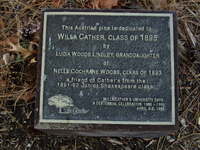
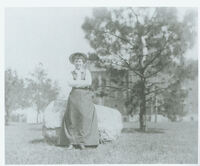
The Cather graduate plaque and Austrian pine are located East of the Arcitecture Hall. The plaque and tree were dedicated to Willa Cather and the class of 1895 by Lucia Woods Lindley who was the granddaughter of Nelle Cochrane Woods, as a part of a larger celebration in Cather's honor. Nelle was a friend of Cather's from a Shakespeare literature class. They were dedicated to Cather in April of 1995, the centennial celebration of her graduation day. [3, 15, 16]
There is also a myth surrounding Cather and a picture taken of her while at the universtiy in which she is leaning against a large boulder. The location of the Cather graduate plaque and tree is said to be in a similar location of where the picture was taken. The rock is now on display in front of Morrill Hall and the pine tree is alive and well in the sculpture garden west of Sheldon Memorial Art Gallery. [15, 16] The plaque stands in front of it, labeling the tree for any passerby.
Legacy
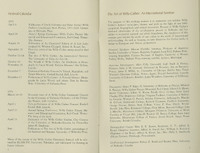
In order to commemorate the work of Willa Cather, the University of Nebraska undertook an elaborate series of celebrations supported by the National Endowment for the Humanities, the Nebraska Arts Council, the Woods Charitable Fund, and many other groups. The Cather Centennial Festival was held from 1973-1974. The university wanted to give the Nebraska author the respectful attention which she rightfully deserved. It was a yearlong series of events ranging from an international seminar, “The Art of Willa Cather,” a commemorative concert on her birthday, December 7, 1973, and even the making of a commemorative postage stamp of Cather. The Cather Garden was also dedicated at this time. [1]
In the spring of 2002, the University began awarding Cather (and Bessey) professorships. They were nominated and awarded for admirable scholarship and creative activity. The nominations are reviewed and awarded based on the decisions of the Committee on University Professorships, with the Chancellor having the final say. Some of these Cather professors include Xiao Cheng Zeng, a professor of chemistry, Carole Levin, a professor of history, and Susan Sheridan, a professor of Educational Psychology. The professorship has been awarded to numerous others from a variety of University departments. [20].
Cather is a prominently featured figure of UNL history. Her memorials, dotted around campus, all seem to tie the illustrious author to the school, claiming her. However, judging by the general opinion that her fellow students (and even some of her professors) had of her, it is a small wonder that the first true notice of her time at UNL came after her death, after she had left the University and made an internationally famous name for herself.
March 28, 1951: Plaque honoring Willa Cather (now in Andrews Hall) dedicated. This plaque, dedicated by the Nebraska Federation of Women's Clubs, was finished in 1950. Its relative proximity to the time of her death makes it seem like the memorial least motivated by the author's fame alone. [6]
Sources
- Administrative newsletter, and Dedicatory brochure, Cather Gardens File,RG 52-02-00 Box 5 Archives and Special Collections, niversity of Nebraska–Lincoln Libraries
- Board of Editors page, 1895 Yearbook, Annuals/Yearbooks (Publications) [Student Life], 1883-1972 RG/38-01-01 Archives and Special Collections, University of Nebraska – Lincoln Libraries. Accessed December 9, 2010. http://yearbooks.unl.edu/yearbook.php?year=1895&page=15
- “Cather’s Campus Years Reviewed by Publication.” ca. 1950. Willa Cather Collected Materials: Clippings and Biographical Materials File MS/008 Box 1 Archives and Special Collections, University of Nebraska – Lincoln Libraries
- Davis & Wilson Architects, Architectural Sketch, Abel/Sandoz Folder , RG – 52/02 Box 1 Archives and Special Collections, University of Nebraska - Lincoln Libraries.
- Dedication photo for Cather plaque, Nebraska Federation of Women’s Clubs, Inc. Scrapbook 1940-1952 Series 2 Nebraska Federation of Women’s Clubs Collection RG1977, Nebraska State Historical Society.
- Minutes, 55th Annual State Convention, Nebraska Federation of Women’s Clubs, Inc. F6 Box 4 Series 4 Nebraska Federation of Women’s Clubs Collection RG1977, Nebraska State Historical Society.
- Minutes, Board of Regents meeting February 2, 1963, page 182 RG 01/01/02 Board of Regents Minutes reel 1957 – 1964 Archives and Special Collections, University of Nebraska – Lincoln Libraries.
- Multiple photographs, Philip and Helen Cather Southwick Collection 1921-1958 MS/077 Archives and Special Collections, University of Nebraska – Lincoln Libraries.
- Pamphlet, 1973 Willa Cather Centennial Festival Committee, Willa Cather Centennial Festival File, RG – 05-01-01 Box 118 Archives and Special Collections, University of Nebraska – Lincoln Libraries.
- Photograph, Willa Cather Collected Materials: Photographs File, MS/008 Box 1 Archives and Special Collections, University of Nebraska – Lincoln Libraries.
- University of Nebraska News Service, Department of Public Relations Letter, Abel/Sandoz Folder, RG – 52/02 Box 5 Archives and Special Collections, University of Nebraska – Lincoln Libraries.
- University of Nebraska News Service, Department of Public Relations Letter, Cather Hall/Pound Hall Folder, RG – 52/02 Box 5 Archives and Special Collections, University of Nebraska – Lincoln Libraries.
-
“Cather plaque is headed home to UNL.” University of Nebraska – Lincoln Bulletin Board, December 16, 1988. Willa Cather Collected Materials: Newspaper Clippings File MS/008 Box 1 Archives and Special Collections, University of Nebraska – Lincoln Libraries.
-
"Cather plaque makes its way back to UNL.” University of Nebraska – Lincoln Bulletin Board,February 24, 1989. Willa Cather Collected Materials: Newspaper Clippings File MS/008 Box 1 Archives and Special Collections, University of Nebraska – Lincoln Libraries.
-
Knoll, Robert E. Prairie University: A History of the University of Nebraska. Lincoln: University of Nebraska, 1995. 24, 30, 32-33, 36-37, 72.
-
Knoll, Robert E. Prairie University: A History of the University of Nebraska. Lincoln: University of Nebraska, 1995. Picture 17.
-
Pickrel, Nina. Multiple Photographs. Nebraska U - Willa Cather Memorials.
-
Sprouls, Frannie. “UNL looking into new dorms in coming years.” Daily Nebraskan, December 1, 2010.
-
The Willa Cather Archive. Last modified 2010. http://cather.unl.edu/
-
University of Nebraska - Lincoln. "Faculty Awards and Honors: Cather/Bessey Professors." Last modified 2010. http://www.unl.edu/svcaa/honors/internal/cbprofessors.shtml
-
Woodress, James. Willa Cather: A Literary Life. Lincoln & London: University of Nebraska Press, 1987. Accessed December 3, 2010. http://cather.unl.edu/life.woodress.html