
Metzger Memories
Item set
- Title
- Metzger Memories
Items
-
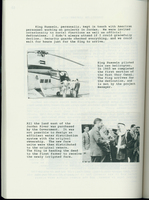 King Hussein, personally, kept in touch with American personnel working on projects in Jordan. We were invited occasionally to social functions as well as official dedications. I didn't always attend if I could gracefully decline. Security guards checked everything, and we could wait for hours just for the King to arrive. King Hussein piloted his own helicopter. In 1965 we completed the first section of the East Ghor Canal. The King arrives for the dedication, and is met by the project manager. All the land east of the Jordan River was purchased by the Government. It was not possible to design an efficient water distribution system with the original ownership. The new farm units were then distributed to the original owners. The King is handing the deed to the first farmer to receive the newly irrigated farm.
 -
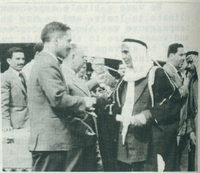 All the land east of the Jordan River was purchased by the Government. It was not possible to design an efficient water distribution system with the original ownership. The new farm units were then distributed to the original owners. The King is handing the deed to the first farmer to receive the newly irrigated farm.
 -
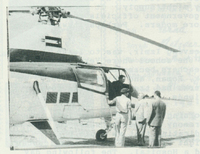 King Hussein piloted his own helicopter. In 1965 we completed the first section of the East Ghor Canal. The King arrives for the dedication, and is met by the project manager.
 -
 TURKEY TO JORDAN The Turkey assignment came to an end April 28, 1960. Turkey had quickly become part of our lives, the Turkish farmer was accepting the small equipment, and I felt that I should stay longer; my job was not yet finished. My two counterparts, Naki and Atif, were like brothers to me. Both were pushing hard to get the idea accepted in Turkey, that the farmer could do better with what he could make than what a foreign country might supply. It became obvious that high Turkish government officials thought that Turkey needed to be more modern. Perhaps it was time for me to move on. The hardest part of leaving Izmir, was to leave the fellowship of the Staff at the school where Verna taught. The Makes and the young teachers became our family. We had taken many trips into Greek, Roman, and Hittite history, we were in Asia Minor. The Turks had treated us like royalty, and we had many Turkish friends. At 8:00 o'clock the morning of April 28, we left the school with the Turkish ceremony of pouring water on the front wheel of the car, indicating that we would be returning. We spent one night with the Browns at Gazicuntab. where the Mission supported a Hospital. The following day we crossed into Syria. We stayed the first night in Aleppo the next in Damancus [sic], and on May 1st, we crossed the boarder [sic] into Jordan. We were a little apprehensive, we had enjoyed the climate in Izmir, and on May 1, when we left Damascus, the temperature was about 90 degrees F. It was extremely dry, and women were in the fields pulling up clumps of barley, in order to salvage a little grain. When we crossed the border into Jordan, the temperature was over 100, and by the time we arrived in Amman, we were convinced that we were going to be living in a very hot country. We reported to the American Embassy as soon as we arrived, and the Ambassador arranged for several from the Agricultural group to welcome us and take us to our living quarters. Everybody assured us that this weather was unusual, and that we seldom would experience anything like this. Our quarters were nice and cool, and perhaps they were right when they said that the weather was unusual. We lived in Jordan 7 years and it was only 5 or 6 times that we ever experienced such weather as the day we arrived. Amman, Jordan has one of the finest climates; elevation of 4000 [sic] feet above sea level, and dry. It seldom froze in the winter and it was unusual for it to reach 85 or 90 on the hottest days in summer, and the summer nights were always cool.
 -
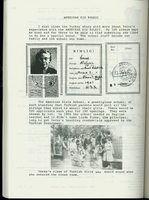 AMERIKAN KIZ KOLEJI I must close the Turkey story with more about Verna's experience with the AMERIKAN KIZ KOLEJI. My job always kept me busy and for Verna to be able to find something she liked to do was a special bonus. The school staff became our family and the school our home. The American Girls School, a prestigious school, of such standing that Turkish parents would pull all the strings they could to enroll their girls. There would be 500 applicants each year for 100 openings. They were chosen by lot. In 1956 the school needed an English teacher and it didn't take Linda Blake, the principal, long to get Verna's teaching credentials approved by the Turkish Government. Verna's class of Turkish girls who would stand when she entered the class room.
 -
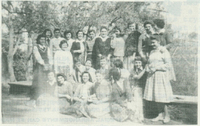 Verna's class of Turkish girls who would stand when she entered the class room.
 -
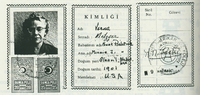 The American Girls School, a prestigious school, of such standing that Turkish parents would pull all the strings they could to enroll their girls. There would be 500 applicants each year for 100 openings. They were chosen by lot. In 1956 the school needed an English teacher and it didn't take Linda Blake, the principal, long to get Verna's teaching credentials approved by the Turkish Government.
 -
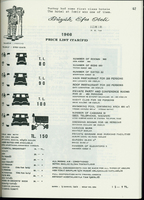 Turkey had some first class hotels [sic] The hotel at Izmir was one of them. Price sheet for the hotel at Izmir
 -
 The next day took us to the town of Finike. There being no road west along the shore of the Mediterranean, we had to take a small boat to Demre, but rough water was too much for several of our people, and they had no interest in the lunch we had brought with us. We arrived at Santa Claus's home town. Let me quote from the book. ANCIENT CIVILIZATIONS AND RUINS OF TURKEY, by Ekrem Akukrgal. "The village of Demre contains the famous church of St. Nicholas. It consists of a Byzantine structure with three apses and a Basilica restored in the 11th century A.D.--A sarcophagus, believed to be the tomb of St. Nicholas, is early Christian in date." It was getting late when we left Demre. The wind had gone down and the boat ride back to Finike was much smoother. I quote from Verna's diary again "Back to Finike over a calm, beautiful Mediterranean, no hotel rooms in Finike, so we go on to the tiny village of Turencova--and took over all 12 beds in a rooming house that might be called a hotel." The 12 beds were in three rooms; one room had three beds, another two, the others beds were in one room. The single girls took the room with the seven beds, the Blakes and the Metzgers the other rooms. Things went well for us in the two rooms, but the girls had problems to work out. When Jack made the arrangements with the manager, he was not told that there was another guest who had claim on one of the beds in the room the girls were to use. The manager had assured the other guest, when he gave up his bed, that he could sleep in the closet of that same room. I do not know what really took place, except that, as the girls were getting ready for bed, in walked the guest who calmly unrolled his blankets and prepared for a good nights sleep in the closet. I could hear a lot of excited voices, it seemed that every one was trying to talk at once. Jack explained to the manager that it was not part of the bargain for the other guest to sleep in the same room, and we never found out where he slept. The next day we visited the ancient Aspendos theater, and the restored stadium at Perga that seated 27,000 people 2000 [sic] years ago. We left for home the next morning in the rain, and arrived in Izmir at 11.00 p.m.
 -
 ELMALI From Verna's diary, April 20, 1957. "We took over all 12 beds. The only hotel--dinner in a local restaurant,--no bed bugs, kerosene lamps, TAP WATER from a 5-gallon petrol can." I might add that the toilet was at the far end of the hall. If you require a first class hotel when you travel in Turkey, you will miss a lot of wonderful sites in an ancient land. It was our fortune to be able to travel with members of the Faculty of the American Girls School. Verna usually went with them on these trips to the interior of Turkey, and I took time off, if possible, and went with them. The Turkish Government permitted us to own a car while in Turkey. If we made a trip with the school faculty, our car and the school bus could accommodate as many as 14 people. The Blakes made perfect guides, they knew the language well, and were excellent historians. The trip in April 1957 was to Demre, known in Byzantine times as Myra, the home of St. Nicholas. Yes, good old St. Nick, (Santa Claus ) to us. Santa Claus came from Turkey, not the north pole, in case you are interested. Most of our roads thru Aydin, Denizli and Isparta were gravel. We made half the trip the first day to a little town called Elmali (Apple in Turkish). Rooms were not easy to find, there were 13 of us and we were assigned to three different hotels. Verna, Ken and I in one and the Blakes in one close by. Our hotel had no shades on the windows, a small light bulb hung from a cord in the middle of the ceiling, there was water and a toilet at the far end of the building. Our night passed with out incident, but the Blakes were awakened by a knock on the door in the middle of the night. A male voice called out in Turkish. "Is there a basket under your bed?" Jack looked under the bed and assured him that there was a basket, and that he would hand it to him. The visitor then informed Jack that perhaps he had better get it himself, because his snakes were in it. A circus had been in town the day before, the snake charmer had slept in that room and left them under the bed.
 -
 I asked Naki where I could find the bath room, he pointed down the hall where there was another dim light and above the door was a dirty white sign, W.C. I slowly opened the door into a small room that was about 4 feet by 5. A small can of water was sitting on the floor in one corner. In the center of the room was an odd looking depression in the floor, perhaps two and one half feet square. Two large flat foot-shaped slabs of marble, with a hole between them, that went some where, there was no toilet paper, and no wash basin, or towels. The day had been a long one, and I was tired. I undressed and tumbled into bed, a wooden frame with ropes laced across the frame for springs. The cotton mattress was hard, there were heavy woolen blankets, and the pillows were stuffed with cotton that felt as if made of wood. I slept well and wakened about 6 o'clock. The next morning a small dark faced lad, about 12 years old, tapped on the door, opened it a small crack, and said " Goodidin Effendem" and with a smile, set a basin of warm water on the stand by the bed. I shaved and dressed, went outside where Naki was waiting. We went to a nearby coffee house and had our breakfast, a glass of scalding hot milk, a half-loaf of freshly baked bread, and a large bunch of sweet white grapes, Ishan was waiting for us with the 1952 Ford station wagon. We spent the next day with Toprak Su (The Soil and Water Conservation division of the Ministry of Agriculture.) Our next hotel was not a lot better than the first. This time the bed was a little softer and the pillow not so hard. I was tired and it didn't take me long to get into bed. The bed seemed to be hot so I threw back the covers, but that didn't cool me off very much, the bed was still hot. By this time I knew that something was not right, so I got up, and turned on the lights in time to see a lot of bedbugs scurry to get out of the light. The following week Verna and I went to Istanbul for a vacation, and we stayed at the International Hotel, recently built, It was very comfortable and well managed, modern hotel, that attracted a great many tourists.
 -
 HOTELS IN TURKEY To travel in Turkey to-day, on a well planned tour with air conditioned busses and modern hotels, is to see ancient history in style. To travel in the interior of Turkey in the 1950s was an experience, spelled with a capital E. Naki and I had to make many trips out of Izmir, to the experiment stations at Aydin and Tarsus, and to farms in these regions. We would often be gone for a week or more at a time. Two large dams were under construction, one in the Gedez valley and one in the Menderes. Water was being supplied for irrigation to small villages in the interior. We cooperated with the Soil and Water Conservation Agency (Toprak Su), a division of the Ministry of Agriculture. We would occasionally stay in private homes, and the hostess could never seem to be satisfied that she had done enough for us, we were treated like VIPs. Much of the time, we stayed in OTEL PALAS, the village palace. The Otel Palas usually was located in the center of the village, and only a small sign on the door would indicate that there were rooms for rent. The entrance looked the same as other doors from the street. Our first trip from Izmir, took us to a small village in Aydin Province. We arrived early in the afternoon, and Ishan took our luggage to the hotel, and made reservations for us. Naki and I went to the Station and when we went to the hotel, I was not prepared for what was in store for me. There were only 6 or 7 street lights, all were so covered with dust that Naki said, " We may have to light a match to find the hotel." When we came to the door of the hotel, I discovered that we were not the only guests. A camel caravan had arrived from the mountain meadows, bringing large bales of hay to the railroad station. After unloading, the drivers parked their camels at the entrance to the hotel. There were Camels lying all over the street. One was right in front of the door. Naki gave it a kick, and with a loud bellow, it leisurely unfolded its joints, got up and moved over, allowing us enough room to get in the door. The squeaky hinges on the door announced our arrival. and, the hotel manager called out, "Hos Geldonis", (Welcome), He pulled a light cord with a 40 watt light bulb, hanging from the ceiling at the far end of the hall. He pointed to a closed door and indicated that I could have that room. I pushed the door open, there was no lock, and found another cord and pulled it and got another dim light. This must be my room, it contained my luggage. I was to learn later that there were only two single rooms, and Naki and I were given them as honored guests. The one other room had 8 beds and they were occupied by the camel drivers.
 -
 there seemed to be no word for this in Turkish, so I had to draw the article the best I could, until Naki understood what was needed, and he could then explain it to the blacksmith who made the clevis. The making of equipment was not difficult, after we drew the plans and were able to translate them into Turkish To get the equipment to operate in the field was a another problem, only the farmers were able to handle the teams, an they did not speak English, so I could not give them instructions. We solved some of our problems by making bulletins with pictures and instructions in Turkish. Making the bulletins was a problem all its own, I would write instructions under a picture in English, Naki would translate and write in Turkish, and many times it didn't fit the page. One example will illustrate what the problem was. Before constructing a ditch, it was necessary to use the plow. I had written MAKE TWO ROUNDS WITH THE PLOW. This was simple language to any American farmer, but to the Turkish farmer it meant nothing. When Naki wrote his explanation, it was so long that it didn't fit the page. I asked him what was wrong, he said that the Turkish farmer didn't know what a "round" with the plow meant. He had written. ONCE GO, ONCE COME,ONCE [sic] GO [sic] ONCE COME, which was exactly what I meant. We did get the bulletins finished, and in good time to use in our irrigation classes. Another example of what translations can do, is best illustrated in a technical paper that was prepared by an Iraqi engineer for our irrigation seminar. The paper was to be translated from Arabic to English, and the only person we had available to do the translating was a school teacher, who knew both English and Arabic, but had no technical knowledge of irrigation engineering. The word WATER GOAT appeared several times in the translation, and it meant nothing in irrigation engineering. What the author intended to say was,"HYDRAULIC [sic] RAM". Why did all this have such an impact on me? As a boy I accepted as the truth, what I read in the history books, without questioning where it came from, or how many times i had been translated. It now became clear to me that an author might have intended to say something entirely different than what I thought was said when I read what had been written. Is what was written in Greek, Aramaic, Hebrew, Arabic 2000 years ago and translated into English, present the thought and ideas that were intended? I can no longer read ancient history or even something written yesterday, without asking myself, IS THAT REALLY WHAT THE AUTHOR MEANT TO SAY?
 -
 TRANSLATING ENGLISH TO TURKISH Working in a foreign country changed much of my thinking. Not until I was confronted with the language differences did I realize what the problems can be in transferring an idea to another person, who not only speaks another language but has been a part of a different culture. I could speak only English, to communicate with the Turks I had to have someone who knew both, English and Turkish. Naki was fluent in both, but some words in English were not in the Turkish language. To explain to Naki a new idea in English was not difficult, but when he tried to express the idea in Turkish, it proved to be a problem that often was not easily solved. The Turkish language was not easy for me. Since most of those I worked with knew English, there was little incentive for me to learn Turkish. In 1923 Ataturk was successful in getting the Turks to change from the Arabic script to Latin letters, they continued to speak Turkish but when they wrote they used the Latin letters. If a foreigner learned the pronunciation it was possible to read a paper in Turkish and be understood by the Turks. I gave several speeches in Turkish. I would write my speech in English and Naki would translate, and write it in Turkish. I often got a good hand from the Turks, but I could only guess that Naki had written in Turkish what I meant to say. The Turks could have made arrangements to hang me and I would have given my consent. Naki and Ishan Bey were very tolerant with me when I tried to express something in Turkish. I occasionally would be embarrassed when I make a statement or gave an answer, and find that it wasn't even related to the subject being discussed. I got along quite well on subjects of irrigation or farm equipment, but sometimes there would be a conversation on a subject that didn't even give me a clue as to what was being said. One day Naki and Ishan were discussing something very disturbing to Naki. I asked Ishan later what was upsetting Naki. His answer was, "Naki wants to marry a girl that his mother does not approve of, and in Turkey the mother's concent [sic] is important." My knowledge of Turkish did not include matters of matrimony. On another occasion, when we drove into a village we heard a very loud discussion from a couple at the entrance of the coffee house. I asked Naki what the fuss was about, and he said, "The wife is insisting that her husband marry another woman so she doesn't have to do all the work." To make multiple hitches for several animals, required words such as, singletree, double tree, and eveners. I needed a clevis to attach the teams to the equipment, but
 -
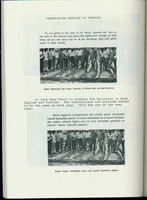 TRANSLATING ENGLISH TO TURKISH To set spiles in the side of the ditch, remove the dirt at the end of the furrow and place the spiles low enough so that when all are set they will be at an elevation that will allow water to flow evenly. Spiles Discharge the Same Amount of Water Into all the Furrows. It took many hours to prepare the bulletins in both English and Turkish. The instructions and pictures needed to be the same on each page. This was one of the easy ones.
 -
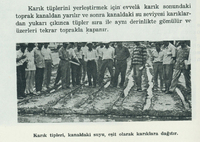 It took many hours to prepare the bulletins in both English and Turkish. The instructions and pictures needed to be the same on each page. This was one of the easy ones.
 -
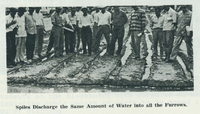 Spiles Discharge the Same Amount of Water Into all the Furrows.
 -
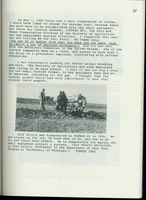
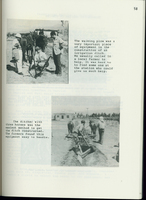 The walking plow was a very important piece of equipment in the construction of an irrigation ditch. We usually called in a local farmer to help. It was hard to to find some one at the station who could give us much help. The ditcher with three horses was the easiest method to get the ditch constructed. The farmers found this equipment easy to handle.
 -
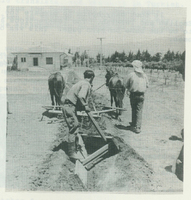 The ditcher with three horses was the easiest method to get the ditch constructed. The farmers found this equipment easy to handle.
 -
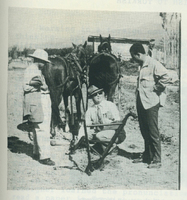 The walking plow was a very important piece of equipment in the construction of an irrigation ditch. We usually called in a local farmer to help. It was hard to to find some one at the station who could give us much help.
 -
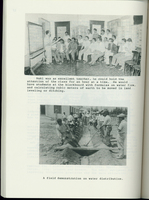 Naki was an excellent teacher, he could hold the attention of the class for an hour at a time. He would have students at the blackboard with formulas on water flow and calculating cubic meters of earth to be moved in land leveling or ditching. A field demonstration on water distribution.
 -
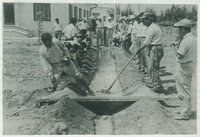 A field demonstration on water distribution.
 -
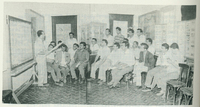 Naki was an excellent teacher, he could hold the attention of the class for an hour at a time. He would have students at the blackboard with formulas on water flow and calculating cubic meters of earth to be moved in land leveling or ditching.
 -
 On May 1, 1960 Verna and I were transferred to Jordan. I would have liked to stayed for another tour, because there was much more to be accomplished with the small equipment, but there was tension between, (TOPRAK SU), the Soil and Water Conservation Division of the Ministry of Agriculture and the experiment station directors. I suspected that Naki was not telling me the full story. My theme song: "You can do it better with what you have and can make, than to import a lot of American machinery." did not set well with the machinery companies in the United States. One of the tractor companies made me a visit, and wanted to know what I was doing as a government employee, interfering with private enterprise. I was continually pushing for better animal breeding and care. The Ministry of Agriculture and some Americans were trying to be more modern. I felt it was too big a step for the small Turkish farmer, to buy equipment that had to be imported, including oil and gas. I thought that the fastest growth could come with improvement in what they already could support. Atif Atilla was transferred to TOPRAK SU in 1956. He was always on the job, he knew what to do, and how to do it, and could show others. He is responsible for making the small equipment project a success. (See TURKEY REVISITED, by John Kolars, Professor in the department of Near East Studies at University of Michigan.) TURKEY 1982
 -
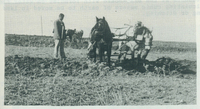 Atif Atilla was transferred to TOPRAK SU in 1956. He was always on the job, he knew what to do, and how to do it, and could show others. He is responsible for making the small equipment project a success. (See TURKEY REVISITED, by John Kolars, Professor in the department of Near East Studies at University of Michigan.) TURKEY 1982