
Metzger Memories
Item set
- Title
- Metzger Memories
Items
-
 REUNION "My how you have changed." If I heard it once I heard it a dozen times. In fact, many had changed so much, they didn't recognize ME. The week of July 8 to 15 1991 was the week of family reunion, for both Verna and me. On Monday the 8th we flew from San Francisco to Denver, and rented a car to begin our week of reunions. First my family and then Verna's. To match time tables, for car, bus and plane can be compared to solving a cross word puzzle, one misplaced letter and you may have to start over. We had only one possible miss and that occurred when we boarded United Air, flight 520 for Denver. Just ahead of us, at the check in counter, was a family from Pakistan. They were checking their luggage thru to Lahore and we had to wait in line. We were able to check in just as they opened the gate to load. Boulder, the first stop was to visit my brother Lawrence. There were three boys in my family, and my other brother, Ernest, from Mesa, Arizona, who was vacationing in Vail [sic] Colo. arranged to be in Boulder at the right time. What do three brothers, all old men in their eighties, with different views on politics and religion, talk about? First they exchange views on their most recent ailments. They then reach agreement on how bad every thing is. They talk about things they used to do and can no longer do. They brag about the accomplishments of their grand children and their great grand children. When the reunion is over they wish each other well, get in their cars and drive off. What do 77 people, ages 9 months to 90 years do when they first meet at a family reunion? They shake hands and say: "I am Marvelle's, I am Verna's, I am Weston's, "but that refers only to the oldest generation present. There is another and another, until you reach the great grandchildren. July 12, 1991, was the first day of the PIELSTICK FAMILY REUNION, at Black Forest Inn, Colorado Springs. They arrived from all corners of the United States. Twelve states are represented. NE. VI. WA. TX. CO. MI. FL. OR. MO. KA. CA. ILL. The first evening was devoted to introductions and identification of family tribes. I, an In-law and I suspect at times considered an Out-law, was attached to the oldest and the retired generation. I believed it to be my right to observe and evaluate those present, in order that I might know after 63 years, just what I had become a part of.
 -
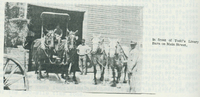
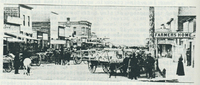
 The pollution of the air and water in Crawford seems of little significance, but I just left San Francisco yesterday in a smog that has the same odor as the diesel truck on the streets of Crawford. In San Francisco there was a warning that all people with breathing problems should stay inside. It may not be necessary to have a sense of smell to live, but it may be that some of the things we are doing in creating odors, is contributing to extinction of life on this planet. Will we lose the ozone layer, poison our environment, the air we breath, and the water we drink? The hitching racks on Main Street in the early 1900s. The dust and flies always found their way into the open doors. The Todd Livery Barn, where Dad would leave Charley when we went to Uncle Henry's. Where teams could be left for days and be certain they would be well cared for. Salesmen would rent teams as we now rent cars. Dr. Richards kept his horse and buggy here. He was present when my two brothers and I came into this world. Those were really house calls.
 -
-
-
 THE CHANGING ORORS OF TIME It is a hot day in June 1984, I have come from Sonoma to attend my 60th Crawford High School reunion. I park in the shade of cotton wood tree, at the north end of Main Street. I suddenly realize this is the location of the Todd Livery Barn where Dad use to leave Charley, when we boarded the train for Uncle Henry's. There is a time clock in my mind, it has no hands, the face is blurred, and I cannot hear it ticking, but it has recorded the passage of time. If I were to close my eyes and walk down Main Street, my nose would tell me that this is not 1914. On a hot June day in 1914 there was a long hitching rack where 12 or more teams of horses were tied. The flies swarm over the hot horse manure, the ground is wet with urine. The sweaty horses were switching their tails and stomping their feet to fight off the flies. There are horses that are beginning to dry off, with long streaks of salt from the drying sweat that is running down their legs. The dry white streaks look like white cotton ribbons. There is only one word that can describe the odor, and that is PUNGENT. The dictionary describes it as " Producing a sharp sensation of smell and taste, sharp and piercing to the mind." Seventy years have passed, it is now 1984 and the little town of Crawford has a population of 1200 [sic], the same as in 1914. The street that was lined with hitching racks is now hard surfaced and there is a large drain that takes the surface runoff to White River which is only a quarter of a mile away. The street is now clean, there are no flies, there is only a little dust where once was horse manure. An 18 wheeler is parked where the hitching racks were, that accommodated 15 teams of horses in 1914, but there is a different odor. The 18 wheeler is loaded with diesel fuel, and the idling motor is belching out smoke that is stifling, oppressive and suffocating. The driver is down on his knees with a wrench to tighten a valve that is leaking diesel fuel. This valve must have been leaking before, because there is a small stream of fuel that is running into the drain. Strange isn't it, the pungent odor of the string of horses, tied to the hitching rack, is no longer with us. The horses are dead, their bodies have returned to dust. The manure was scooped up and spread out on the land to make it richer and more productive. What of the diesel fuel that ran into the drain, and then into the river? Where does the carbon monoxide go that is coming from the idling motor?
 -
 COMMUNICATIONS & TRANSPORTATION April 15,1982, [sic] and Verna and I are on the last lap of a three-week trip to Turkey, A three minute telephone call to Sonoma, from Frankfurt Germany, informs our daughter we will be leaving in one hour. The plane will leave at 10:30 a.m. Frankfort time, and arrive in San Francisco at 11:30 a.m. San Francisco time, the same day. We fly at an elevation of 30,000 feet and a speed of 500 miles per hour, and cross a time zone every hour. We will travel almost as fast as the sun, by taking the flight close to the Arctic Circle. The sun appears to stand still as it shines in the window for the entire trip. This would have been a miracle the day I helped my father string new telephone wire into the ranch house in Western Nebraska on a warm June day in 1916. We had a phone before that date but the barbed wire on the top of the fence posts made a very poor connection, and it was difficult for us to talk to the neighbors that were on the same line. Our call to the phone was two long and two short rings. Some times, neighbors would carry on a three, or four-way conversation, a common social occasion. With the new wire we could now reach a central operator in Moyer's drug store in Crawford. This made it possible to contact other party lines and make long distance calls. Our transportation in 1916 was as different from that of 1982 as was our communications. The morning we finished stringing the new wire, Dad hitched Charley, a dappled gray, high-spirited horse to the small buggy that was used for fast travel, and go to the post office and pick up or weekly mail. There was normally room for two adults in the one seat, but if my brother who was then 8 years old, would sit close to me, we took the space of one adult and Dad would let us ride with him to go to the post office and pick up the weekly mail. Will the next 80 years bring the change in communication and transportation that the last 80 have brought? The dialed cal from Frankfurt to Sonoma took no longer than it did to make the two long rings and the two short ones. The clarity of voice surpassed the old country line. The hour that it took to cover the 5 miles to the post office with Old Charley and the buggy was the same length as the hour it took us in flight to cover the 500-mile time zone. In 1994 we are talking about the super communication highway, and space travel is already here.
 -
-
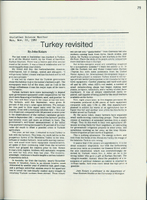
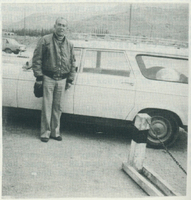
 I guess I can say that "we lucked out", because, I asked a Turk just outside our hotel in Izmir, if he could direct us to a travel agency, he spoke good English and asked us where we would like to go. He told us he had lived in Western Turkey all his life, that he was a retired Air Force officer and occasionally escorted visitors to ancient sites. He said his name was Mustafa, and that he had references if we wished to contact them. The deal was sealed when we found that he was a friend of Naki Uner, my Turkish counterpart in 1955 to 1960. Mustafa made our trip to Turkey the experience we had hoped for, we rode with him for 10 days, in his clean, well maintained, station wagon. Mustafa took good care of us, he would not let us go into a restaurant, rent a room or by anything without his inspection and approval as to safety, quality and price. He was more than a chauffeur, he was our guardian and guide. We had not been out of Izmir one day until Mustafa asked me what he should call Verna. He asked if it was all right for him to call her "MY LADY", I informed him that it would be perfectly proper, and that I thought she might like that, and from there on Verna was "MY LADY". He would help her in and out of the car, and spared no effort to help her climb around old ruins, and get to any place she wanted to go. For five years I had traveled the west coast of Turkey. I thought I had seen all the ruins and old city sites. Mustafa had spent several years working with EXREM AKURGAL, an archeologist who spent his life studying Ancient Civilizations and lost cities of Turkey. Verna and I were taken to sites I had never heard of. For three days we visited people and places around Izmir. We stayed at the school where Verna taught, and she was able to see two more of her students who were now teaching in the school. I was able to see Naki Uner, the Engineer that help design the small equipment, Atif Atilla, the man who made it work, and my farmer friend, that Ishan and I would visit early in the morning, "One-Arm Ahmet" [sic] [At this point a reproduction of the following article is included in the original document: Kolars, John. "Turkey Revisted." The Christian Science Monitor, (Nov. 22, 1982): 23]
 -
 TURKEY 1982 March 1, 1982, 6:30 a.m. Verna to Jim, "How would you like to make a trip to Turkey? Half awake, I mumbled, "It sounds O.K., but let me wake up before I answer [sic]" I have been working on several projects, and one of them has a time limit. We are having a membership drive for the Chamber of Commerce, but that should be finished in a couple of weeks. Our passports are in order and we do not need visas, so perhaps we could go in two or three weeks. Surprise trips have been proposed by Verna before and have turned out to be some of our most interesting experiences. The trip to Mesa Verde in 1951, with all the family, the one to Africa in 1966 from Amman, Jordan, and the one to Mexico with Russ and Peggy, the fastest decision we ever made, in eight hours after the trip was proposed at breakfast, we were on a flight to Mexico City. Perhaps it is time for another surprise trip, this time to Turkey. At 6:00 o'clock the morning of March 23rd, we were on our way to Izmir, Turkey, where we lived for 5 years, from 1955 to 1960. I had served as Irrigation Advisor to the Turkish Government, and Verna taught English in a Turkish Girls school, under the Congregational Church Mission. These five years had been a very rewarding experience for both of us, and we were anxious to see Turkey again. We took TWA Flight 754 from S.F.to [sic] Boston, where we spent a few days with Jack and Linda Blake. Verna met two of her former pupils she had taught while in Turkey, both were teaching in Wellesley College, Sumru Erkut, a top student had her PhD. and was flying to San Francisco to present a paper at an astronomy conference. When we were ready to leave Boston, the airport was fogged in, our flight had to leave from N. Y., and it wasn't until midnight that we could get a flight to New York, and then to Frankfurt and Istanbul, so it took us nearly 24 hours to get from Boston to Istanbul. We were met in Istanbul by Mel Wittier, a friend from previous days in Turkey. We spent two days in Istanbul with both Turkish and American friends, and were able to see our former landlady from Izmir, Nemica Aysoy, now retired and living in Istanbul. I had an international drivers license, and since we had driven in Turkey before, we thought it would be our best method of getting around, but renting a car proved to be more difficult and expensive than I had thought. We soon found that we could hire a driver and his car for much less.
 -
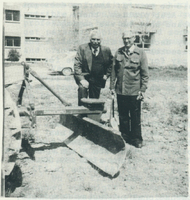
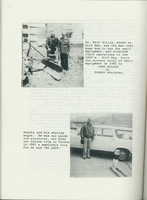 Dr. Atif Atilla, known as Atif Bey, was the man that knew how to use the small equipment, and directed field operations in the 4 1950's. Atif Bey, tells the success story of small equipment in 1982 to John Kolars in TURKEY REVISTED, [sic] Mustfa and his station wagon. He was our guide and protector, and made our return trip to Turkey in 1982 a memorable trip for me and "MY LADY"
 -
-
-
 In 1959 I attended a Rotary meeting in Beirut, Lebanon. I sat next to a banker who said to me, "If America does not change its idea on this Israel-Arab problem, there will be a lot of trouble." I now understand what he was saying. We make our foreign policy decisions from local pressure groups. The local pressures are too much for our politicians, and we will pay for their mistakes for a long time to come. Israel cannot exist with out our support, and some day we will not be able to afford it. and some day we will find that we can no longer continue our support. Rotary has had a continuous growth since it was founded in 1911 by Paul Harris, a Chicago business man, who felt that it would be a good idea for business men to meet on a regular basis to discuss their problems and meet for good fellowship. Rotary started with 4 men. In 1914 there were 4000 [sic] clubs. In 1957, 9288 [sic] clubs with 439,000 members. In October of 1990 the were 25,163 clubs in 172 countries with a membership of 1,107,950. There have been many international projects; Hospitals, Schools, Clinics. The major project of 1989-90 was called polio-plus, and with the cooperation of the World Health Organization,the [sic] Agency For International Development, and over 225,000 clubs, a program was launched to eradicate polio in the world. To-date [sic] they have raised over $500,000,000, and more than 530,000,000 children have received the vaccinations. Since the Berlin wall has come down, all eastern block countries have started clubs again, including Russia. Recently women have joined the clubs in the United States, and a few other countries. Sonoma had its first woman President in 1992, Grace Salt, a very active member since 1988.
 -
 The contact with Rotarians from these countries was an experience I will always cherish. At every opportunity possible, I would remove my bureaucratic hat and put on my professional hat and attend Rotary. I often was able to get personal opinions and some times very frank statements and attitudes that other countries had of the United States and of the American people. Verna and I attended the Rotary International Convention in Lucerne, Switzerland, in May of 1957. I helped start the Izmir Turkey Club in 1960, this was the third club to be formed in Turkey. I attended, again in Izmir in May of 1982 when Verna and I were there on a visit. If leaving my wife sitting in a car, or in a hotel room for hours, while I hunted up a Rotary meeting, can be called wife abuse, I am guilty. I would go out of my way, or change my travel schedule, to make a meeting, and Verna would sit and wait for me. On one trip home on leave, we drove thru France. We stopped one night in Fontainbleau [sic], the Rotary club was meeting in the same hotel where we were staying. This was the first meeting of the season and it was Ladies' night, so Verna attended with me, and if it hadn't been for her knowledge of French I would have had a difficult time making our wishes known. At the dinner there was much toasting and many greetings. We were treated well but few could speak English. There were many toasts and the wine bottles lined up the full length of the table. The main meal was finally served. Verna was tired and asked to be excused, and I stayed for a while and presented the banner from the Longmont Rotary club. When I left the meeting, I went back to our room, I didn't want to disturb Verna, so I left the light off. I took my tooth brush from my case and a tube, I thought was tooth paste, but it turned out to be Mentholatum. I could taste this tooth brush every time it was wet, and I soon got a new one. Verna still accuses me of getting too much wine. I attended the Amman, Jordan, club many times during our stay in Jordan. Every time I appeared at the meeting, the Club President would say, "We have an American guest today; the meeting will be conducted in English." I soon became aware of the fact that the majority of the members were refugees from Palestine, these were Doctors, Teachers and Business men that had been in Palestine while under the British, so they all spoke good English.
 -
 ROTARY The countries of the world are fast becoming one. What happens in China can be seen in the USA as it occurs. We have so many common problems that we can no longer ignore our neighbors. We have arrived at a point where we must sit down together and solve problems of air and water pollution, energy, food production, population growth and others. We are living on a planet that has limited resources. There are many organizations and businesses that are now operating internationally, and it is time for all of us to be aware of the problems that must be solved if we are to save life on this planet. Rotary International was organized in 1911, and is now in over 170 countries, and has been active in many fields such as, Education, Health, and Business. I have been a member since October 1945, when I joined the Longmnt [sic] Club, and in 1955, when we went overseas, they were willing to keep me on as a regular member. We were instructed when we left the United States, that we were not to become involved in religious or political activities in a foreign country. No one said that I couldn't go to Rotary in a foreign land. In 1955 there were about 4000 [sic] clubs in more than 50 countries, I knew that some of these countries would have Rotary Clubs, and that I might be able to attend, and I was pleased that I could retain my membership. Armed with the international directory of Rotary Clubs, I looked for one at every stop we made. Our flight to Turkey in Sept. 1955 had a rest stop in Copenhagen. We took a ferry to Malmo, Sweden on Sept. 4th., where I attended my first Rotary Club outside the United States. By the time we returned to the United States in 1967, I had attended 34 clubs in 24 countries, Sweden, Norway, Germany, England, Belgium, Holland, France, Italy, Turkey, Greece, Syria, Lebanon, Egypt, Kenya, India, Nepal, Japan, Hong Kong, Canada, Austria, Jordan, Israel. In 1975 when we went to Colombia, SA, I attended 2 more clubs. This made a total of 36 clubs in 25 countries, on 4 continents, and I left a Longmont banner at every club, and received one in return. These banners will be found on the wall of the Rotary meeting room in Longmont, Colorado.
 -
 College brought a new dimension to my experience as an entertainer, I met a man who was to remain a friend for life, Ray Magnuson from South Dakota. I saw Ray for the first time on July 4, 1927, at Ardmore South Dakota. Ray entertained a 4th of July crowd, when President Coolidge was present. The President was using the Black Hills for his summer White House. When Ray and I were rooming together in 1927, at the University of Nebraska, we paid some of our college expenses with our Banjos, guitar and harmonica. Most of our entertainment was in and around Lincoln, but we did go out of town on special occasions. Some of our trips did not make- us much money. It cost more to get to the town and back home than we made [sic] In Feb., 1928, we had an engagement at Stromsburg Nebr. The radio had announced that there was a blizzard on the way, but since it was still as far as Lusk, Wyoming, in the morning, we thought that we could make the trip before the storm would reach eastern Nebraska. The blizzard reached Stromsburg about the same time we did and our audience consisted of less than a dozen people. I think they felt sorry for us, they gave us $5.00 and it took all of it to pay our friend who had loaned us the car. We had to ask him to wait a few days until we got enough money to fill the gas tank. Ray and I tried out for the Red Path Chautaqua [sic] circuit and were offered a contract for the summer of 1928. Easter vacation changed our plans, Verna and I were married and Ray had an offer from the University of Nebraska for a summer job, so the contract was never was signed. For 40 years, the banjo, guitar and harmonica lay quiet, I would occasionally play for a Christmas party, or for a family gathering, Silent Night, or Happy Birthday was all I seemed to remember. In 1976 we came to Sonoma. Dan Ruggles, the music man of Sonoma, some times pushed me to play for a program he was sponsoring. Ray Magnuson was living in Santa Rosa, and occasionally we would get together for old times sake, but most of the time the harmonica, banjo and guitar were quiet. I have had the fun of playing with a dance band and a blue grass group, and I have played harmonica solos with the pipe organ. It takes more practice than I seem to be willing to put in. Dan Ruggles, I need you to give me a boost. I want to hear again the singing, the clapping of hands and stomping of feet from the kids on the front row. I want to walk off stage and hear them shout, [sic]"MORE MORE."
 -
 MUSIC "Hey, what are you doing Kid: [sic]"? With a start I turned and saw Old Joe standing in the door way. What was I doing at 5 years of age, standing at Old Joe's bunk bed? I was blowing on his harmonica, and it tasted like something I had never tasted before. Old Joe chewed tobacco and his harmonica got the benefit of the portion that didn't stick to his mustache when he tried to hit the spittoon. For many summers my Father hired a man that I knew as as Old Joe. He must have been a drifter that would appear at haying time when Dad needed more help in the hay field. When the day's work was ended, we would sit out on the porch in the cool of the evening and listen to Old Joe play his harmonica. To me it sounded as if he had moved the organ from the church. He played, Amazing Grace, or Onward Christian Soldiers. He played music that I had never heard before, Darling Nellie Gray, Down by the Old Mill Stream, When Johnie comes Marching Home. I wanted a Harmonica and knew that if Santa knew how badly I wanted one, he would bring me one for Christmas, but Dad beat Santa to it, he bought me one for my 6th birthday, and on that day, my music career began. Dad could play a harmonica and he taught me how to breath in and out so that I got a note with each breath. I soon found out that with enough huffing and puffing I could get a noise that sounded as if it might be a tune. We had a neighbor, Clint Jones, who often helped during the haying season. Clint would bring his banjo with him and then we really had music, Old Joe would play his harmonica and Clint would accompany him with his banjo. I wanted Clint's banjo, and he sold it to me for $5.00. I paid him from my allowance which was fifty Cents a month. Now I had a harmonica and a banjo. Old Joe and Clint were soon gone, but night after night I would try to make the Harmonica sound as if Old Joe was playing and at the same try to get the right cord on the banjo. Victory was mine on the evening of May 14, 1924. I made my first appearance between acts of the High School Senior play. I heard my first audience clap, stomp their feet and, as I left the stage, call for more, but I had no more, I could play only two pieces. The banjo and harmonica did well, they followed me thru college. I later purchased a guitar from Clint Jones and was able to use either the guitar or banjo with the Harmonica.
 -
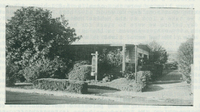
 Our community activities soon occupied our time. We joined the Congregational Church, Verna served as secretary to the Board of Trustees and I became Treasurer. Verna soon made her contact with PEO and in 1979-1980 was President. She became a member of AAUW, joined Women's club, delivered meals on wheels, and became a member of the Hospital Auxiliary. I joined the Chamber of Commerce and, for 10 years worked on the Membership Committee. I passed examinations for Life Insurance, Variable Annuities, and Real Estate, joined Rotary and was a member of the board of directors for 6 years. In 1978, received an appointment from Sonoma County Supervisors on the Ground Weather Advisory Committee, and later the Flood Control Advisory Committee. The community gave its support to the Senior Service Center, and we helped with that. My volunteer activities were soon taking all my time, and the Insurance and Real Estate licenses, became inactive. We moved from our mobile home in Oct. 1991 to a two bedroom apartment. We can get our meals and have other help when needed. Sonoma has treated us like royalty. We have lived here in Sonoma 18 years, longer than any other place. 29 Mazatlan Drive. Fifteen years in one house, [sic] We live less than a mile from our former home and occasionally join our friends for special social events.
 -
-
 NEBRASKA TO CALIFORNIA In December of 1975, Verna and I made a trip to see Ken and family in Cape Girardeau [sic] Missouri. Ken was teaching at the University. We spent Christmas with them and then drove west to Arizona to see my brother Ernie and family, in Mesa and Verna's sister, Marvelle, in Sun City. It was now January and when we were ready to return to Scottsbluff, there was a blizzard in the Rocky Mountain Area, and we were afraid to drive thru the mountains. While we were living in Jordan, we became acquainted with Romain and Bertha Swedenburg. Romain was minister at the Community church in Beirut and we had often driven from Amman Jordan to visit. They had returned to the US and were now serving a church in Fresno California. We knew that it would be some time before we could go home thru the mountains, so we decided to visit the Swedenburgs. The best route home from Fresno [sic] CA. was north on 99 and then I-80. If we went that route we would be within a couple hours from Sonoma. How could we come that close without stopping to see Dale and Peggy? Every time we were in Sonoma, we had looked at houses, thinking that some day we would live here. Peggy suggested that we take a look at the Mobile Homes at Pueblo Serena. The day before we were to start for home, we went to Pueblo Serena, the manger showed us the only two coaches that were for sale. We had never lived in a mobile home, and I wasn't interested. We made an appointment to return the next day, but canceled it the next morning. As we drove thru Sonoma on our way home, Verna said, "It will be at least another year before we get back here, perhaps we should have looked again." This comment sparked a lot of conversation for the remainder of the day. When we reach Elko Nevada, we had decided to make an offer on one of the coaches, so we made phone call to the manager of the park. We were home for only one day, and received a telephone call, telling us that we had purchased the coach. Now we ha to do something. We listed our house in Scottsbluff, and sold it quickly. We called a mover and loaded everything on the truck, and arrived in Sonoma, May 1, 1976. We were now Californians. Peggy and Russ met us at 29 Mazatlan Drive, as we drove up at exactly at 12:00 noon. They presented us with flowers and a bottle of Sonoma wine. Our house hold goods arrived a few hours before we did, and were all unloaded. We began the unpacking process within an hour. Russ informed us that if we would get our boxes unloaded he would be glad to get them out of the way the next day.
 -
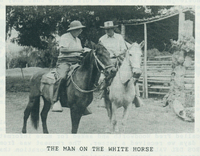
 Senor Humberto loaded the luggage in his pickup and took me directly to the Continental Hotel, where we were to be staying, for the month we were in Cali. Senor Humberto looked very familiar, I had a sense of having seen this man before. Shortly after I had the call from IESC, Verna and I were watching a TV documentary, on South America. Cali, Colombia, was one of the locations where the filming was done, and one of the scenes was an interview with a man who owned a large plantation. He was mounted on a white horse and riding thru an orange grove. I suddenly realized, that the man sitting beside me was the man I had seen on the white horse, when I watched the TV documentary. For 4 weeks I was to ride beside this man. I was to have my own horse, and we would be carrying maps and instruments, designing a new irrigation system for his orange groves and rice fields. Our conversation on the ride into Cali was to answer many questions that both of us had been asking. Humberto had been reluctant to accept my assistance. He had an unhappy experience with some U.S Government personnel who had been working with USAID. He said they would seldom get out in the field, they would just ride around and talk. My concern had been that I would have to work with a laborer or some one who would not be able to understand what I was trying to do. I was insisting on working with the owner or a responsible person in the field. Senor Huberto's first question to me was, "Can you ride a horse?" My answer was, "I could ride a horse as early as I could write my name." It was good that I could ride a horse, because it was the only way to get to the irrigated fields. The first three hours on the plantation was spent in the saddle. I hadn't ridden a horse for 10 years, and when I dismounted, I staggered like a drunken sailor. One of the interesting aspects of the assignmet [sic], was that we were housed in the Continental Hotel with 7 other IESC volunteers. All were working on diffenent [sic] projects. Dairy, Leather goods, House construction, clothing mfg., Grocery marketing, and ball point pen mfg. Each of us had our own counterpart, and mine was THE MAN ON THE WHITE HORSE.
 -
 THE MAN ON THE WHITE HORSE The day began at 4:00 a.m. Our flight from Scottsbluff to Denver was on a small 10 passenger plane. Our luggage was so bulky that I had to sit with some of it on my lap, and it was a relief to get on a larger plane to Miami. From Miami to Bogata [sic] was not much better than the flight from Scottsbluff. The luggage was all checked in, but our seat assignment placed us beside a man that weighed at least 250 pounds, he spilled over into one of the seats that we had been assigned. Augustine Sanchez, a congenial, talkative man who spoke good English. Augustin couldn't do enough for us, he got us thru customs in a hurry, he seemed to know every officer in the terminal. He insisted that we go to his home and meet his family, the result was that we were late getting to our hotel, and we lost our reservation, and we had to sleep on cots in the office. We wanted to do a little sight seeing before we went to the assignment in Cali, so we left some of the luggage in Bogata and made a trip to Quito, Ecuador. Quito is on the equator so we had our pictures taken, holding hands, Verna standing in the southern hemisphere and I, standing in the northern hemisphere. We had reservations to Machu Picchu, but Verna became ill with an amoeba bug and was not able to make the trip, so she spent the next three days in bed in Cuzco, while I made the trip to Machu Picchu. Verna was very ill when we returned to Bogota [sic]. We located a doctor at once but he didn't do her much good. I wanted to call the client in Cali, and cancel our appointment, but it was easier to fly the 180 miles to Cali than it was to get back to the U.S. The IESC office in Bogota [sic] called the client in Cali and informed him that we would try to complete the assignment. When we reached Cali, we were met by our client Senor Humberto Tenoria, and his wife Lucia. Senor Humberto was a graduate Engineer from Texas A & M, and spoke very good English, and we were welcomed as if we were long lost friends. Humberto ask permission to take Verna to his doctor, who was a specialist in tropical diseases, so Lucia took her directly to the hospital in her car. The Doctor ran a few tests and in three days she was out of the hospital, weak and thin, but on the road to recovery.
 -
 Negotiations thru the main office seemed never to end. My qualifications didn't seem to suit the client. The client's response didn't answer the questions I was asking. Later both the client and I were to have a good laugh over the reasons for the delay. Senior Humberto Tenerio, the client, owner of the plantation, had a bad experience with personnel who had been working for USAID. He complained that they just rode around in the car and made suggestions, but wouldn't get out in the field. I had some experience with projects of this type and I was concerned that my contacts would be with some laborer, or gang foreman and I wanted to be certain that the owner would be out in the field with me. I had been in situations on special assignments, where I had only laborers to go to the field with me, I wanted the boss. I didn't want to run a construction gang. Differences were finally settled and Verna and I, with all our shots and passports and visas, left home the last week of Jan. 1975. We wanted to see more of South America before reporting to our client in Cali, Colombia, and for the next week, we went sight seeing in Equador [sic], Colombia, and Peru. THE MAN ON THE WHITE HORSE.
 -
-
 I E S C Of all the organizations in the United States that promote good will and cooperation between nations, it is the INTERNATIONAL EXECUTIVE SERVICE CORPS. (IESC). The IESC was organized more than 30 years ago. Its purpose was to make available U. S. experienced personnel to foreign countries that wanted help in a variety of fields, Agriculture, Education, Medicine, Industry, Banking and others. There was no salary for the U.S. personnel. The company or client paid the costs of travel and per-deim for the volunteer and spouse. Often the tour of duty was for 30 or 60 days. The United States Government, thru the Agency for International Development, occasionally would cooperate with the program if it involved a project that was of national interest. Rotary International coordinated some of its projects with IESC. A recent news letter from IESC, Sept 1991 reported over 12C volunteers in 39 countries. Thru the encouragement of a friend, Harvey Brewbaker, I placed an application with IESC. I received only an acknowledgement from the New York office that they had received the application and that it would be placed on file. In November of 1974 I got my first call from New York. "JIM: JIM: where are you?" Verna was calling from in the house. "You have a telephone call from New York." I crawled from under the house where I had been cleaning a drain, and make a run for the telephone. I watch Verna cringe as I cross the dining room floor with my muddy shoes. "Hello", the answer comes in a strong authoritative voice. "Mr. Metzger, this is Fred Woodworth, I am the recruiter for the International Executive Service Corp. (IESC). We have a client in Cali, Colombia, S.A. who is asking for an Irrigation Specialist to design and help construct an irrigation system on two plantations. If you are interested give me a call tomorrow." The request came as a surprise, Verna and I talked it over and decided that it might be a great experience and so we called Fred Woodworth and asked for more information. In a few days we received a letter. The request was from CITROS DEL VALLE LTD. a family-owned corporation that had an orange and banana plantation.