
Nu History
Item set
- Title
- Nu History
Items
-
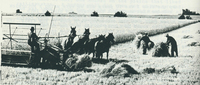 The photos are taken from the magazine, THE FURROW. A published by the JOHN DEERE CO. a magazine that Dad received for years. They show the equipment we used to cut and thresh wheat, oats, barley, and rye. The grain binder was a great invention, it cut and bound the grain so it could be handled with little loss. It was pulled by four horses. The wooden reel pushed the standing grain back over a cutting bar, and onto a moving canvas platform. Two elevator canvas belts took it to packers that pressed it into a bundle, and a circular needle, threaded with binder twine circled the bundle and threaded a device that tied a knot. The bundle was then dropped into a basket that would carry several bundles, and dumped in a windrow where they would be set up in shocks. Dad hired extra help, sometimes Indians from the reservation, until his sons were big enough to help.
 -
 HARVEST TIME In the early 1900s practically all grain was harvested with horse-drawn equipment. A lot of physical labor was required to handle the cut grain. It was cut with a binder, shocked in the field and when the threshing machine was available it would be hauled to the machine. The grain was then put in grain wagons and scooped from the wagon to a bin. The weather was a very important factor. Usually in late July and August there was little or no rain and the operation would not be interrupted. If there was rain, threshing could be delayed for weeks. When weather conditions were favorable it would mean 12 to 14 hour days and sometimes in 100-degree temperature. By the time I was 10 years old we were using a McCormick grain blinder that would cut the grain and bind it into bundles tied with twine. The grain binder was pulled by a four horse team. If the threshing were done in the field, the bound bundles would be hauled to the machine in hay wagons. The threshing machine was powered by a steam engine. It was common practice for 6 or 8 neighbors living in the community to cooperate in the threshing operation, and follow the machine from one farm to another, until all the grain was threshed. The men were fed at noon by the women of the house where the threshing was being done. Great mounds of mashed potatoes, big kettles of vegetables and 10 to 20 pounds of meat, would be consumed at one meal. Every house wife dreaded to see the threshing crew come to their farm. Verna needs to tell the story, she has helped with it many times. The cooking was done on a wood or coal range. Refrigeration, if there was any, was an old ice box. All the water for cooking and washing had to be hauled from the well that was often some distance from the house. My Father was skilled in all the tasks needed to do this work and was a hard man for me to follow. He was tireless and no one could ever accuse him of being lazy. He always did his share of the work. I began following the threshing crew when I was 15 years old. I would work so hard, and be so tired and hungry that I would make myself sick eating too much. It was always a relief to get back to school in September. I swore that when I got thru school that I would never get involved with farming and ranching again.
 -
 Rattlesnakes congregate in the fall of the year in river banks or rocky outcrops. It was an annual affair for ranchers in Western Nebraska, to go to the rocky banks of the Niobrara river and kill as many as two or three hundred at a time. The snakes could be found sunning themselves on the rocks. Some times they could be dug out in bunches of rolled up snakes. We had a neighbor who lived in a sod house, and kept a bull snake around the house during the summer. He said he could be sure that the rattlers would not come near, the bull snake would chase them off. He never had any trouble with mice and rats while the bull snake was around. He had a cat, but during the summer there were never small kittens I guess the snake liked them also. I know of only one animal on the plains that liked rattlesnakes. A badger will dig them out of the ground, and eat them, thick fur on the badger would keep the poison fangs from doing any damage. The only domesticated animal that seemed to survive the rattlers bite was a hog. I have seen a hog kill a snake and eat it. We had a dog on the ranch that hated snakes, and would occasionally kill one by grabbing it and shaking it until it was dead. Dogs have been bitten by rattlesnakes and have been killed by them. I have known of two homesteaders who were bitten. They both recovered, but the cure for a snake bite can be a bit drastic. If a rattler bit you, take a pocket knife and make a deep cut over the bite, if possible place a tourniquet above the wound, then suck the blood and poison out as fast as you can. The most drastic attempt to get rid of the poison, that I have ever heard of, is told by Marie Sandoz of her father. In her book, OLD JULES, chapter XVII, SNAKE BITE. Jules reached under a building to pull out a hammer, and a snake bit him on the back of his hand. He called for Marie to get his knife, she couldn't find it fast enough to suit him, so he reached for his shot gun and shot off the back o his hand. It took more than 6 hours to get to the Doctor, who told him it was all that saved his life. At one time I had a pint jar filled with rattles that the family had collected. Now I have only two small ones left.
 -
 RATTLESNAKES The rattlesnake has been the topic of much conversation by homesteaders in Western Nebraska. I have never been bitten by one, only because I was out of reach when it made the strike. I have thought that all living creatures on this earth had a purpose, but I have never figured out what the purpose of the rattlesnake was. Snakes are useful in keeping rodents under control, but why does it have to carry a load of poison? I have been told that the rattlesnake lives only in the western hemisphere. It is very well known in the western states of the United States. My father told me when I was very young, that if I heard a rattlesnake, just stand still, don't move until you locate it. There were several times as a small boy that I took the advice, but it is difficult to do. It is also often hard to locate the snake. The gray diamond back rattler is well camouflaged, and can be hidden in the grass and weeds, especially on stony ground. The horses and cattle on the ranch are also afraid of the rattler. I have had a saddle horse nearly jump out from under me when he heard the dreaded rattle. One hot day in August, I was loading bundles of grain in the rack to take to the threshing machine. The team was well trained, and as I loaded the shocked grain on the wagon, they would move up to the next shock, without driving them. I thrust my pitchfork into the shock of grain and a sudden buzz stopped me. It reached the ears of the team at the same time, and in a matter of seconds I had a run away team that left me standing with my pitchfork in the shock of grain. Every time I moved my fork there came another rattle. I finally located the snake, it was in a depression in the ground where a horse had stepped. It was 5 feet long, and coiled like a gray rope. I got rid of the snake in a hurry, took my knife and cut off the rattles. My team was stopped by a friend that was working close by. Prairie dog holes were a good hiding place, and if a horse or cow got too close, the snake would strike. This happened to one of our best work horses. For a month that poor animal walked around with a head so badly swollen that its eyes were closed and it nearly starved before it could eat. We were able to stick a hose down its throat and give it water. The animal did live, but it took it a long time to recover.
 -
 There have been many sad experiences with dug wells. Diggers have been buried alive because not enough care was taken to prevent earth from caving in on the digger. Children and animals have fallen in wells that were not covered or fenced. Mari Sandoz, the daughter of a prominent homesteader in Western Nebraska, tells a story of her father, known as OLD JULES, who dug a well on his homestead near Hay Springs. Nebraska, he hired two young neighbors to help him. The young fellows would operate the windlass and take the dirt out of the well. Water was found at 60 feet, and when OLD JULES was finished they pulled him out in the bucket. The boys thought they would have some fun with the old man s they would lift him almost to the surface and let him drop. The rope broke and let him fall to the bottom of the well. His foot was badly broken, and the frightened boys were so scared they pulled him out of the well and went off and left him to find his way home. It was three weeks later that soldiers from Fort Robinson found him in his home with a badly infected foot, and took him to the hospital. The doctor who treated him, was the now famous Dr. Walter Reed. We had two dug wells on our homestead. There was one that was not used and it was covered with planks and then fenced. Dad had a fine Shire stallion that weighed about 2000 lbs. The horse was reaching thru the fence to get the green grass in side the enclosure, the fence broke, and he stepped on the planks and fell in the 40 foot well. He was no doubt killed at once when he hit bottom. We filled in the well, but Dad lost a registered Shire stallion worth at least $1000.00. There are many stories told of homesteaders who tried for a year or more to get water and finally gave up, and left their homestead.
 -
 DRINKING WATER For much of my life, if I wanted water I went to the faucet, and turned on the right one for cold and the left for hot. Some one went to a lot of work and expense to make this possible, but it hasn't always been that way. When a homesteader filed for a 640 acre tract of land under the homestead act of 1862, the first thing to be developed was a water supply. If there was a stream or spring on the homestead, the problem was solved, but if a well had to be dug, there were many questions to be answered. Where do you dig? Was water close to the surface? What type of soil would be encountered in digging? Would it be good water and enough of it? All of these questions had to be answered or your homestead was of little value. There was a well on the homestead that my father settled on. He bought a 640 acres farm from a family that relinquished their rights, so the problem of a water supply was well known before he took possession of the property. Digging wells was an art. It was not uncommon before digging was started, to call in a person who was called a water witch or divinor [sic]. This person with a forked willow stick, held in both hands in front of him, walk along a site where he hoped to find water, when the stick turned down, in his hand, he would just say, "Dig here", and often he right. When a site was located, the next step was to dig a hole, four feet square, just large enough for a man to work with a short-handled spade. It was usually easy digging for the first 5 or 6 feet, because the dirt could be thrown out of the hole, but when the hole became deeper, it was necessary to fill a bucket and a helper could pull it out by tieing [sic] a rope to the bucket, attached to a windlass. When the hole was deep enough to be a danger from earth caving in on the digger, a solid wooden frame, four feet square would be made and lowered in the hole. The frame would go down as the digger went deeper. I have seen dug wells that were as deep as 80 feet. It was dark down in the hole, and the deeper you dug, the darker it becomes. The deepest well I was in was only 40 fee deep. If the digger was lucky he would hit water at 30 feet, but he would dig in the mud and water until the water came in fast enough to fill the bucket. There is no greater disappointment than to dig for days and find no water.
 -
 There is a lot of snow on the ground. The wind and cold have made the snow very hard, and the horses hoofs squeak as they walk on the snow, as I lead them to the wagon. I try to start, but the wheels are frozen to the ground, and it is necessary to turn the team from left to right and work the front wheels loose. We start off at a fast walk, with the wheels squealing when the iron tires turn in the cold snow. The lake where we cut the ice is only three miles from the ice house, and we are soon unloading. Dad and our neighbor, Clint Jones , mark out the blocks that are to be cut. Then with the saws, we cut out blocks of ice that are about 30 inches by 20 inches. The blocks will be from 6 to 8 inches thick, depending on how cold it has been, and will weigh from 75 to 85 lbs. The wagon will hold a ton or about 24 blocks of ice. The team can easily pull that much if they don't slip. We haul the load to the ice house and pack the cut blocks into one large block that nearly fills the house. We then fill in around the large block with sawdust, and put lots of straw or hay on top. This will not be opened until warm weather comes. When we open the ice we take from one corner, and then re-cover. We can expect the ice that was packed in January to last until late July or August. Usually filling the ice house was not an exciting job. There was a lot of hard work in cold weather, but we could always keep warm while working. This wasn't always true for the horses we used, they had to stand while we filled the wagon. We normally unhitched the team, but one day there was a lot of ice close to the wagon and I didn't think it would take long to load, so I left them hitched. This was mistake, a dog chased a rabbit in front of the team, and frightened them, they started to run with the wagon half full of ice, and they didn't stop until the reached home. There were blocks of ice strewn along the way. I had to walk home, but there was no damage to the wagon. All the cold weather and hard work was forgotten by the 4th of July. Home made ice cream has a way of making you forget your troubles.
 -
 FILLING THE ICE HOUSE To have an ice cold drink or a dish of ice cream was a real luxury when I was a boy. Refrigerators were available in the early 1930's, but at that time we had no electricity. Units that used gas or oil were available but expensive so we used an ice box with ice we cut from the pond. To live on a ranch in Nebraska, required an adjustable thermostat. The weather was your partner and often not a silent one. Hot, cold, wet, dry and many combinations of these governed your life. In order to have the luxury of a cold drink or a dish of ice cream on a hot summer day, required some very cold days during the winter. It must be 10 to 20 degrees below zero for a 15 or 20 day period to freeze the ice on the lake to a depth that would support teams and equipment. We usually waited until the ice was 7 or 8 inches thick before we would even attempt to put up ice. Christmas vacation was often the most favorable time to put up ice, and I had to spend my vacation working. At 6:00 o'clock in the morning, Dad would pound on the bedroom door and say, "It's time to get up, we are going to put up ice today." I would throw the covers back and step out of bed, and when my feet touched that cold floor, I felt as if I had stepped on a cake of ice. The thermometer had been hovering very close to the zero mark for several days. Dad says that it should warm up. There is ice on the water pail in the kitchen. Mumsie will have breakfast for us when the chores are finished. By 7 O'clock it is beginning to get light, and Dad gets the equipment needed to cut the ice: There will be saws, ice tongs, stakes and string for marking out the squares to cut. We will get a wooden plank, to use as a slide for loading the wagon. I will get the team and hitch them to the wagon. It is so cold that I have to take the bridles into the house when I go to breakfast, in order to have the bits warm enough so that they will not freeze to the horses' tongues. The horses are cold and don't like to stand for long, so I hurry as much as possible to get them hitched to the wagon.
 -
 The trip into town was uneventful, Dick didn't jump when the train went by, and he crossed the bridge with out as much as a second look. Frank Lewis was on hand to help me fill the wagon. We didn't even weigh the load, Frank said that if the lower box was filled it would be a half ton. He was anxious for me to get started home, before the storm reached us. Frank asked me to go to the store with him, he gave me a sandwich and sent me on my way. It was one o'clock when I started home. The sky looked gray, the sun was disappearing, and in the sky looked very dark in the north. I imagined a lot of problems. What if the wagon broke down under the 1000 lbs of weight? What if the team got scared and ran away? What if? What if? Getting the team to go home was no problem, they always wanted to go home. My problem was to hold them down so they wouldn't go too fast. The first mile went very well, then I felt a snow flake hit my face. I was getting anxious, but there was nothing to do but keep going. It was only four more miles, and another hour, but it seemed an eternity to me. I got off the wagon and walked beside the team when I got cold. The driving snow melted on my face, the lines became very wet, that made little difference, because the team followed the road. I was very glad to head the team into the drive way and get the coal under cover. While I was gone, things were happening at home. Dad and Mumsie finished digging the potatoes and had them in the cellar. They had pulled all the cabbage and had it stored in the barn. The temperature never got below zero, and the storm was over in a couple of days, but It did give the homesteaders a scare. There was no radio, no TV weather man, just a little country line with its short rings and the voice of the operator to tell us that we could get a change in weather.
 -
 EARLY WINTER Winter on the Western Plains, for the homesteaders, was a dreaded time. If snow and cold came in September, it could be especially hard. The growing season, in Western Nebraska, could be as short at 90 days. Hay for the horses and cattle would have been harvested, but grain crops could still be in the field. Garden crops, such as carrots potatoes and cabbage, could be caught in an early freeze and be a catastrophe. These crops meant basic food for the family. The meat that was most often available was beef or pork, butchered on the farm. Farm families lived very well if crops matured early enough to be harvested. I remember only one year when we got caught with an early freeze. I think that I was 12 years old, the year would have been 1919. The family was at the breakfast table, when the telephone rang with a series of short rings. This was a call from central that there was an announcement for all on the line. Dad went to the phone, he listened for a couple of minutes, then he hung up the receiver and came back to the table. "There is a snow and heavy wind coming our way, it is as far east as Sheridan, Wyoming, and will be here by night." His words meant only one thing, we had better get ready for a blizzard. How could this be? This is only September, the sun was shining and not a cloud in the sky, it gave signs of being a warm day. Lawrence and I were just ready to go to school, the storm was a long way from us, and we should have plenty of time to get home before it got as far as Crawford, Nebraska. It didn't take long for plans to be changed, I was not to go to school. Dad consulted Mumsie for a few minutes, then turned to me and said, "Do you think you could take Blossom and Dick and go to town and get some coal? Frank Lewis will help you load, you should get along very well if you take the river road into town." My first reaction was that of elation; sure I could do it, on second thought it didn't seem to be so good. I remembered that Dad had a problem getting Dick to cross the bridge, the wagon was almost upset one time on a trip to town, when Dick refused to step on the loose planks. When he did step on the planks, he gave a leap that nearly threw us from the wagon. Dad helped me hitch the team to the wagon and gave final instructions for crossing the bridge and the railroad tracks. His last words were, "You may let the team trot going into town, but walk them when you come home, or you will lose some of the coal."
 -
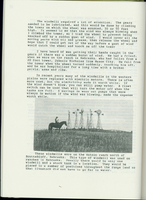 These windmills were on the Watson ranch north of Scottsbluff, Nebraska. This type of windmill was used on ranches in Nebraska. Usually there would be only one windmill and a stock tank in a location. They would be placed in a number of positions throughout the range land so that livestock did not have to go far to water. These windmills were on the Watson ranch north of Scottsbluff, Nebraska. This type of windmill was used on ranches in Nebraska. Usually there would be only one windmill and a stock tank in a location. They would be placed in a number of positions throughout the range land so that livestock did not have to go far to water.
 -
 These windmills were on the Watson ranch north of Scottsbluff, Nebraska. This type of windmill was used on ranches in Nebraska. Usually there would be only one windmill and a stock tank in a location. They would be placed in a number of positions throughout the range land so that livestock did not have to go far to water.
 -
 PUMPS AND WINDMILLS The homesteader with a good well on his place, had another problem to solve, the water had to be raised from the bottom of the well to ground level. It was always possible for a person to attach a 3 or 4 gallon pail to a rope, and let it down in the well, and when the pail hit the water, give the rope a quick jerk and the pail would flip over and fill with water, then pull the rope hand over hand until the pail reached the surface. One person would have to work all day to water 100 head of cattle. I have seen many types of inventions that made it easier to get the water out, than just dropping a bucket in the water and then hand over hand draw it to the surface. The first improvement was a single pulley mounted above the well. This made it possible to get the water to the surface with out leaning over the well. The next improvement was a windlass. An A type frame was set over the well, a long rod placed thru the A frame. This rod was placed thru a small drum around which the rope could be wound. A crank on the rod was turned by hand and would lift the bucket of water. This was a great improvement over the pulley, but required a lot of time and labor. The next improvement was the long-handled pump. The design of the pump was much like those in use today. It was a cylinder, a piece of pipe, 2 or 3 inches in diameter, 18 inches long, with a plunger in side the cylinder. A rod then connected it to the pump handle, as you lifted and lowered the handle you would lift and lower the plunger inside the cylinder. Three flutter valves were used in the cylinder, one on each end of the cylinder and one on the plunger. The valve in the bottom of the cylinder held the water while it was being forced out thru the top valve. When the stroke was completed, a cylinder full of water would be pushed up thru the pipe and out of the pump. A small (weep) hole was drilled in the pipe, just far enough from the top of the ground to permit water to drain back after pumping. This would prevent the pump from freezing in very cold weather. The pump could always be worked by hand, but some one figured that the wind wheel could do the work for them. The windmill was not new, it had been used for a long time. Man were home made on the order of a wind-vane, the best ones were made commercially. We had a SAMPSON on the homestead in western Nebraska, but there were several other makes. [sic] the Fairbury, the Aero and others.
 -
 It was now the third day of the storm. The sun was beginning to show thru the clouds. There had been no wind, and the snow was now 4 feet deep, it was beautiful to see, a white sea of snow, but almost impossible to go any place. Dad said, "You had better try to go." I grudgingly went to the barn to get my saddle horse, Baldy, the horse that I had been riding to school, and headed for the Dawes Forbes' ranch. It was only three miles, but I think the longest three miles I have ever traveled. Dad suggested that I not go around by the road, and take a pair of wire cutters with me and cut the fence. Baldy wasn't pleased with what I was doing, but with some urging she waded out into the snow. I would follow the fence line as far as I could. There was no other guide line, and even then it was hard to see. There had been no wind, only the tops of the posts appeared above the snow. The white caps made them look like a line of little soldiers standing quietly at attention. It took me nearly two hours to reach my destination. Baldy couldn't carry me and wade thru the snow. I put the lariat over the saddle horn, and drove her ahead of me. What I saw when I got there was very discouraging. There were both cattle and horses to feed and water. Some of the cows were calving, and two of them were having trouble, which was a problem that took a lot of time. Two days of hard work; The wind did not blow, and the sun melted the snow, so in a short time we could move around. When it became time to go home, Dawes Forbes thanked me, gave me two dollars, and said, "KID, you did a good job."
 -
 DEEP SNOW It was April 1922, and the day dawned bright and clear. It was like many other April mornings in Western Nebraska. It had been warmer than usual for April and much of the ground preparation for planting, was finished. This year Dad is seeding alfalfa with the oat crop. The oats will be harvested in August and the alfalfa would continue to grow and be a crop for several years to come. The planting was done with an 8 foot grain drill pulled by four horses. The alfalfa seed was placed in a small hopper, along side the big hopper that held the oats. and will be seeded at the same time. All went well the first day in the field. The second day began with another bright morning, but by noon the sky was gray and cloudy. By the middle of the after noon it began to snow. With in an hour there was so much snow on the ground that I had to quit. I unhitched the team and went home. By nightfall there was six inches of snow. There was no wind and everything was covered with a white blanket. The next morning it was still snowing. The grain drill that I had been using was so well covered that all I could see above the snow, was the seat, and the top of the hopper. There was still no wind, this was not like Western Nebraska. There was nothing we could do in the field, but now we had a new problem. Dad was a horse breeder and foals were arriving. We had to spend all day getting them into dry quarters. It was necessary to scoop enough snow to get the herd to feed and water. There was now 3 feet of soft white snow on the ground, and still snowing. Monday morning arrived, the third day of the snow. An emergency telephone call, a series of rings, announced that there would be no school today. I was feeling good about everything, because this would be a vacation. It wasn't long before the phone rang again, this time it was two longs and two shorts, that was our ring. Dad got up from the breakfast table to answer. He talked for some time, and from the tone of his voice I knew that something was not good. I heard him say, "I can send him over, but I am not sure that he can get there." HIM meant me, and I didn't want to go anywhere. Dad came back to the table and sat down. I was afraid to start the conversation, so I said nothing. Finally, what seemed ages to me, he said, "Dawes Forbes is sick and in bed. He can't get his cattle to feed or water and he wants you to help him for a few days." I didn't want to go any where, above all things, I didn't want to go to work for Dawes Forbes. I got along with him, but he always called me KID, and I didn't like to be called KID.
 -
 I can only imagine what my college work would have been with out a typewriter, I established several USDA flood control projects while with the CCC camp and Soil Conservation Service. I often made preliminary surveys with out clerical help. There were reports while on assignment in foreign countries, where clerical help was not available. A shortage of technical staff and language problems made it necessary to write my own reports. I have to confess, that even I had a hard time reading my hand writing when it got cold. My typewriter made it possible for others to read what I wrote. My spelling has improved, when I wrote by hand I might be able to make A look like an E or an F, and if it were type written it had better be correct. I worked all summer in 1924 to save $60.00, and bought a Remington portable typewriter. In 1928 I married an English and typing teacher, who taught the same typing class that I had taken 4 years earlier. You can understand why I was especially careful when I wrote love letters to her. Verna is still of special help when I do this writing. How can I look up a word in the dictionary, or even get my computer to spell, if I can't even get the first two letters right? I have just ask her how to spell curriculum, I can't find it under CA or CO. she says, "look under CU." Participation in extra curricular activities while in High School was difficult for me. It was necessary for me to work mornings and evenings at home. I did get my parents to let me play foot ball my senior year, but this was not very successful, the Crawford team won the western Nebraska championship in 1923, the year that I played, but I was not experienced and played on the second team most of the time. I took the hard hits from the backfield of the first team. I had one experience that I will probably never forget. Working in the manual training class was a friend that liked caramel candy, one day he gave me a piece, I liked it so well that I gave him a nickel to get me some, he would give it to me at the next manual training class. He never did come back to class, and I lost a nickel. I don't know whether it was because I lost the nickel, or that I didn't get the caramel candy that made me remember it all these years. I gradated in June 1924, I did have an opportunity to show some of my skills, the seniors put on a play the week of graduation. A request was made for members of the class to provide some entertainment between acts. I volunteered to play my banjo and harmonica. This was a novelty act that was new to the audience, and I got a good hand. This act brought me a lot of attention. I guess I needed this to satisfy my ego.
 -
 HIGH SCHOOL My high school years were not the happiest years of my life. From a one room country school, where we seldom had more than 10 or 12 students, to a high school that had 140 students with four or five teachers was to be a difficult adjustment for a 13 year old country kid. Most of my high school class mates had been together thru the first eight grades, and had many friends. There were only two of us from my school. It appeared to me that all were dressed better than I, and my self esteem was about as low as it could get. I thought I was the country hick. It was to be many years before I could rid myself of that feeling. Every morning before I left home I had to care for the horses and cattle. As soon as I was finished with my chores I would grab my books, hurry to the barn, saddle my horse and ride the four and one half miles to the barn where I kept my horse. I would make a run for school before the bell rang at 9:00 o'clock, At 3:30 p.m. I would reverse the process, and hope to get home before it became dark. My mother would have supper ready as soon as we were thru with our chores. The regular diet would be meat, potatoes and gravy, with homemade bread, which we washed down with lots of cold milk. The family always ate together and Dad usually wanted to know what we had learned that day. Home work would take an hour or two. I studied at the dining room table, by the light of a kerosene light. It was a great help when we were able to get a gasoline light that hung from the wall and lighted the entire room. Bed time came at 8:00 o'clock, and we were up the next morning at 5:30. I expected to do this five days a week, and Saturday meant extra work to haul enough feed to last for the following week. I looked thru my records and found the transcript of grades that were sent to the University of Nebraska when I matriculated in the fall of 1927. The 32 credits required to graduate included English, Latin, chemistry, physics and mathematics. The electives included manual training, and typing. English and Latin were difficult for me. I took Latin the second time, and then just got passing grades. I liked manual training, Dad had taught me to use wood working tools, and I could make the other students look like amateurs. This was the only time that I really felt equal to my peers. I graduated with an average grade of 80. I liked manual training the best, but the typing class was to prove the most valuable course in High School.
 -
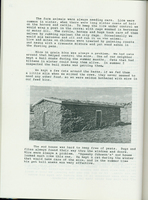 The farm animals were always needing care. Lice were common in winter, when there were long winter coats of hair on the horses and cattle. To keep the lice under control we would wrap a post in the corral with rags soaked in kerosene or motor oil. The cattle, horses and hogs took care of them selves by rubbing against the oily rags. Occasionally we would mix kerosene and oil and rub it on the animal. Lice and mites on chickens were treated by painting roosts and nests with a creosote mixture and put wood ashes in the dusting pans. Mice in grain bins was always a problem. We had cats around that helped control the mice. One of our neighbor kept a bull snake during the summer months. Cats that had kittens in winter could keep them alive. In summer I suspected the bull snake was getting them. We kept a few cats around the barns, if we fed them a little milk when we milked the cows, they never seemed to need any other food, so we were seldom bothered with mice in our feed bins.
 -
 The sod house was hard to keep free of pests. Bugs and flies always found their way thru the windows and doors. Mice were always a problem. "Squeaky Johnson's" sod house looked much like this one. He kept a cat during the winter that would take care of the mice, and in the summer time his pet bull snake was very effective.
 -
 PEST CONTROL Are you being eaten by bugs, lice, fleas, mice or rats? Call the pest exterminator. He will bring his chemicals and electrically powered machines and clean things up for you. As late as 1932 we had no electrical equipment and very few chemicals that could be of help. We had to invent our own method of getting rid of the pests. If we couldn't get rid of them, we just lived with them. It seemed to me, when I was a boy, that my folks were always fighting some kind of pest. Flies, bedbugs, fleas, mice, mites, these were always a concern in the house. Lice ticks, fleas, worms, were year around problems with cattle, horses, hogs, chickens, cats and dogs. Grasshoppers, potato bugs, and worms were eating up our garden and other crops the minute we turned our backs. The ordinary house fly, on the ranch where there were cattle and horses, was the most common pest. We built fly traps that caught them by the thousands. The traps were made of ordinary window screen rolled into a cylinder with cone shaped entrance at the bottom. Fly bait of food would attract the flies, when they flew away, they would hit the cone shaped part of the trap and crawl into a hole that the could never find to get out of. Then there was sticky fly paper of various kinds. The ribbon of sticky paper that hung from the ceiling, or the large flat piece of paper wit glue that was an attraction for flies and bugs. Bedbugs, ticks or fleas were not common if care was taken to keep things clean. The problem could arise at harvest time when extra help was hired. Mumsie made sure that some of the clothing would be left outside, but that didn't always work. When there was evidence that some of these pests might be present, she would close up the house and put a pan of sulphur [sic] on the floor and light a match to it. The fumes would kill every living thing in the house. When the sulphur [sic] burned out, she would open up the house, and air it out. When winter came, mice could always find a way into the house. The worms and bugs always seemed to get to the garden before we did. The tobacco worms on the tomato vines, or the potato bug on the potatoes. The chemical that we used was called PARIS GREEN, a bright green powder, made by mixing sodium arsenic with copper sulfate and acetic acid. We would put a small amount of the mixture with water in a pail, and walk down the potato row and sprinkle the mixture on the vines. If we did not use the poison, we took a small can with some kerosene in it and picked the bugs and worms off the vine and threw them into the kerosene.
 -
 Smokey was a small, ugly horse, a dirty smokey [sic] color, with a dark stripe down his back. My father would never have had it on the ranch under normal conditions, but he had hired an Indian from the reservation to help him harvest the fall crops, and he had loaned him some money, that he couldn't repay, and so gave Dad the horse. Smokey had a bad habit of running away. I broke chin straps and bridle reins trying to hold him, he would run for home and go right into the barn if the door was open. Eventually I found a way to stop him, I took a long shank curb bit, with a wire jaw strap, and put an end to his running. I rode to school in all kinds of weather, hot, cold, snow or rain, but with proper clothes I could keep warm and dry, Handling a horse in very cold weather could be difficult, if it were below zero, 40 below is the coldest I remember, great care had to be taken to get the frost out of the bit. A bit with frost in it can take the skin off a horse's tongue. The frost can be removed by putting the bit in water or blowing on it, the moisture from the breath was enough to take the frost out. It was several years before I was permitted to drive the car, and then it had to be for special occasions in my senior year. The saddle horse was my transportation. This was the first horse I owned. Dad gave me the gift when I was 8 years old, I named her "GERTIE". I looked forward to the day when I could train her. One day an evangelist came to the door and was explaining to Mumsie that the world was sure to come to an end in about ten years. My first thought was that I would have time to train my horse.
 -
 This was the first horse I owned. Dad gave me the gift when I was 8 years old, I named her "GERTIE". I looked forward to the day when I could train her. One day an evangelist came to the door and was explaining to Mumsie that the world was sure to come to an end in about ten years. My first thought was that I would have time to train my horse.
 -
 TRANSPORTATION TO SCHOOL In May of 1920 I passed the county examinations that permitted me to enter high school. In September I enrolled in the high school in Crawford, Nebraska. It was about 4.5 miles from the ranch to the school. I rode a horse for the 4 years, and only on rare occasions would I be permitted to use the car. My father raised horses, and much of his income came from selling teams of horses for farm work. He occasionally would sell one that would be used on a single buggy or as a saddle horse. Some times the horse would be partly trained, and it was my task to do some of that early training. I remember the name of every horse I rode. Many of these horses were only half broke, and did not want to be ridden. This meant some rough rides for me. The first horse was Bob, a flea bitten sorrel, Bob always wanted to turn and go home when he got to the bridge, As a small boy I used to go as far as the bridge and then turn around. There was Lucy, Betty, Smokey, Baldy, Dick. I remember three of these horses better that the others, because they occasionally left me sitting on the ground and I would have to walk home. Lucy hated automobiles and trains. In 1920 there were only a few automobiles on the road, and when one of these contraptions came along with flapping side curtains, she would have a fit. She would turn in spite of anything I did, and start for home. Usually the driver would stop, turn off the engine, and let me pass. I would still have to get as far from the car as possible. There were two railroads in Crawford, and the tracks crossed at the point I entered the city limits. The engineers would take delight in blowing the whistle. Lucy would jump and start to run. One time she just stuck her head between her front legs and bucked me off, and I had to walk all the way home. Baldy hated dogs, and in the fall during fair time, the Indians from the Rose Bud reservation, would camp along the road where I crossed the river. The dogs around the camp seemed to take delight in snapping at Baldy's heels. She would kick at them, and occasionally hit one and send him head over heels into the borrow pit at the side of the road. The fair usually lasted 8 or 10 days, as time passed, the number of dogs that bark at my horse, became fewer, and the lines of dried meat got longer.
 -
 I would have been better off had I known. I was scared, if Lawrence is lost I am in real trouble. Dad leaped from the dining room table, went to the barn, saddle his horse, mounted and pulled me up behind the saddle, and told me to show the way we had gone. For an hour we crossed and recrossed that wheat field. Suddenly, Dad stopped his horse, right in front of us was a sobbing little 4 year boy wearing a bright red shirt. Dad reached down and pulled him up into the saddle with him. Not a word was spoken until we reached the house. As we sat down to dinner, Lawrence, between sobs, said, "Didn't you see my RED SHIRT"? I never was punished for running off and leaving my brother. I think my parents knew that I was badly scared. Dad just said, "Don't run off and leave any one again." It is painful to this day, for me to leave someone if I think they may be lost, or have no way to get home. If this picture were in color the shirts would be red. I am sure that when Lawrence outgrew his he would get mine, so he would wear a red shirt for a long time. The same would be true of the overalls. These overalls were special, they had two buttons for each suspender. When I got caught under the barn I couldn't get one of the buttons unhooked.
 -
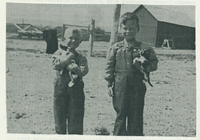 If this picture were in color the shirts would be red. I am sure that when Lawrence outgrew his he would get mine, so he would wear a red shirt for a long time. The same would be true of the overalls. These overalls were special, they had two buttons for each suspender. When I got caught under the barn I couldn't get one of the buttons unhooked.