
Nu History
Item set
- Title
- Nu History
Items
-
 appeared to me as if we were going right over the same old track. I knew that I never would be comfortable until l [sic] got my college degree. I decided that I must make a change. I announced, one Sunday at the dinner table that I was going to Lincoln and to the University of Nebraska. It was a sudden blow, but my parents seemed to accept it and agreed that my younger brother, Lawrence, would take my place for the remainder of the year. The mental torment the remainder of the day was one of the tough times in my life. I now could not turn back, but between 1:30 p.m. and 10:00 p.m., my mind was in a turmoil. I worked out a settlement with my father on the partnership and he gave me a check for $500.00. When the crop was harvested we would complete the settlement. He said nothing as he wrote the check, but I knew he must feel as frustrated as I did. I packed my suitcase, and boxed up some clothes to be sent later. I took my banjo and my beloved typewriter, and waited for the time when the train would take me to a new world. The die was cast, I dare not look back, or I might be tempted to change my mind. Verna was at the ranch that week end, I was to take her back to town in the evening. We had very little conversation the rest of the day. At 9:00 o'clock we loaded my belongings in the car, Dad and Momsie would take me to the train, and then take Verna to her apartment. It took less than an 30 minutes to reach the depot. It was vacant except for a lone baggage cart. A freight train was sitting on the side track, it was breathing heavily as steam escaped the cylinders. It was waiting for No. 42, the passenger train that would take me to Lincoln. The agent sold me my ticket, and we waited for only a few minutes before the lights of No. 42 appeared. The train rolled to a screeching halt. I told my parents good buy [sic], with only a peck on the cheek for my mother, and a handshake from Dad. Verna followed me to the train, we stood for a few minutes and watched as the baggage was loaded. ALL ABOARD I kissed Verna, shed a lot of tears, turned and took the steps into the car and found a seat. It was dark by the time the train left Crawford. I had a seat by the window. My spirits were low, I peered out of the window and watched the lights of Crawford, disappear I could see the twinkling lights of the scattered ranch homes slip by. We stopped for a passenger at Belont [sic]; at Marsland we picked up another. I have no idea how long I stayed awake, the clatter of wheels, the mournful wail of the whistle had a hypnotic effect, Five hundred miles to Lincoln thru the sand hills of Nebraska would start a new life for me.
 -
 LEAVING HOME Some one has said that one generation stands on the shoulders of the preceding generation. If this were not true, my friends and I would have had to invent the wheel again. I take for granted my comfortable life, it is very different from that of the cave dweller. The people living now are the ones that influence my life, and help cut the patterns from which I weave my tapestry. The influence of my parents on my life is hard for me to evaluate. How is it that they were my parents, that I would be born into a caring family with concern that society would accept me? By the time I reached maturity, I had adopted the customs and manners of the society in which I live. The people that I met by chance, or was it by design, after I left the protection of my family, is the story I want to tell. After leaving High School I went into partnership with my father on the ranch at Crawford, Nebraska. The word partnership, hardly describes the arrangement, Dad had run the ranch for as long as I had lived, and he continued to make most of the decisions, I merely followed. Many people have touched my life and have influenced my thoughts and actions. There is, however, one person that has been my life since I met her in September, 1925. She was one of the new High School teachers who came to Crawford, and has been my room mate and traveling companion for 66 years. Verna Pielsick came to Crawford to teach English and commercial studies. We met at a party that was held to introduce the new teachers to the other young people in the community, one of the games played was to tie a marsh-mallow in the middle of a string about four feet long, with a contestant at each end, chewing the string until they reached the marsh-mallow Verna and I reach the marsh-mallow at the same time. We dated most of 1925 and 1926. I, an awkward country bumpkin, she a college graduate, interested in music; art, and the coach of the drama team. I could not convince myself that she could be interested in me. I knew that there were others interested in her also, but on October 9, 1926, she agreed to marry me. We would not be able to marry at that time if she were to continue teaching. Married women were not allowed to teach, as she just might take a job from a man who was supporting a family. In Sept. of 1927 Verna returned to Crawford to begin her third year of teaching. We had our first date and it
 -
 The roads we had to travel were roads made by horse drawn wagons and carriages. Ruts were often 8 to 10 inches deep, this meant that the clearance on the car had to be as much as the horse drawn equipment. It was not uncommon to hit a high center and have to use a shovel to dig out the center or fill in the ruts. There was very little on the car that could not be fixed by a good blacksmith. In fact the first auto mechanic we had in Crawford, was a young man who worked as a blacksmith and later changed his sign to a mechanic. I have repaired many parts of the Model T. The bearings in the motor could be made by hand. The gears in the differential could be repaired by any one that could handle a wrench. It was possible to get the gears in backward, which I have done, and when I expected to go forward I went backward instead. It was a problem for my father to drive. When he first started driving and had an emergency he would yell "WHOA" expecting to stop. I learned to drive at the age of 10, and he would often let me drive. No license was required for either the car or the driver in the early 1900's. I never had a drivers licence [sic] until after Verna and I were married. We bought our first car in 1929. It was a 1922 coupe, for which we paid $25.00, and drove from Lincoln to Crawford, a distance of 475 miles, with a cost of $8.75 for gasoline. The only problems we had were flat tires and a broken fan belt. There were no paved roads, a few miles of gravel, but mostly just dirt roads. I have no idea how any tires I have had to patch. If we went 500 miles with out a flat we were lucky. We patched them at the side of the road and pumped them up with a hand pump. In 1926 I drove from Crawford to Cumro, Nebraska where Verna was spending the summer on the ranch with her folks. I left Crawford at 3:00 a.m. and arrived at 9:30 p.m., a distance of 350 miles. I had to go thru the sand hills, open 11 gates, and back up some of the hills when I was low on gas, in order to get gas to the motor. I made this same trip in 1972. The road was paved and is Nebr. HY No 2. It took me only 8 hours to make the trip. Just one half the time it took me in 1926. The hills appear to be smaller, there were no gates to open, no cattle guards to cross. I did't [sic] have to patch any tires.
 -
 THE MODEL T FORD The history of Henry Ford and his introduction to the world of his MODEL T, is a story that could fill a book. The story I want to tell is that of the Model Ts in my life. My father bought a model T ford in 1917. He had just sold 18 or 20 head of horses to the U. S. Government to be used in the war in Europe. He bought a touring car, I never knew why it was called a touring car, it had a cloth top that could be used up or down, and side curtains to keep our the wind and rain. It was popular before the closed sedan was manufactured. I recall hearing long discussions among MODEL T owners, as to the merit of the touring car. Some said that the sedan was too tightly enclosed and would never sell, some said it would be too hot, not enough air, especially for those riding in the back seat. I courted Verna in a 1922 model that was very much like the 1917. It was a black car, the only color that Ford made. Dad had kept the 1917 model, and made a pick up by cutting the back seat off and putting a box in its place, and it was still in use in 1930. The 1922 model cost $450.00. It had a four-cylinder motor that had to be cranked to start it. It did not have a gear shift, nor was it automatic. It used what is called a planetary gear system. There was a hand brake, operated with the left hand for parking and, when set would allow the motor to continue to run. The driver had to operate three foot pedals. The left pedal was the forward gear, when pushed down it became the low gear, or starting gear, when released it became the high gear. The right pedal was the foot brake. The center pedal was the reverse gear. The pedals tightened bands in the transmission, a similar principal is used in the modern automatic transmission. The 1917 and 1922 models did not have a foot feed. The speed of the motor was regulated by a hand throttle. It had no battery, no oil pump, no water pump,no [sic] fuel pump. The ignition and lights were made possible by a series of magnets attached to the fly wheel and a series of stationary coils mounted on the motor block. The faster the motor was running, the better the lights, they became very dim if the motor slowed, and that was usually when they were needed most.
 -
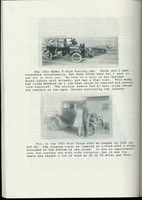 The 1922 Model T Ford Touring Car. Verna and I went horseback occasionally, but more often than not I went to see her in this car. We were on a trip to Hot Springs South Dakota with friends, and had a flat tire. This model had tires mounted on a rim that could be removed and another tire replaced. The earlier models had to have tires reoved [sic] and patched on the spot, before continuing the journey. This is the 1922 Ford Coupe that we bought in 1929 for $25.00. The windows could be lowered or lifted with a strap attached to the bottom of the glass. It was an improvement over the touring car with side curtains, but it was top heavy and caught a lot of wind at 30 or 35 miles per hour.
 -
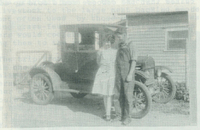 This is the 1922 Ford Coupe that we bought in 1929 for $25.00. The windows could be lowered or lifted with a strap attached to the bottom of the glass. It was an improvement over the touring car with side curtains, but it was top heavy and caught a lot of wind at 30 or 35 miles per hour.
 -
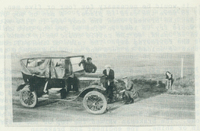 The 1922 Model T Ford Touring Car. Verna and I went horseback occasionally, but more often than not I went to see her in this car. We were on a trip to Hot Springs South Dakota with friends, and had a flat tire. This model had tires mounted on a rim that could be removed and another tire replaced. The earlier models had to have tires reoved [sic] and patched on the spot, before continuing the journey.
 -
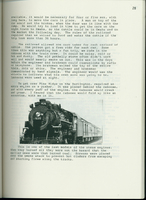 available, it would be necessary for four or five men, with long bars, to move the cars in place. A man on top of the car would set the brakes, when the door was in line with the ramp. We would try to load in time to get the cars on the night train to Omaha, so the cattle could be in Omaha and on the market the following day. The rules of the railroad required that we unload to feed and water the cattle if the trip took more than 36 hours. The railroad allowed one care taker for each carload of cattle. One person got a free ride for each car. Some times this was anything but a fun trip, we rode in the caboose with the train crew. It could be noisy, cold or hot and dusty. The old potbelly stove often didn't work well and would nearly smoke us out. This was in the days before the engineer and brakemen could communicate by radio or telephone. The brakeman walked the top of the entire train, rain or shine. The engineer and brakeman communicated by hand signals. The engineer would use the whistle to indicate what his next move was going to be, lanterns were used at night. To get over Pine Ridge on the Burlington, required an extra engine as a pusher. It was placed behind the caboose, and with every puff of the engine, the caboose would creek and groan. I feared that the caboose would fold up like an accordion, with me in it. This is one of the last models of the steam engines. When they burned oil they were not the hazard that the earlier ones were that burned coal. Screens were placed over the smoke stack to prevent hot cinders from escaping and starting fires along the tracks.
 -
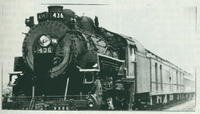 This is one of the last models of the steam engines. When they burned oil they were not the hazard that the earlier ones were that burned coal. Screens were placed over the smoke stack to prevent hot cinders from escaping and starting fires along the tracks.
 -
 We were only about five miles from a center where rail cars could be unloaded. The closest loading point was Horn, a siding three miles from the ranch, but it did not have facilities to load livestock. We went to Crawford, the closest shipping point. We loaded livestock for shipment to Omaha or Kansas City. We received coal, lumber, farm equipment, and other supplies. The settler that was within 10 or 12 miles of a shipping point was among the fortunate, he could make a round trip of 24 miles in a day with a good team of horses, and a loaded wagon. The longest trip I have made with a loaded wagon, was to haul wheat to Whitney Nebraska, for shipment to Omaha. I was 12 years old, there were five of us with teams and wagons. The wagons would hold 40 bushels of wheat that weighed 2400 [sic] lbs. Dad would usually try to buy our supplies of coal, for cooking and heating, when a carload was shipped into Crawford. If we unloaded directly from the car, when it came in, we could get it cheaper than if we took the supply at the lumber yard. We were able to get our winter supply for only $4.00 per ton. The greatest boon to the rancher, was to be able to ship livestock to the large meat packing centers. Omaha was the most often used by those who lived in Western Nebraska. Shipping grass-fed cattle was usually done in October, and ranchers would cooperate in rounding up the cattle and driving them to the rail center. The trip from the ranches to the rail center could be done in one day. I have ridden in the roundup, with Jim Calame, Harvey Finley and Dawes Forbes, all neighboring ranchers. One of us would put a halter on an old cow, and lead her down the road, and the range cattle would follow. All would go well until we got close to town, most of the cattle had never heard a train whistle, nor had they seen a Model T Ford with flapping side curtains, and it took a good cowboy, on his best saddle horse to keep a wild eyed steer from going back home. Cattle cars had to be ordered ahead of time, in order to have them on track when needed. Several cars would be spotted at the stock yards that had loading ramps. It wasn't hard to chase 40 head of steers up the ramp and close the door on them, but to move the loaded car with 40,000 lbs. of beef was not always easy. If there was a switch engine handy, the railroad crew would move the loaded car, and spot an empty one, but if there was no engine
 -
 With the good memories, there are bad ones. The railroads were a blessing for the early homesteaders. My parents moved their entire belongings in one box car to the land where they lived for over 40 years. The coal burning engines brought with them the dreaded grass fires that put fear into the hearts of every settler. Fire guards were plowed on both sides of the track to prevent fires fro burning the grazing land, crops and homes. I have seen as any as 5 fires started in a single mile. The plowed fire guards usually stopped them, but if one jumped the guards, an emergency call would go out over the party line, and every settler available would come as fast as he could with plow and team. Guards would be plowed around hay stacks, homes and barns. The Chicago, Burlington and Quincy, (CB&Q), known as the Burlington, ran thru our ranch. My brother and I would, occasionally walk along the tracks and place a penny on the rails, and then crawl out of sight under the bridge and wait for a train to run over it. We couldn't always find it afterward, but when we did it was just a thin copper wafer. The wooden bridge, that spanned the drainage way, was a casualty of fire. After it burned a couple of times, it was replaced with a large concrete culvert. My father did some work for the Burlington Railroad, with a four horse team and fresno, (a large earth scoop), he moved earth over the concrete culvert, so that the rails could be relayed. I suppose the reason the memory is so vivid in my mind, is because I had a part in the project. The earth moving job was hard on horses, it took a team in good working condition to walk in the soft earth for more than three or four hours. This meant that if Dad put in a full day, he needed more than one team. The task of changing teams was partly my job. I was only 9 or 10 years old and I would bring a fresh four-horse team to him each day. Dad would have the extra team tied in the barn, and at noon I would go to the barn, and put the collars on the horses, I would take one horse at a time and tie it to a post, I would then take the halter rope for each horse and lead them to where he was working. Four horses, weighing 1800 pounds each, breathing down my neck didn't make me feel very comfortable. It only took about thirty minutes to get to the job. Dad would change the harness from the team he was using to the ones I brought an I would take the tired team back to the barn, to water and feed them.
 -
 The North Western Railroad would often add a passenger car to a freight train and take it as far as Glenn, a small park and recreational area, and leave it until the passengers were ready to return. Dad had just finished cultivating corn and was in the mood for a holiday. Mumsie packed a picnic basket, Dad hitched Charlie to the buggy and we drove to Crawford. I am now an experienced traveler, and I try to explain to Lawrence, my LITTLE brother, 4 years old, just what the process is, I explained in detail that we drive to town as we always do on Sunday when we go to church. This time we will go to the depot and get on a train. When we get to the depot there seems to be a lot of confusion, buying tickets, arranging the picnic baskets and getting them on the special car. The trip seems very short. The telephone poles fly past, we must be going at least 30 miles an hour. At 5:00 O'clock our special car is picked up and returned to Crawford. [sic] and we are home before the sun goes down. Lawrence and I are soon in bed, but the folks have several hours of work. Feeding the livestock, milking the cows, all must to be done, even on holidays. Phyllis Zauner, in her publication, THE TRAIN WHISTLE'S ECHO, graphically describes the dramatic effect the railroad had on the development of the UNITED STATES---"It is difficult to comprehend the compelling fascination and wonderment that every aspect of railroading possessed for an entire nation for a century." The railroad came to Crawford in 1886. It closely followed the Sidney--Deadwood trail that ran thru our ranch, a trail dimmed by erosion, but deep tracks made by the stage coaches could easily be followed when I was a boy. I took a bad fall when my saddle horse nearly went on his knees, when he stumbled over the hidden ruts made by the stage coaches. The trains that ran on this track seemed to me to be the ultimate in travel. The fact is, in the early 1900's, if it hadn't been for the trains, we would have traveled no faster that the Romans did, 2000 years before. We could go no faster than the horse could run. My memories are filled with the thrill of hearing the passenger train, No. 42, with its long wailing whistle, as it approached the little town of Crawford. Every night when I crawled into my bed, I would try to stay awake until the engineer released the whistle cord on the last note. It will stop only long enough to load the mail and a few passengers, before it labors over Pine Ridge and settles down to a dreary night run thru the Sand Hills to Lincoln [sic] Nebraska.
 -
 TRAINS The transcontinental railroads in the late 1800's, put the covered wagon, the stage coach, and the pony express out of business. Travel across the United States and the transportation of household goods, and building materials, brought fast development along the main lines. The development of the shorter railroads that branched off the main lines, brought many homesteaders to Western Nebraska. Some of my most vivid memories are related to the steam locomotive. It was the only mode of travel that was available, when I was a boy, that could go faster than a horse. My parents moved all they owned by rail to their homestead. My father earned extra money with his teams by working for the railroad. We were able to get needed supplies by rail, and one of our greatest fears was to have a prairie fire that would be set by a steam locomotive. One of the thrills of my life was my first ride on a train. At 5:00 O'clock in the morning. Dad calls out to me, "It is time to get up, get your pants on," We are going to make a trip to Uncle Henry's today and pick buffalo berries and choke cherries. My parents had been doing this every year since they came to Crawford. I was 5 years old, now, and old enough to go with them. My brother, Lawrence and I have had to stay with the neighbor while the folks made the annual trip to pick some of the wild cherries for jams and jelly for the next winter. It was a warm September morning, and Dad hitches Charlie, the dapple gray horse, to the small one-seated buggy and we drove the 5 miles to Crawford. He puts Charlie in the livery stable and we board the train for Andrews, a little town with a post office, a general store, and the depot for the North Western railroad. Uncle Henry, Dad's brother, lives only a few miles from here, over very rough roads. He had taken a homestead at about the same time my folks moved to Crawford, in 1907. I remember very little about picking berries. I do know, that when we finished we were so late that Uncle Henry had to get his team to a gallop to reach the depot before the train left for Crawford. On the 4th. [sic] of July 1913, Mumsie wanted to go with a church group for a picnic at Glenn, Nebraska. This resort and picnic area was 12 miles from Cawford [sic] on White River.
 -
 It was in March 1907 that my father came to Crawford. from Eastern Nebraska to the homestead, at Crawford. He took all of his possessions in a railroad car, a team of horses, a wagon, a plow, two hogs and a cow. He and his father-in-law, rode in the same car. It took two days and one night for the freight train to make the trip. It was late in the evening when they arrived in Crawford and they waited until the following morning to unload. The Tenth Cavalry, a regiment of Blacks was stationed at the Fort, and the soldiers often came into Crawford, to celebrate. That night there was a fight at one of the bars, and two men killed. The next morning my grandfather promptly got on the next passenger train and went back home. He told my father that no daughter of his would ever come to this wild place. I was born on April 1, 1907 in Crawford, so I guess she did come. The history of the establishment of Fort Robinson needs to be told. The Red Cloud Agency was where Chief Red Cloud made his last stand for his people. The U. S Army left corpses all over Western Nebraska, men, women and children. What we did to the native Americans is a disgrace, and we still brag about our conquest of the west. The Red Cloud Agency, that was to eventually become Fort Robinson, was named after Chief Red Cloud, who died in 1909, two years after I was born. In 1940 Verna and I took Dale, Gordon, and a cousin, Bob Phillips, to see Captain James Cook. The Cook ranch was about 25 miles from the site of the Red Cloud Agency. We spent an after noon with Captain Cook, in his home that was filled with personal affects of Red Cloud. The Captain had been a good friend of the Chief. When Chief Red Cloud was forced to live on the reservation, he left many of his treasures with Captain Cook for safe keeping. There were many items that Red Cloud valued, such as feathered head desses [sic], beaded moccasins, buffalo robes and many other items of clothing. I came away from our visit with Captain Cook, feeling as if I too had known this Chief. The treatment they received from the Whites can only be described as brutal and inhuman.
 -
 FORT ROBINSON Don Cunningham writes IN NEBRASKA LAND MAGAZINE, "For four turbulent years, Red Cloud Agency, a miscellaneous collection of store houses, corrals, work shops, residence and other structures surrounded by a rough pine stockade, stood on a low hill near White River, two miles west of the present town of Crawford Nebraska. The Red Cloud Agency became Fort Robinson, and the American flag was raised for the first time in Feb. 1876." Fort Robinson was only about 6 miles from the ranch were I was born. At intervals from 1916 to 1976, before Verna and I came to Sonoma, Fort Robinson was a place frequently visited. When I was as young as 4 or 5, I recall going thru Fort Robinson on the train to visit my Uncle Henry who was living on a homestead close to Andrews, a small town at the head of White River. My most significant trip to the Fort was in 1917 during World War I. My father raised horses, and there was a big demand by the army for horses to ship to Europe, and he sold 18 or 20 to the U.S. Government. These horses were trained at the Fort and then shipped to England and France. I was only 10 years old and Dad gave me a well trained horse to ride, and when we took them to the Fort, I rode ahead, leading one and he followed behind on his horse. I was so small that he had to shorten the stirrups and help me on. If I was alone I had to lead the horse up to a tree stump or a rock in order to mount. The families around Crawford often went to the Fort to celebrate the 4th of July. There were polo matches, horse races and jumping. It was a popular hiking spot for young people living in Crawford, and Verna and I spent a good many Sunday afternoons in 1925 and 1926, with our friends, hiking in the hills around Fort Robinson. From 1939 to 1945 we were again living in Western Nebraska. and made trips to the Fort. It was still being used as a remount station, and at one time had 17,000 horses. It became a prisoner of war camp during World War II, and a training camp for the K9 corp. Dogs were trained and and [sic] used with the guards at the POW camps. In 1955 the State of Nebraska acquired the 22,000 acres for an experiment station for cattle breeding, and later made it a State Park. When we returned from our overseas assignment in 1967 we lived in Scottsbluff, and made frequent trips to the Fort. The former housing for the military personnel had been converted to accommodations for tourists and we would go there for a week-end vacation.
 -
 An annual corn husking contest was held every year in the early 1900's. The last one I was to observe was in 1932, at York Nebraska, Verna and the family were living in York and I would come from Lincoln on week ends, This contest was to be the last, for the year. The Nebraska Champion Cornhusker, would be crowned at the end of the day. In the fall of 1932 I wanted to earn a little extra money for school. A farmer had an ad in the local paper for a corn husker, so I called for more information. He was paying 2 cents a bushel, and he would furnish the team and wagon. This sounded O. K. to me, so the next morning, I went to his farm. I harnessed the team, hitched them to the wagon and went to work. I had my lunch with me and took only a few minutes to eat. By nightfall I had filled one wagon and half of another. By the time I had unloaded the last load I was a wreck, my hands were sore, my back ached and I could hardly stand up straight. I had worn out a pair of husking mittens that had cost me 25 cents, and I had a blister on my right hand under the hook. The farmer seemed to be pleased, he complemented me on my ability to handle his team, He was pleased that I was able to scoop the corn to the top of the bin. I had harvested 75 bushels. He paid me the $1.50 I had earned, and said he would be glad for me to come back next week. I had netted $1.25 for my day's work, and I needed money badly, but I never went back, I thought there must be a better way to make a little money. Times are different now. a farmer pulls into his corn field with a $50,000 machine that takes four rows, it removes the husks, shells the corn and will fill 7 or 8 wagons in a day, but in the last few years many of them have gone broke, just as we did in the 1930's. I have never husked an ear of corn since 1932, and I did find an easier way to earn a little money. I think I know why Nebraska is called the CORN HUSKER STATE, but why do they call the football team the CORN HUSKERS? I suspect sometimes when they get thru playing a game, they are as sore as I was when I husked corn in 1932.
 -
 HUSKING CORN For more than a month, Dad has gone to the corn field early in the morning. When it got light enough to see where he had worked the day before, he turns the team into the ripe corn field so the wagon straddles the last row that he had husked. He gets out of the wagon, the teams walks slowly down the field, and he will husk the two rows next to the wagon. Dad takes an ear of corn in his left hand, with a hook on his right hand, he quickly removes the husks from the ear and throws it in the wagon. He does not look up, the ear hits the bang boards that are built high on the far side and the ear drops easily into the wagon. As regular as the tick of a clock, one ear follows another, they hit the bang board and becomes apart of the load. He will get two loads today, each will have 40 or 50 bushels of ear corn. It is 5:00 O'clock in the morning, and it is dark and cold. I don't want to get up, but Dad says that if we work this week end we can finish husking corn. This is a holiday week end, and I will take a team of horses and a wagon and follow him to the field. I will also take one ear at a time, wrench the leaves from it and throw it into the wagon. Dad takes the lead and pulls into the field ahead of me. I work as fast as I can but he gradually pulls ahead and leaves me far behind. Noon arrives, and it is time to go to lunch. My wagon is only about two thirds filled, his is so full he has to place another board on top to keep the corn from falling out. He calls to me as he get on his wagon. "How are you doing Son?" I merely groan, get up on my load and follow him to the corn crib. My back aches, my hands are sore, I can hardly straighten up. The wind had blown some of the cornstalks down, and I feel as if I have been crawling on my hands and knees most of the time. I am certain that Dad is having a good time, watching me struggle. He is 35 years older than I, but he can out class me in this operation. I never was able to keep up with him. Some times he would let me start ahead of him. The first time he let me start ahead, I thought he wanted to take it a little easier. When we came to the end of the field, he said he would like to go ahead this time, so I pulled my team over and let him pass. It wasn't long until I found out why he wanted to go ahead. While he was waiting on me to husk my two rows, he reached over and took a third row. Now he had only one row to husk, and soon left me far behind.
 -
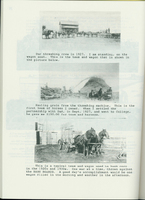 Our threshing crew in 1927. I am standing, on the wagon seat. This is the team and wagon that is shown in the picture below. Hauling grain from the threshing machine. This is the first team of horses I owned. When I settled the partnership with Dad, in Sept. 1927, and went to College, he gave me $150.00 for team and harness. This is a typical team and wagon used to husk corn in the 1920s and 1930s. One ear at a time, thrown against the BANG BOARDS. A good day's accomplishment would be one wagon filled in the morning and another in the afternoon.
 -
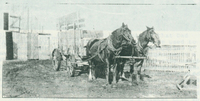 This is a typical team and wagon used to husk corn in the 1920s and 1930s. One ear at a time, thrown against the BANG BOARDS. A good day's accomplishment would be one wagon filled in the morning and another in the afternoon.
 -
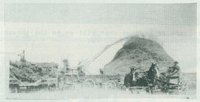 Hauling grain from the threshing machine. This is the first team of horses I owned. When I settled the partnership with Dad, in Sept. 1927, and went to College, he gave me $150.00 for team and harness.
 -
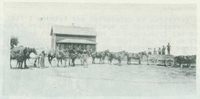 Our threshing crew in 1927. I am standing, on the wagon seat. This is the team and wagon that is shown in the picture below.
 -
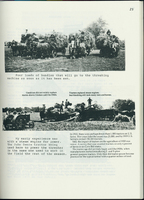 In 1910, there were perhaps fewer than 1,000 tractors on U.S. farms. Five years later the count was 25,000, and by 1919 U.S. farmers owned 158,000 tractors. Still, the impact of tractors on the agriculture of 1920 was minor. A survey that year counted tractors on only 6 percent of farms in six Corn Belt states. The tractor age did not truly begin until the 1920s, when manufacturers started introducing 2- and 3-plow general-purpose tractors. Only then did tractor power become practical for the typical farmer with a quarter section of land. My early experience was with a steam engine for power. The John Deere tractor being used here to power the thresher is the same one used to work in the field the rest of the season.
 -
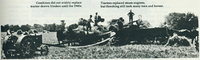 Combines did not widely replace tractor-drawn binders until the 1940s. Tractors replaced steam engines, but threshing still took many men and horses.
 -
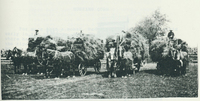 Four loads of bundles that will go to the threshing machine as soon as it has been set.
 -
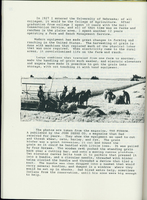 In 1927 I entered the University of Nebraska; of all colleges, it would be the College of Agriculture. After graduation from college I spent 10 years with the Soil Conservation Service, and all of that time was on farms and ranches in the plains area. I spent another 12 years operating a Farm and Ranch Management Service. Modern equipment has made great changes in farming and ranching in the United States. The harvesting of grain is done with machines that replaced much of the physical labor that was once required. When electricity came to the rural areas, it revolutionized life on the farm and ranch. Large combines that traveled from one farm to another, made the handling of grain much easier, and electric elevator and augers have made it possible to get the grain into storage, with out touching it with hand equipment. The photos are taken from the magazine, THE FURROW. A published by the JOHN DEERE CO. a magazine that Dad received for years. They show the equipment we used to cut and thresh wheat, oats, barley, and rye. The grain binder was a great invention, it cut and bound the grain so it could be handled with little loss. It was pulled by four horses. The wooden reel pushed the standing grain back over a cutting bar, and onto a moving canvas platform. Two elevator canvas belts took it to packers that pressed it into a bundle, and a circular needle, threaded with binder twine circled the bundle and threaded a device that tied a knot. The bundle was then dropped into a basket that would carry several bundles, and dumped in a windrow where they would be set up in shocks. Dad hired extra help, sometimes Indians from the reservation, until his sons were big enough to help.