Nu History
Item set
- Title
- Nu History
Items
-
 SUMNER The depression of the 1930s changed the life of a lot of people in the United States. Although we lost all the money we had and were in debt when we had to leave the ranch, our life during that period was comfortable and without a feeling of need. Our closest town and rail center was Sumner, Nebraska. We did most of our shopping at a small grocery store where we could trade eggs and cream for groceries, and other item we needed for every day living. We had a radio that kept us in touch with the outside world. Omaha, and Kansas City would give us the daily livestock markets and news. This was a battery operated system, there was no electricity, so the battery had to be charged every few weeks. We would take one into Sumner to be charged and take a charged battery home with us. Sumner was our closest point to obtain parts for equipment we used in the hay field. Many times we were able to repair equipment in our shop on the ranch, but occasionally we would break something that needed a new part. On one hot August day in 1930, we broke a catch on the hay rake, we needed it badly, but if one of the men in the field took time to go to Sumner, we would have to stop the entire stacking crew. When Verna found out what had happened, she agreed to take Dale, (age 6 months), put him in his basket and take him in the pickup and go to Sumner. She drove the 12 miles in 100 degree heat, over dusty roads and returned, only to find that the dealer had given her the wrong part. She took time out to take care of Dale, got back in the pickup and did it all over again. Sumner was our loading point when we sold cattle and shipped to Omaha. We usually cooperated with Malcolm or Don, Verna's brothers who lived close by. We would start early and drive the cattle the 12 miles, hoping to get them out that day and have them in Omaha the following day. As soon as the cattle were loaded, one of us would take the saddle horses home and the other would make the trip to Omaha. Often these trips were monotonous and tiring. I did make one that was more interesting than most. Sumner was not on the main line of the Union Pacific, and we would be switched over at Kearney. I was the only person, other than the train crew, in the caboose. It was late at night when we left Kearney, and I was awakened at midnight when we reached Grand Island. Before we left, a well dressed gentleman, carrying his suit case, climbed the steps into
 -
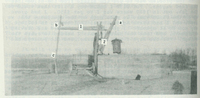
 Harry was as anxious as I was to see if the lift would work this time, so down in the silo goes Harry, I go to the barn to get Bob, the horse we always use. Harry fills the barrel, and calls to me, "Take it away." I hit old Bob on the rump, and send him off at a fast walk, and just wait. As the load comes to the top, I stand without taking a breath, the cross bar hits the chain, trips the catch, and the full load drops into the wagon. Where did that message come from? Who told me how to solve the problem? We left the ranch in September of 1932, but returned on several occasions, and that lift was still in operation. The pit silo was 30 feet deep and 20 feet in diameter. When the silo was full we could scoop the ensilage into the wagon, but if it were more than 5 or 6 feet below the surface we had to use the lift. The operation was simple: The barrel was attached to a rope that went thru pulleys a--to--b--to--c. The horse pulled the load to tke [sic] top. When the barrel reach pulley A, it would be lifted from the silo and swing from frame 2 into frame 1 and dump the load into the wagon. My problem was with the hook that caught the barrel when it swung over to frame 1 to dump it in the wagon.
 -
-
 WHERE DOES IT COME FROM? What is this thing we call the mind? We say that it is in our brain, but the brain can still exist and the mind be gone. Is our physical being an illusion? The first time I had the idea that I might be missing something important came from an experience I had in 1930. Verna and I were living on the ranch, and drought damaged our corn crop that we needed to feed the livestock that winter. To salvage the crop meant digging a pit silo, and cutting the corn to fill it. We had all the equipment we needed to do this, and in three weeks time we dug the pit silo and filled it. The problem was to get the silage from the silos into the feed wagons. For $150 I could buy a lift that would do the job, but in 1930 where was I to get $150. I had grown up on the ranch where we made much of the equipment that we used, and I had taken Agricultural Engineering in college, why not do it myself? I got my drafting board and drawing equipment, and took the measurements I needed to reach the silage, For two days I cut lift arms, and fit pulleys and ropes. The next day Harry, the hired man, helped me set the improvised lift over the silo. When feeding time arrived, we hitched Bob to the singletree and rope that would pull the load from the silo. Harry went into the silo and filled the barrel, but when we pulled the load up it wouldn't dump in the wagon, I had to do it by hand, so I went back to the drawing board, and made changes. For two weeks we used the lift, but we might as well have used a ladder and carried the silage out on our backs. Why can't I make this work? One night I had a dream, it was so vivid that I wakened with a start, THERE IT WAS, the lift, right in front of me. I thought some one said to me "Put two more links in the chain and set the catch at an angle." I got out of bed, went to another room, and lit the kerosene lamp and looked at the clock, it was 3:30 a.m. It was too early to get up, but I knew that I wouldn't sleep, so I got out my drawing board and designed the lift as I was instructed, by this mysterious voice. As soon as it was day light I went to the shop and made the suggested changes. I had to wait until feeding time to find out if this was the answer.
 -
 I soon find the cattle, they are bunched together behind a wind break of trees, but a lone cow is standing beside a newborn calf that is half hidden in the snow. It appears to be only a few hours old, but unless it can get dry and nurse, it won't live long in this kind of weather. I ride to the calf, and expect to get it on the horse with me and get it to a warmer place, but when I get off of my horse, the cow makes a lunge for me, and I quickly get back in the saddle, and again dismount, but with the same results. I try to drop a rope over the head of the little critter, but he won't lift it high enough. I ride off, and wish him well, because it is dangerous to face that old cow. I look over the rest of the cattle and find no more calves, so I ride over to the hay yards to check the fences. When I get off my horse and drop the reins, he has been trained to stand when the reins drop. I fix a gate that is down, and turn just in time to see him start for home. He crosses the river and heads for the barn. For a moment I stand in shock. It is four miles around by the bridge, where I can cross and keep dry. It is less than 3/4 of a mile to the house if I cross the river. There are small cakes of ice slowly floating down the river, it has been cold enough for the river to start freezing again. It will take me well over an hour to go by was of the bridge, and less than 20 minutes to cross the river. I do not hesitate long, it is too cold to waste time, so I decide to go the short route. I sit down on the bank of the river, off come my boots with spurs still attached, then my pants. The shocker comes when the long johns come off, there is nothing between me and the snowy bank. The trip across was not as bad as I had expected. I rolled up my clothes, held them over my head while crossing. On the other side it was less of a shock, by scraping away the snow from a tree stump, it did not take long to get the long johns on. By the time I reach the house I'm beginning to get warm, but the potbelly stove never looked so good, and I DID HAVE DRY PANTS. What happened to the calf that was left in the snow? The calves were all shipped to Omaha in October. The heaviest one weighed 500 lbs., but he was a queer looking creature, his ears were only an inch long, and looked like small horns; his tail had a length of only 5 inches. The frozen ends of ears and tail made him appear to be something other than a cow, but it never stunted his growth.
 -
 DRY PANTS The life for the men and women who lived on the plains of the west, before barbed wire was a rugged existence. Trailing cattle from Texas, thru the tall blue stem grass of Kansas, to the short buffalo grass and wheat grass of Montana and the Dakotas, was a period that has become history. I came to this world in 1907, after this historic period. I was, however, privileged to have known some of these people who lived at that time. Drought, floods, and blizzards were serious problems for them. The fascinating stories that I heard as a boy, from some of these men: Tom Moody, Pete Cooper and Frank O'Rourke and his wife Jerene, made me appreciate the difficulties they experienced. Verna and I were to meet Frank and Jerene again, in 1967 when we returned from Jordan. Our life on the ranch along the South Loup river in 1929-1932, had many of the same problems that these early settlers experienced. The ranch house in which we lived was comfortable with its three rooms, a path and a Montgomery catalogue. Verna had to get the water from a well 50 yards from the house. I had to cut wood for the central heating system, a potbelly stove in the center of the room. The quarters could seem very confining, when sitting out a long winter storm. March 15, 1931, was the third day of a dreaded spring blizzard. I have not seen the cattle for two days, there was enough hay to take care of for several days, but this is calving time and this kind of weather is what kills new born calves. I leave Verna and our son Dale, who is now nearly a year old, with a good supply of wood for the fire, and go to the barn and saddle my horse, I must see the cattle. My horse, Spike, a three year old gelding, has lots of spirit and is easy to ride. I have been training him for six months and he has the makings of a good cow horse, and I can rope from him with confidence, if I keep the rope from getting under his tail. When the rope gets under his tail he goes crazy and I have to ride hard to keep from being thrown. I glance at the thermometer as I leave the house, it is 15 above zero. It is not as cold as it has been, but with the wind at 25 miles per hour, it is hard to keep warm. The short trip to the meadow where the cattle are, is across the river. The water is low, it comes to the belly on my horse. If I lift my feet, they will stay dry.
 -
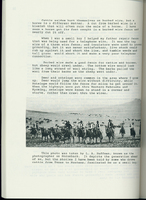 Cattle seldom hurt themselves on barbed wire, but a horse is a different matter. A cut from barbed wire is a blemish that will often ruin the sale of a horse. I have seen a horse get its foot caught in a barbed wire fence and nearly cut it off. When I was a small boy I helped my father repair fence that was being used for a telephone wire. It was the top wire of a three wire fence, and insulators were used to prevent grounding, but it was never satisfactory, live stock could rub up against it and short the line, and tumble weeds and tall grass would short it and make a very poor telephone connection. Barbed wire made a good fence for cattle and horses, but sheep would crawl under. The bottom wire would look like a long strand of wool string. The barbs pulled the wool from their backs as the sheep went under. Deer and antelope were common in the area where I grew up. Deer would jump the wire without difficulty, while Antelope would follow the fence for miles to get around it. When the highways were put thru Western Nebraska and Wyoming, antelope were known to stand in a corner and starve, rather than crawl thru the wires.
 -
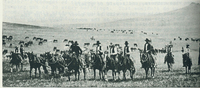 This photo was taken by L. A. Huffman, known as the photographer on Horseback. It depicts the generation ahead of me, but the stories I have been told by some who drove cattle from Texas to Montana, fascinated me as a small boy.
 -
 BARBED WIRE Just one more day, and I will have examined every fence post on the ranch. Ten miles of barbed wire will keep 150 head of cattle in the pasture and out of the hay meadows and grain fields. The men who trailed cattle from Texas to Montana didn't have to bother with barbed wire fences, it was those invading homesteaders that started the problem. My father was one of those homesteaders. He taught me how to build fence, to dig post holes and string barbed wire. Good firm corner posts were necessary in order to have wire tight enough to discourage cattle and horses from crawling thru between the wires. "Good fences make good neighbors," was a statement I often heard, as a boy. The month of April was a very long month for me. It was calving time and I had to make regular trips to the meadow where we kept the cattle all winter. Then I would hitch the team to a wagon and load it with a dozen fence posts, and a few rolls of barbed wire. I would wear a good pair of heavy leather gloves to keep from cutting my hands, and getting blisters from the posthole digger. I will have a post hole digger, a wire stretcher, staples, hammer, wire cutters, and a pair of pliers. My plans this morning will be to cover my half of the fence that joins our neighbor on the south. Many of the posts have been rotted off and I will reset them or replace them with new ones. The ground is wet from recent rains and the digging is easier than where I have been working, but by noon, I am tired, my shoulders ache and I am bored with the job. A familiar buzz, gives me a start as I touch a rotting corner post. I give it a shake, I hear the buzz again, there is a rattler some where, I can't see him, but I learned from my father many years before, that I must stand still and make no move until I can locate the snake. I soon spot it lying in the sun, close to a Yucca plant. I reach for my shovel and cut his head off. I remove the rattles and take them home to add to the jar that is half full from the collection that I have made thru the years. It looks as if we are going to have a change in the weather, so I head for home, and get there just in time. There is lots of lightening with this storm and I am glad to stay under cover. When there is lightening it's no time to repair fence. Our neighbor lost 5 head of cattle that were standing along the fence, when lightening struck and ran along the wire and executed all of them.
 -
 If Verna's parents moved back to the ranch, they would re-finace [sic] the loans on the cattle and equipment, but that meant that Verna and I would lose everything we had put into the project, and more too. Now our $9,500 was worth only $4,553. We had lost $5,000, which was more than double our origional [sic] investment. This was good fortune in disguise, because it forced us to leave. We had gone broke in 3 years. The depression lasted for another 8 years, and many of our friends stayed on, and eventually lost everything, and could not start again. I was able to return to the University and get my degree, and start over. Verna and I had both grown up in the ranching area of Nebraska. We were both familiar with the life, and we were having a good time. We had two healthy children, a boy and a girl. We had all the good food we could eat, beef, eggs, milk, vegetables, and fruit. We could even have all the fresh fish we could eat by setting lines in the river. We enjoyed our neighbors and the community activities, it was going to be hard to leave. Now we were four and not two. Dale was born April 19, 1930, and Peggy on April 30, 1932. I thought for the first time of the bread lines that I had been hearing about on the radio. I thought of the people on Wall Street who were jumping out of 20 story buildings. That wouldn't do me any good, the only windows I could jump out of were only three feet from the ground. The depression did pass, we did repay the money we owed others, Dale and Peggy are both old enough to draw social security. They have two brothers who are now grandfathers. We did survive the depression. I can now look back and only wonder what life would have been for us, if we could have held on for a few more years, and then be forced to leave.
 -
 THE DEPRESSION There have been two times in my life when I could have taken a 3-year vacation, gone fishing or sight seeing and have been better off financially. I would not want to go thru these experiences again, but there were valuable lessons learned. The depression of the 1930s was one of these times. October 1929 to September 1932 was for us the great depression. We lost all our money and were in debt. It was to take us 15 years to get these debts paid. Verna's parents lived on a cattle ranch in Custer County Nebraska. They were 30 miles south east of Broken Bow, the mailing address was Cumro, a rural post office, that no longer appears on the map. Cumro consisted of a filling station, a general store and the post office. The ranch was located on the South Loup river six miles from Cumro. Verna's father became ill in the summer of 1929, and was no longer able to do the heavy work. He asked us if we would take over for awhile. He was willing to keep the cattle and pay us for operating the unit, or he would sell all live stock and equipment if we wanted to buy. On October 1, we signed a contracts to buy the cattle and ranching equipment. Verna had $1,400 that she had saved from teaching, and I had $750 that I had expected to pay tuition for the next two years. It would take $2000 to make the down payment, so we borrowed $7,500 from the bank and our parents for the remainder. To-day this seems a small amount of money, but under to-days values the 150 head of livestock and haying equipment would be worth $400,000. Now our address would be Cumro Nebraska. On Oct. 29th the stock market took its first fall. For the next three years it continued to fall. We had borrowed money at the Mason City bank, and by January 1932 they were getting anxious for more money from us. The president of the bank was my Uncle, Will Redmond, and I knew that he was taking a lot of pressure for us to make some payments on the loan, I knew that he was trying to protect us. In July of 1932 it happened. A notice, issued by the Federal Land Bank. "We will no longer make loans on ranches that are not operated by the owner." The loan was due October 1932, and this meant that Verna's parents had to return to the ranch or lose it.
 -
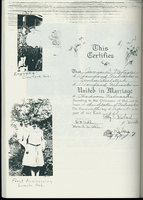 This Certifies That James D. Metzger of Crawford, Nebraska and Verna Pielstick of Crawford, Nebraska were United in Marriage at Chadron, Nebraska According to the Ordinance of God, and the laws of the State of Nebraska On the ninth day of April i the year of our Lord 1927. Eddy C Newland, Minister. Witnesses. A H. Uhl. Mrs. A. H. Uhl
 -
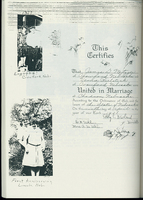 This Certifies That James D. Metzger of Crawford, Nebraska and Verna Pielstick of Crawford, Nebraska were United in Marriage at Chadron, Nebraska According to the Ordinance of God, and the laws of the State of Nebraska On the ninth day of April i the year of our Lord 1927. Eddy C Newland, Minister. Witnesses. A H. Uhl. Mrs. A. H. Uhl
 -
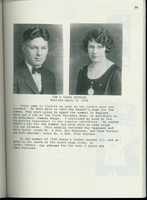 Verna came to Lincoln as soon as her school year was finished. We were able to rent the Sheaff's home for the summer. They were going to spend the summer in England. Verna got a job at the First National Bank, as secretary to the President, Samuel Waugh. I continued my work at the Engineering Department in the tractor laboratory. We rented Sheaff's car for the summer and were able to take trips with our friends. This usually included Ray Magnuson and Marie Quick, later Mr. & Mrs. Ray Magnuson, and Glen Feather and Ruth Heather, later Mr. & Mrs. Glen Feather. In the summer of 1929 Verna's father became ill, and we moved to the ranch on the South Loup river, in Custer, County. Our address for the next 3 years was Cumro [sic] Nebraska.
 -
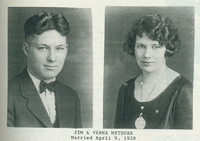 JIM & VERNA METZGER Married April 9, 1928
 -
 There were many questions in my mind. There was no doubt that I wanted to marry Verna. I knew that if I didn't that there were others looking her way. The question was, can it be kept a secret? Will Verna and Jerry have to cancel their contracts with the school? How will her family deal with this? There seemed to be questions and more questions. Have we acted too hastily? We still have time to change our minds. We reassured each other that this was really what we wanted to do. We had known each other for two years, and we had been engaged for a year and a half; but how can we ever be certain? We arrived at the court house and obtained the proper license, with the assurance from the county clerk that he did not have to publish the information. He did say however, that if someone came to check the records, he could not withhold them. One more step was necessary, we must find a minister. Art and I had known the Congregational Minister in Chadron. Eddy Newland who had been in Crawford several years, a telephone call and a promise from him to marry us and keep it a secret, was all we needed. At High Noon, on Aril 9, 1928, there was a double wedding; James Metzger and Verna Pielstick witnessed the marriage of Arthur Uhl to Jerry Blair, the marriage of James D. Metzger and Verna E, Pielstick was witnessed by Mr. & Mrs. Arthur Uhl. Art and I each bought our wives a half dozen roses and we treated ourselves to a steak dinner, with strawberries for desert [sic]. We returned to Crawford Mr. and Mrs. Metzger. Two days later I returned to the University at Lincoln, Nebraska. Verna remained to complete the school term and joined me in Lincoln in June. I am writing this in January 1994. It has been more than 65 years since Verna and I took that step. I have never had any regrets, and I have never heard Verna express any, so I am going to assume that it is still all right with her.
 -
 THE WEDDING DAY It is 10:00 O'clock Easter Sunday evening, Apr.8,1928 [sic]. If we get married tomorrow will you? The question came from Art Uhl. Two gasps and 20 minutes later, Verna and I agreed that perhaps it was the thing to do. For over a year Art Uhl and Jerry Blair had been planning to marry, and for a year and a half Jim Metzger and Verna Pielstick had been engaged. Marriage for Jerry and Verna was out of the question if they wanted to keep their teaching contracts with the Crawford School System. The rules in 1928 said that married women could not teach, these jobs were to be given to men who had families to support. How could it make a difference when there were no men in Crawford Nebraska qualified to teach in the Crawford school system? Could the marriages be kept a secret in a small town of 1200 people, where every one knew everybody's business? Easter Monday, April 9, 1928 arrived, but it started early, 3:00 a. m. for me. This was a momentous decision, after all nothing like this had happened to be before, and I couldn't sleep. I wasn't sure how to deal with the situation I called Art on the phone and found that he had a short night also. We had all agreed that the marriage had to be kept a secret, but how could we be certain? My conversation with Art was very short, this was a country line and some one might be listening. I told my parents what we were doing, and they didn't offer any objection, but were surprised at the sudden decision. Our first problem was to select a place to get married Do we drive to Lusk, Wyoming? That was out of state and only 60 miles from Crawford. Do we go to Hot Springs South Dakota? That was out of state and about the same distance? The easiest place to go was our own County Seat, Chadron. We knew a minister who would marry us, and be willing to keep it a secret. We were both acquainted with the County Clerk, and we thought he would be willing to withhold the announcement from the papers. It would be risky, but we decided to take the chance. The morning of April 9, 1928 was bright and clear. We drove to Chadron in Art's new green Buick. I don't remember anything we talked about during the hour it took us to get to the court house, I do remember noticing the rolling hills with some streaks of snow in the gullies, I had seen this many times before, but some how this time it was different.
 -
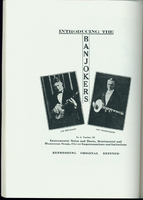 INTRODUCING THE BANJOKERS In a Variety of Instrumental Solos and Duets, Sentimental and Humorous Songs, Clever Impersonations and Imitations REFRESHING ORIGINAL REFINED
 -
 INTRODUCING THE BANJOKERS In a Variety of Instrumental Solos and Duets, Sentimental and Humorous Songs, Clever Impersonations and Imitations REFRESHING ORIGINAL REFINED
 -
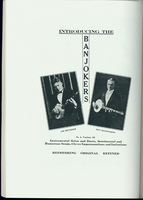
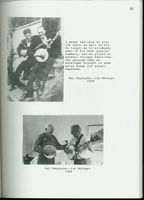 I never was able to play the banjo as well as Ray. He taught me to accompany some of his most popular numbers, and we played at several College functions The program that we developed brought us some extra money for school expenses.
 -
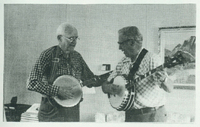 Ray Magnuson--Jim Metzger 1988
 -
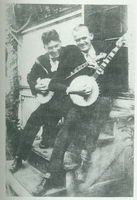 Ray Magnuson--Jim Metzger 1928
 -
 I suggested to him that if he had no place to stay, I would be glad to have him stay with me. I had been asked by a fried, Rev. Sheaff, the Methodist minister at Epworth Methodist Church, to be sure and look him up when in Lincoln. Ray never went to Iowa, and he became my room mate at 29th, and Holdrege for the college year of 1927 and 1928. We both played banjo, we worked out a program of music and other skits, which helped us pay our school expenses. Ray's experience with college, his attitude toward fraternities, politics, religion and life in general had a great deal of influence on me. We often talked into the wee hours of the morning. We tried out for a tour with the Red Path Chautaqua [sic] circuit, and were accepted. Other opportunities emerged and we did not sign the contract. Verna and I were married on April 9, 1928, and Ray had an opportunity to work for the University of Nebraska extension service. This all seemed more important than to travel all summer with the Chautaqua [sic]. Ray graduated from the University in 1929, and later entered the ministry, and served a number of churches in Nebraska before coming to California in 1955. Verna and went on the ranch in 1929. Verna and I were to see Ray and his wife Marie many times while they were living in Nebraska. When they came to California, we took the assignment in Turkey. Seldom more than two years would pass that we would not see them. After Marie's death, Ray married Florence Samsel, also a friend from Nebraska days. On Aug. 9, 1990, we had breakfast with Ray and Florence. They had tickets on a cruise for the inside passage to Alaska, and we joined them, so four old folks in their eighties packed their ailments, their walking sticks, bifocals, binoculars and hearing aids and headed for Alaska. Florence's death in 1992, broke up the circle of four that had spent many hours together. Ray continues to live in Santa Rosa, and we see him often. The life friendship has extended over 66 years, and Ray and I can still find much to talk about.
 -
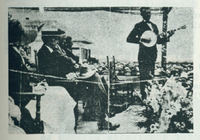
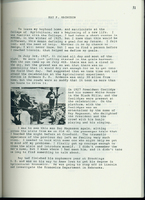 RAY F. MAGNUSON To leave my boyhood home, and matriculate at the College of Agriculture, was a beginning of a new life. I was familiar with the College, I had taken a short course in MOTORS, in the winter of 1925, but I knew that this would be different, this meant defining a goal for my future. I felt lost, and the need of help. Whether it be by chance or design, I will never know, but I was to find a person before I reached Lincoln, that helped me define my goals. On July 3rd. 1927, it rained all day and most of the night. We were just getting started in the grain harvest. When the sun came up on July 4th. there was not a cloud in the sky, but the ground was so wet that there was no possibility that it would dry out enough for us to get into the field that day. Dad suggested that we take time out and attend the celebration at the Agricultural experiment station in Ardmore S. D. Ardmore was only 30 miles from home, but the roads were so muddy that it took us more than two hours to drive it. In 1927 President Coolidge had his summer White House in the Black Hills, and the Coolidges were present at the celebration. On the platform, with the Coolidges was an entertainer by the name of Ray Magnuson, who delighted the President and the crowd with his banjo playing and his singing. I was to see this man Ray Magnuson again, sitting across the aisle from me on Old 42, the passenger train that I boarded the night before at Crawford. The traumatic experience of the previous day left me feeling very much alone. I needed to talk with some one who might help me get my mind off my problems. I finally got up courage enough to cross the aisle and introduce myself. I didn't remember the man's name, but I knew where I had seen him, and it didn't take us long to find something to talk about. Ray had finished his sophomore year at Brookings S. D. and was on his way to Ames Iowa to get his degree in Agricultural Economics. He was going to stop off in Lincoln and investigate the Economics Department in Nebraska.
 -