
Nu History
Item set
- Title
- Nu History
Items
-
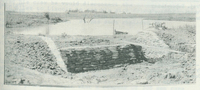 Farm ponds and other water conservation structures were built on more than 100 farms in Jefferson County in 1934-1938 [sic]
 -
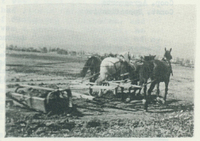 Four Horse Team with loaded fresno.
 -
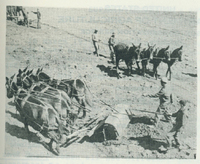 Thousands of cubic yards of earth were moved with horses and mules and the fresno, in building dams and terraces.
 -
 Not until I set up my survey crew, did I realize what the depression was for some people, who could not get jobs. I usually had four men on a crew, I had young fellows with several years of college, and one who had degree in engineering, but could not get work, so he enrolled as a private in the CCC camp. Our survey crews were kept very busy. We were building small earth dams and terraces with teams that the farmers ha available. We had to have two farms surveyed each week to keep the construction crews busy. Training men for the job, proved to be a difficult task. Some of the supervisory personnel and most of the enrolled men had no farm experience. Some had never been around horses, and had to learn how to drive a team, hold a plow in the ground, and load a fresno. A man who had been raised on a farm and knew how to do these things soon was a sergeant and supervising crews. An Engineer who had no farm experiences was useless at the Fairbury camp, he might have the technical training but know nothing about farm crops and farming problems. Unless some one was with him in making the surveys, he would treat an alfalfa field the same as a corn field. The farmers would be very unhappy, and it wasn't always easy to calm them down. It was the responsibility of the army to take care of the men, but it was difficult some times to separate the work project from camp projects. We had 200 men transferred to Fairbury from Arkansas in 1935, and many of these boys ha never worn shoes. They were issued a pair of shoes that they were required to wear in camp, but when they got to the field the shoes would come off. They would follow the teams and equipment all day in bare feet. By the time November came and snow was on the ground, some still went barefoot. There were days when we would have as many as 45 or 50 teams in the field. We built dams and terraces that I saw in operation fifty years later. The tree planting project for wind breaks was another thing that proved to be very useful. I learned more the first year in camp than I did in a year of college. It is one thing to make surveys and draft plans in the class room, and another to do it in the field with help that has never been off the streets of New York, or from Mississippi where they never saw ice or snow.
 -
 CCC CAMP DAYS On Aug. 1, 1934 I went to work for the Forest Service as Flood Control Engineer. The Civilian Conservation Corp, known as the CCC Camps, were being set up all over the U.S. I was assigned to Fairbury Nebr. The camp units were usually composed of 200 or 225 men, and the U. S. Army had the responsibility of feeding and housing them. In Nebraska the U.S. Forest Service was responsible for the work units. I wanted to be certain that I would be on time my first day of work, so I left Lincoln the day before and stayed all night with my Aunt Maude and Uncle Bob Dillon, who were living in Beatrice. It was only about 25 miles from Beatrice to Fairbury, and the next morning I got up early and was in Fairbury by 7:30. The County Fairgrounds was to be the camp site. The Army had arrived only a few days earlier and had about 40 men in camp, who were busy getting the site in shape for a camp that would accommodate 200 enlisted men, Army personnel and the Forest Service Staff. The hog barn was being made into the mess hall. The cattle barn and chicken house were to be barracks. The agricultural exhibit hall was to be the recreation center. The Engineer's office and the Superintendent's office were two red railroad box cars that had been moved in. I was assigned one of them, and used one end for living quarters and the other for my office. The summer of 1934 was a hot one, day time temperatures reached 110 to 115 degrees in eastern Nebraska, the summer was the hottest on record. We had a fan that helped keep the hot air moving, but the box car had no shade, no air conditioning, and there were no screens on the doors, and it cooled off very little at night. The Forest Service staff in Fairbury consisted of a Superintendent, an Engineer, and four Foremen. Our assignment was erosion control on farm land. We built small earth dams, terraces, brush dams in gullies and planted trees for windbreaks. Agreements were signed with farmers and an erosion control plan was developed, describing the type of work to be done and cropping plan to be followed. The problems we had in getting started seemed never to end. We were slow in getting equipment we needed, such as wheelbarrows, shovels, hand tools of all kinds, and fresnos. The Rock Island Rail Road Co. loaned us surveying equipment: a transit, level, rods and stadia boards.
 -
 The (Civilian Conservation Corp), the CCC Camps were established in 1933. One of the professors that I met, Claton W. Watkins, was head of the Nebraska Forestry Dept. and was in charge of the Nebraska CCC projects. Seldom a week would pass that I didn't have an opportunity to speak with him, and I never missed an opportunity to ask him what the possibility were for a job when I got my degree. He would often say to me, "There is nothing new today, but keep asking, it looks as if there will be an opportunity soon." On July 1, 1934, Watkins called me and said, " Can [sic] you get me a transcript of your grades, and a history of your past experience?" Transcript of grades, yes, but past experiences! I went broke raising cattle, it didn't seem to me to be a very good history, but it didn't seem to bother him, because on July 15th he handed me a contract to sign, a contract for one year, as Flood Control Engineer at a CCC camp at Fairbury [sic] Nebr. On Aug. 1, I reported for work at Fairbury. I had never asked Watkins what the pay would be, and he often remarked that I was the only person he had ever hired that did not ask what the pay would be. I don't remember how I felt about the pay, because I was getting $60.00 a month and I knew that it would be better than that. The job paid $160 a month, and I was never paid so well to learn as much as that first year out of college. The family joined me in September, and we were able to live again. We soon started to pay back the money we owed, but it took us about 15 years to get the debt paid.
 -
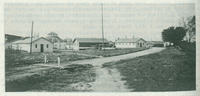 The fair grounds at Fairbury were converted into a camp for 200 CCC enrolles [sic], with barracks, mess hall, recreational facilities and headquarters for Army and Forest Service.
 -
 UNIVERSITY OF NEBRASKA 1932 Life at York in Sept. 1932 was a new start for us. Verna's brothers did very well running the dairy, they were both in school and Verna was able to work out a satisfactory routine with the two youngsters. I felt free to go back to Lincoln for my junior year at College. On the 14th I drove to Lincoln and matriculate, for my junior year. This was familiar territory to me and it did not take me long to get settled. My schedule was very rigid. I had worked in the Ag. Engineering dept. when I was there in 1927-1929. I could work 4 hours a day and still carry 15 or 16 hours a semester. I was up at 5:00 o'clock, and open the building by 8:00. o'clock, then to class and be back at 5:00 o'clock and lock up. Nebraska was testing every make and model of farm tractor in use in the state, and I spent hours on these tractors, from small sizes of garden models, to 70 horse-power caterpillar tractors. This could mean 5 days a week, and left me free on week ends to go to York, and be with the family. By the spring of 1933 the ranch loan was completed, and we were able to get our furniture at the ranch. Verna's folks sold the place at York and moved their furniture to the ranch. We moved to Lincoln, just one block from the campus, 3223 Fair Street, where we were to live until August 1, 1934. How we were able to get enough money to live on and still attend school, remains a puzzle to me. Our rent was $10.00 per month, ham was selling for 10 cents per pound, and we had a garden. My income was 35 cents per hour, [sic] On week ends I tried to earn a little extra money by husking corn at 2 cents a bushel, I couldn't earn enough to make it worth while, so I did that only once. I borrowed $100.00 from the Methodist fund, and sold the pickup for $200.00. We then bought a Durant for $80.00 which furnished transportation for more than a year. On January 14 1934, Gordon was born, so now we had 2 boys and a girl. June 1934 was a very hot month in Lincoln. Verna took the youngsters to Crawford and was spending the summer with my parents, and I stayed in Lincoln with the Tractor Testing, and took some college courses during the summer. My professor was a fat man who weighed 300 pounds, or more, and it was very hot. The classroom had only one window, and no air conditioning, I envisioned him melting and running all over the floor.
 -
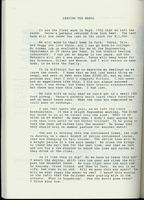 LEAVING THE RANCH It was the first week in Sept. 1932 that we left the ranch. Verna's parents returned from York [sic] Nebr. The Land Bank will now renew the loan on the ranch for $11,000. We will move to their home in York. Verna, Dale, and Peggy can live there, and I can go back to college. My former job is available for me at the Engineering Department at 25 cents per hour, in the tractor testing laboratory. I can get my degree in two years, and the Metzgers will get a new start. Verna will keep house for her brothers, Oliver and Weston, and I will return on week ends, to be with the family. It is difficult for me to describe my feelings as we leave the ranch. I knew that we had lost every thing we owned, and were in debt more than $3000.00, but my real problem was, that I felt a complete failure. I had never had an experience like this, I did not always succeed in what I was doing, but there were usually alternatives, but there was none this time. I had lost. We took with us only what we could get in a small 1932 Ford pickup. Verna's parents would leave their furniture and we would leave ours. When the loan was completed we could make an exchange. I can feel again the pain, as we left the ranch headquarters. It was a bright September morning, The hired man waved to us as we turned into the road. WHAT IS HE DOING ON MY HORSE? He knew that I didn't want anyone to ride that colt until he was better trained! Is he going to turn the cows and calves into the meadow? He knows that they should stay on summer pasture for another month! The sun is shining thru the cottonwood trees, the light is dancing on a small branch of yellow cottonwood leaves, that are changing to fall colors. The entire tree will be a bright yellow in a few more weeks! We cross the bridge to check the mail box for the last time, and then we turn and sit for a few minutes to watch the cows and calves as they drink at the river. Is it like this to die? Do we have to leave this now? I start the engine, shift into low gear and climb the hill past the Shumaker Ranch. We turn right onto the main road to Kearney, Grand Island, and then to York. An era in our life, had come to an end. Will we pass this way again? How will we ever repay the money we owe? I heard this morning on the radio that the dairymen were pouring milk in the streets. What is happening? Has the world gone crazy? I think mine has.
 -
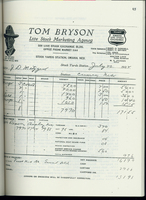 Tom Bryson Live Stock Marketing Agency
 -
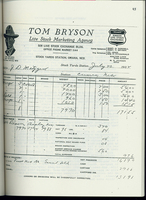 Tom Bryson Live Stock Marketing Agency
 -
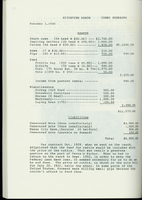 RIVERVIEW RANCH CUMRO NEBRASKA October 1,1930 [sic] Assets Stock cows (54 head @ $50.00) $2,700.00 Yearling heifers (20 head @ $50.00) 1.000.00 [sic] Calves (64 head @ $30.00) !,920.00 [sic] $5,6200.00 [sic] Sows (7 @ $30.00) 210.00 Pigs (60 @ $12.00) 720.00 930.00 Feed Prairie hay (200 tons @ $5.00) 1,000.00 Alfalfa (50 tons @ 10.00) 500.00 Corn (70 Acres Est. 30 bu. @ 75¢) 1,575.00 Oats 1(200 bu. @ 25¢) 50.00 2,225.00 Income from pasture rental 500.00 Miscellaneous Pickup 1929 Ford 500.00 Household furniture 500.00 Horses (6 Head) 200.00 Machinery 1,000.00 Laying hens (175) 100.00 2,300.00 $11,575.00 Liabilities Unsecured Note (Runs indefinitely) $4,950.00 Unsecured note (Runs indefinitely) 1,000.00 Mason City Bank,(Secured 20 heifers) 800.00 Unsecured note (payable on demand) 100.00 Total $6,850.00 Our contract Oct. 1929, when we went on the ranch, stipulated that the feed for cattle would be included with the price of the cattle. That was really a generous gesture on the part of Verna's Father. When he had to return to the ranch in Sept. 1932, in order to keep the Federal Land Bank loan, it seemed necessary for us to do as he and [sic] done. The price of cattle, as shown on the sale bill for July 20, 1932, tells the story. In some parts of the United States, farmers were killing small pigs because the [sic] couldn't afford to feed them.
 -
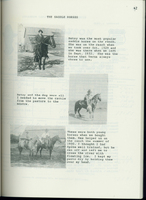 Betsy was the most popular saddle horse on the ranch. She was on the ranch when we took over Oct. 1929 and she was there when we left in Sept. 1932. She was the horse that Verna always chose to use, [sic] Betsy and the dog were all I needed to move the cattle from the pasture to the meadow. These were both young horses when we bought them. Wes helped us on the ranch the summer of 1930. I thought I had Spike well trained, but he ran off and left me to cross the river with floating ice. I kept my pants dry by holding them over my head.
 -
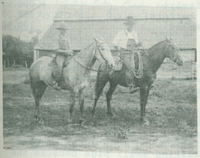 These were both young horses when we bought them. Wes helped us on the ranch the summer of 1930. I thought I had Spike well trained, but he ran off and left me to cross the river with floating ice. I kept my pants dry by holding them over my head.
 -
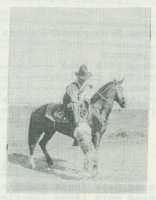 Betsy and the dog were all I needed to move the cattle from the pasture to the meadow.
 -
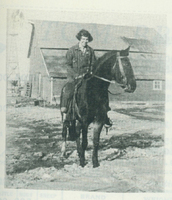 Betsy was the most popular saddle horse on the ranch. She was on the ranch when we took over Oct. 1929 and she was there when we left in Sept. 1932. She was the horse that Verna always chose to use, [sic]
 -
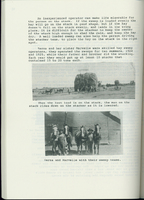 An inexperienced operator can make life miserable for the person on the stack. If the sweep is loaded evenly the hay will go on the stack in good shape, but if the hay doesn't fall on the stack evenly, and lands in the wrong place, it is difficult for the stacker to keep the center of the stack high enough to shed the rain, and keep the hay dry. A well loaded sweep can also help the person driving the stacker team, to place the hay on the stack in the right spot. Verna and her sister Marvelle were skilled hay sweep operators, they operated the sweeps for two summers, 1924 and 1925, while their father and brother did the stacking. Each year they would put up at least 10 stacks that contained 15 to 20 tons each. When the last load is on the stack, the man on the stack rides down on the stacker as it is lowered. Verna and Marvelle with their sweep teams.
 -
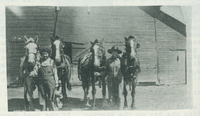 Verna and Marvelle with their sweep teams.
 -
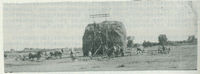 When the last load is on the stack, the man on the stack rides down on the stacker as it is lowered.
 -
 HAY SWEEP "HARRY, keep your eyes open, I have a snake in this load", Harry is stacking the hay this morning, because I want to teach a new horse to work on the hay sweep. I have just seen a snake crawl under the first shock that I put on the sweep, and did not see it get out, it is probably a harmless bull snake, but we do have rattlers on the meadow. The new horse is doing very well, but it takes some time to teach a young horse to work on this ingenious machine we call a "HAY BUCK". I have no idea who invented this queer looking piece of equipment, it looks like a dust pan with a short handle, and instead of a solid pan in which you would sweep dust, it has teeth like a comb. There is a wheel on each side to carry the load, and a horse hitched on each side, that can move the machine backward and forward. The operator has a seat on the handle of the pan, and can move forward or backward to lift or lower the teeth. The horses have to work differently than if they are hitched side by side, to turn to the left the horse on the left must stop, while the one on the right walks forward. A turn to the right requires the horse on the right to stand while the one on the left goes forward. To load this odd looking piece of equipment with hay, and haul it to the stacker, so that it can be lifted to the top of the stack, requires a skilled operator. The operator will take the sweep to the area where the hay has been raked and bunched, and one bunch at a time is scooped up by the sweep. The load is evenly placed by loading first one side and then the other. Four or five bunches are usually enough for the team to pull. The operator can ride by sitting on the handle, close to the load. The load is then placed on the stacker head, which is the same size as the sweep. The team pushed the load forward until it is firmly placed on the stacker, the sweep is then backed out and the load remains firmly on the stacker head. The horses then back the sweep away, leaving the load to be lifted to the top of the stack. Great care must be taken when loading the hay on the stacker. The teeth of the stacker head are the same distance apart as those of the sweep, and must mesh properly when loading the hay on the stacker. If the load doesn't stay on the stacker head when backing out with the sweep, the operator must sit far back on the handle, lift the teeth and shove the hay up tight. The operator is continually talking to the team, and a well trained horse soon understands: get up, whoa, back, and learns to stand while the other horse changes the position of the sweep.
 -
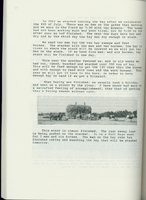 In 1931 we started cutting the day after we celebrated the 4th of July. There was no dew on the grass that morning and we were in the field by 7:30 with two mowers. The teams had not been working much and soon tired, but by 5:00 in the after noon we had finished. The next few days were hot and dry and by the third day the hay was dry enough to stack. We need two men for the two hay sweeps and four horses. The stacker with one man and two horses, the hay is close to where the stack will be located so we will put two men on the stack. If we have five men, and six horses, the stack will be finished in one day. This year the weather favored us, and in six weeks we had cut, raked, bunched and stacked over 200 ton of hay. This will be feed enough to get the 120 cows thru the winter and with enough to feed milk cows and the work horses. This year we will put 10 tons in the barn, in order to have enough hay on hand if we get a blizzard. When haying was finished, we usually took a holiday, and went on a picnic by the river. I have never had more of a satisfied feeling of accomplishment, than that of getting thru a haying season without rain. This stack is almost finished. The last sweep load is being pushed on the stacker. It is a full days work for 5 men and six horses. The man on the hay rake has finished raking and bunching the hay that will be stacked tomorrow.
 -
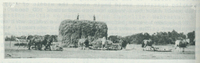 This stack is almost finished. The last sweep load is being pushed on the stacker. It is a full days work for 5 men and six horses. The man on the hay rake has finished raking and bunching the hay that will be stacked tomorrow.
 -
 PUTTING UP HAY ON THE RANCH Putting up hay for winter feed was an important part of ranching in the cattle country. Many hours were spent in other activities such as treating cattle for lice, vaccinating, branding, dehorning, castrating, and occasionally treating for snake bites. There were times when we had to pull a cow from the quicksand. Good hay was however, the life blood of the cattle business. Alfalfa is an excellent feed for a cow, but it takes lots of irrigation water, which is often not available. The bulk of hay was from native grasses that grew in the bottom land along the river. There was always some grass to cut, even in dry years. In wet years the native grass could grow to a height of 3 feet, it could be high enough to touch the stirrups of my saddle when I rode thru the meadow. The main topic among farmers and ranchers during haying time, was the weather. A rancher who ran into a rainy spell during the haying season would be hard to live with. He would cut the hay, and wait at least a day or two for it to dry enough to stack. Wet hay will spoil if stacked too early. A rain after the hay has been cut can cause it to bleach and lose food value. On the ranch along the South Loup River, the haying operation would begin about the middle of July, and it would take four weeks to cut and stack 200 tons. For several weeks before haying time we would work on the equipment. The mowers needed a complete overhaul, the sickle needed new plates or a new bearing in the gear box. The rake must have some broken teeth replaced. The hay sweeps must have parts replaced that were broken, a swivel wheel or broken teeth must be replaced. The stacker needs anew rope, and some of the pulleys replaced. Harness for the teams must be repaired. It often took more than a week just to get all the equipment in order, because everything must work well if once the weather is favorable. The day arrives to start the haying operation. We are going to have to wait until the dew is gone, to prevent the weeds and dirt from gumming up the sickles. If we start later the grass will be dryer and we can get it in the stack sooner. The hired man and I, each with a good team, will cut enough to make one stack of hay. We can expect about a ton and a half of hay per acre, and we want enough for a 20 ton stack, so we will have to cut about 14 acres.
 -
 the caboose, and sat down across the aisle from me. I could hardly believe my eyes, this man was Dwight Griswold, the Governor of Nebraska. What was he doing riding a freight train? He had attended a conference in Grand Island and was due in Omaha the next day, and he said it was the fastest way to get there. Many changes have been made in the past 75 years, in getting cattle to market. There is still no substitute for the saddle horse when it comes to handling cattle, and a well-trained, intelligent horse is the best friend a rancher can have. The 18 wheelers, the livestock semi-trailers, will now come to the ranch, load the cattle and take them directly to market. Before we left the ranch in 1932 we were able to use the trucks, but we did not have good facilities for loading, and dirt roads were not always passable for the heavy loads. The attached sale bill is for part of a truck load shipped on July 20, 1932. The same 8 head would be worth at least $5,000 to-day. It has been many years since I have seen a train load of livestock. The large stock yards in Kansas City, Chicago, and Omaha no longer exist. They have been replaced with smaller processing plants that can be reached by trucks. One of the last stories told of the problems involved in getting cattle to market was in Rushville, Nebraska. A rancher brought in 200 head of yearlings to be shipped to Omaha, it was dark when they reached the loading yards. The city lights were on, the cattle had never seen lights, and the city had to turn them off long enough to get the cattle in the yards.
 -
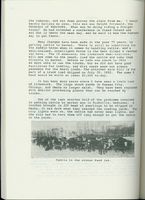
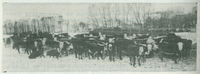 Cattle in the winter feed lot.