
Nu History
Item set
- Title
- Nu History
Items
-
 The classroom and field demonstration material was ready by May of 1956. For the next month we held classes in the morning and worked in the field in the afternoon. We used teams that were owned by the Experiment Station and farmers that lived close by. One of my problems in handling the teams for the demonstrations, was that I had to learn Turkish commands, the horses didn't understand my English. When we completed the training courses, each student was supplied with enough equipment to start his own projects. My concern was that the students, who had taken the classes would have problems with the farmers, they had no farm experience, and to show the farmers the new methods of hitching their teams, might not be accepted. I had gone as far as I could, the Turks would have to take it from here. Naki suggested to me that he had a friend who might be able to do the training necessary to include the farmers. In Bornova, a small village close to Izmir, there was a viticulture research station. The field foreman was a man by the name of Atif Atilla. He did not have a degree, and was shunned when promotions were made. Atif not only spoke English, he spoke farmer Turkish, had a farm of his own, and the farmers had confidence in him, and best of all he knew how to handle the teams and equipment. With some negotiations between the two experiment station directors, Atif was loaned to us for an indefinite period. It was a pleasure to work with Atif, he taught me the language I needed to drive the teams, he knew how to hold a plow in the ground, put a harness on a horse, and he knew how to read the instructions on the surveyors' stakes. For four and a half years, Atif, Naki and I covered the entire Ege Region where we set up equipment and held training courses. We made trips to Southern Turkey to the experiment station at Tarsus, we used small equipment to terrace the hills for new tree planting, as well as building new irrigation systems. To get the equipment into the hands of the farmers seemed very slow to a pushy American, but Naki and Atif seemed to be pleased, and informed me often that we were getting along very well for Turkey. I did learn to relax a little and stop occasionally to drink coffee or chi (tea). In September of 1956 Turkey hosted an irrigation seminar for 7 middle east countries. Iran, Egypt, India, Jordan, Iraq, Lebanon and Greece. The small equipment for improving irrigation practices was the main attraction.
 -
 CONSTRUCTION OF SMALL EQUIPMENT There was little doubt in my mind by the time we had visited the experiment stations and many of the farming areas in the Ege Region, that improvement in irrigation practices could be accomplished, only by getting the Turkish farmer involved, and making equipment that he knew how to use. We needed the local equipment dealers, and the manufactures from the communities where we were working. I was still confused as what the duties of an Advisor should be. Naki had seen only irrigation equipment that was made in the United States. Would I still be an Advisor if I introduced an entirely new plan that no one in Turkey had ever seen? I felt sure that the farmers would understand, but very few of the Station Directors and Ministry personnel had farm experience, or knew how to irrigate. I discouraged anymore imports of American equipment. The farms were too small and it was impractical to use the large equipment that was available from the United States. With assistance from the University of Nebraska group, I obtained bulletins and drawings of equipment we used when I was a boy on the farm. The Agricultural Engineering Extension agent sent me all the material they had. They cleaned out the Engineering Department files of animal drawn equipment. The file included multiple hitches for farm animals, small earth moving equipment such as fresno, plows, ditchers and floats. With the help of Jack Steele, Carl Forsburg, and Naki, we were able to convince the Ministry of Agriculture in Ankara that it was worth the cost of making some of this equipment. The Ministry set up a budget that would cover the cost of construction. The next four months was a very busy time, we used local blacksmiths, and solicited the help of several equipment companies that made farm machinery. By March 15, 1956 we had enough equipment available to put on demonstrations and take enough pictures to prepare bulletins and other teaching material for training. Teaching men to handle the equipment, training horses and oxen for multiple hitches took a lot of time. Translating English to Turkish, was enough to drive Naki and me crazy. To find words in English to convey an idea in Turkish is a story in itself.
 -
 The only parts available were 5000 miles from Turkey, so this machine sat in the corner for six months before parts arrived. It now appeared to me that the aid we were giving from the United States was geared to methods used in the States, and it had little value on the small farms in Western Turkey. To farm it the American way was out of question, big tractors and equipment to fit were not practical. Every farmer had a team of horses or oxen, and was skilled in handling small farm equipment. This equipment could be bought at home and repaired in local shops. The skill of the Turkish blacksmith and the people who made the plows, cultivators and wagons were as good as any I have worked with. I felt that Turkey could do a better job in farming with improvement in the equipment they had, and could make, than with the equipment that was being imported from other countries. All imported equipment required oil and gas, and Turkey had none, and it all required scarce foreign exchange. YOU CAN DO IT BETTER WITH WHAT YOU HAVE, AND CAN MAKE THAN YOU CAN WITH IMPORTED EQUIPMENT. This became my theme song for the next five years. The idea of using animal power and homemade equipment was not shared by many Turks in high places. They wanted to do as we did in America, by using modern equipment. Many machine manufacturers in America were of the same opinion, so it took some time to convince the Governments that we should give the small, homemade equipment a try. We could make the equipment in the blacksmith shops, and use the farmers' teams of horses or oxen. It appeared now that I was going to have to call to mind, many of the things I had done as a boy. We could be making the earth-moving equipment, we could hitch four horses to a fresno, three would do for the ditcher. How could I now be an advisor, if I directed the entire operation? My Counterpart, Naki had no idea how to harness a horse, or hold a plow in the ground. What would I be now, THE BOSS, THE DICTATOR, or could I NOW be called an Advisor?
 -
 WHAT IS AN ADVISOR? What is an Advisor? This was a confusing term to me. How do I get my ideas across to someone with out appearing to be superior, or patronizing? My classification and job description contained statements like this: "He must not become easily discouraged,---must work patiently and tenaciously toward bringing about the practical adoption of ideas. He must have imagination, initiative and be a "self starter." If I were to propose what I thought had to be done, it would mean a completely different approach to irrigation, in Turkey. I didn't want to appear as the smart American that had all the answers, but after spending 3 weeks in the country, I was certain that the direction they were now taking in preparing land for irrigation, was headed for disaster. My observation during the time we had been drinking tea and coffee and riding around the country, had taken me back 40 years. It appeared to me that Turkey was trying to modernize its agricultural practices by using equipment that wasn't designed to fit the small farms in the area. I saw many tractors that were sitting idle for lack of some part that was worn out or broken. There were disc-plows that were 16 feet long, that were used on wheat farms of 400 or 500 acres in Kansas and Texas. How could they ever be used in an area where the average-sized farm was 10 to 20 hectars [sic].(20 to 50 acres)? Turkey had received money to purchase tractors, much of it from America. A lot of modern equipment was in Turkey, but very little attempt had been made to repair and service any of it, so much of it was sitting around and not being used. I would ask questions as to why it was not being used, and the answer usually was; "It is broken and there are no parts available." After a little questioning as to what the policy had been in buying these tractors, I found that they wanted to try as many as possible in order to know which ones were best for Turkey. It was total chaos, no tractor company felt the need to set up service departments. I found over 50 makes and models, and most of them could not even use the same tires, let along any other parts. An example of poor planning can be illustrated with one example, a 60 horsepower tractor with earth-moving equipment used hydraulic lifts, and when the operator unhooked the tractor from the carryall, he forgot to disconnect the hydraulic hose. When he pulled away it tore the hose apart.
 -
 The next morning Ishan said to me, "If you will give me ten lira I think I can get it. I gave him the lira, about one dollar in U.S. currency. He suggested that I stay at the apartment, while he went to the dock. In about an hour, the truck load of furniture arrived. The Government offices opened at 9:30 in the morning. In the summer time, this seemed very late to me. I had been working with a farmer at the experiment station, that went by the name of ONE ARM AHMET. He had lost his arm in an accident, and in this way his friends identified him from another AHMET at the station. I persuaded Ishan Bey to take me to the village where one-armed Ahmet lived. He spoke no English and I very little Turkish, but we both talked horse language. He was open to new ideas and I helped him with hi planting. He had been hiring 25 women to make rows for him to plant cotton. I suggested that he put another type of blade on his plow and with his oxen he did more in two hour than the women could do in a day. This method saved him money and he was always glad to see me come. Ishan would pick me up at the apartment at six o'clock in the morning and we would go to Ahmet's village, and be back by 9:00 o'clock when the offices opened. One morning when Ishan stopped for me, I got in the back seat of the car, but suddenly remembered that I didn't have my camera. I asked him to wait a few minutes while I went to the apartment to get it, but when I returned, he was gone. I could only wait until he returned. It was more than a hour before he knocked on the door, and with many apologizes said, " I heard the door slam and thought you were in the car: I thought you were being very quiet". He missed me only when he reached the village. Ishan died in 1982, just a few weeks before our visit to Turkey. We did get to the village to see one-armed Ahmet, but Ishan didn't take us.
 -
 ISHAN CANDAS If there is one person that might be called a HERO in our Turkish story, it would be ISHAN CANDAS, my companion and my official driver for the five years in Turkey. He was a small man, only 5'6" tall, and weighed about 150 lbs. He wore his chauffeur's uniform as proudly as an Army General. For many years he had been the chauffeur for the Governor of the Izmir Province, and was now working for the American Consulate. Ishan watched over us as a hen would watch over her brood of young chicks. He helped us find an apartment, took us to the markets, helped us get anything on the markets that we might need, and tactfully made suggestions to me on proper protocol, when we visited experiment station directors, and governors of the various provinces. He knew them all and his English saved the day for me. I have known better drivers than Ishan Bey, he was so short that he couldn't see over the top of the steering wheel, he looked thru it. He never looked farther ahead than 50 feet and he would scare me to death two or three times every day. He would nearly hit an ox team and cart, or a flock of sheep, before coming to a halt. I wanted to get a cushion to get him higher in the seat, but it was an insult to him that I would make such a suggestion. For me to hold my position was important to him. I rode in the back seat, and he always opened the door for me. When we were on long trips, he would be comfortable if I rode in front, but when in the city, I rode in the back seat. We were a curiosity in some of the small villages, and the youngsters would like to look the car over, but they had better not touch it, Ishan would holler "YELLA" (get out of here) and they would scatter like rabbits. Ishan's ability to speak English, his knowledge of the area, an ability to help a foreigner adapt to Turkish life, made it possible for me to operate in the community with out Naki. I can explain best with a few stories. When our furniture arrived in Izmir by ship, it had to clear customs. I was told by the consulate, what papers I had to have, and how to go about getting it from the dock to out apartment. Armed with the proper credentials I went to the Dock, Ishan knew just where to go, and with his help, I began my negotiation, with the customs officers, but nothing moved the furniture. When night came I was still not able to get the furniture released.
 -
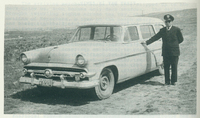
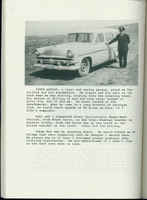 ISHAN CANDAS, a loyal and caring person, proud of his uniform and his automobile. He always had his eyes on the road when he was driving, staring thru the steering wheel His method of driving in mud and snow never seemed to worry him, but it did me. He never looked at the speedometer, when he came to a long stretch of straight road, he would reach speeds of 80 miles an hour, if I didn't complain. Naki and I inspected every Agricultural Experiment Station, from Mount Aarat [sic], on the Iran--Russian boarder [sic] in eastern Turkey, from the Black Sea on the north to the Syrian boarder [sic] on the south. Ishan did the driving. Ishan Bey was my sounding board. He would inform me of things that were happening that he thought I should know. He always saw to it that I followed proper protocol when visiting dignitaries. He was embarrassed if I didn't ride in the back seat when in town.
 -
-
 FIRST DAY IN IZMIR Our first day in Izmir was devoted to finding a place to live. I was the only member of FOA staff that was not located in Ankara, and the U.S. Consulate in Izmir was to be my official station. We would receive our mail thru the Consulate, and the State Department would also be of assistance in helping us locate an apartment. Before leaving Washington we had met Donald Eddy and his family who were on their way to Izmir. He was assigned as the U.S. Consul. The Eddy family were stationed in Izmir the five years we were there, and we became good friends. Our driver, Ishan Candas picked us up at 8:30 a.m., and we went first to the Girls School that was under the sponsorship of the Congregational mission, hoping they might be of assistance in locating an apartment, close to the school. We had friends in Longmont who were acquainted with the directors of the school, and suggested that we should make contact with the Blakes who ran the school. The trip to the school that morning turned out to be a very important contact for us. The American Kiz College: (The American Girls School) was under the Congregational Church Board. The Turkey Mission operated 2 Hospitals, 4 Schools and 2 Clinics. Jack and Linda Blake were full time missionaries, and had lived in Turkey more that 20 years. There were both Turkish and American teachers. Our contact with the school staff and visiting personnel from U. S. colleges was to greatly enrich our 5 year tour in Turkey. Verna was to become a member of the staff for over 4 years, teaching Turkish girls. We located an apartment just three blocks from the school. Our air freight, which was one of Verna's packing lists, arrived in good time and it took us only a few days to get settled enough, that I felt like going to work with Naki, and meet the Directors of the Experiment Stations and the Province Governors. We must first visit the Mayor of Izmir, and the Governor of the Izmir Province. This took several hours, where we drank tea and coffee, at every stop. We met 2 experiment station directors and 3 governors of provinces. After five days of endless cups of coffee and tea, I thought it must be time to go to work, but it was to be another 2 weeks with more coffee and tea, before I had the nerve to ask Naki when we would begin our work on the plans that we made in Ankara.
 -
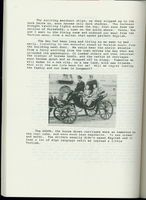 The arriving merchant ships, as they slipped up to the dock below us, soon became only dark shadows. The darkness brought twinkling lights across the bay, that soon drew the outline of Karashaka, a town on the north shore. Verna, Ken and I went to the dining room and ordered our meal from the Turkish menu, from a waiter that spoke perfect English. The day had been long and tiring so we went to bed early, listening to the mournful sound of Turkish music fro the building next door. We could hear the shrill whistle from a ferry arriving from the town across the bay that was unloaded its passengers. It loaded others and then returned The clatter of horses hoofs, and the rattle of carriages soon became quiet and we dropped off to sleep. Tomorrow we will waken in a new city, in a new land, with new friends. What will the new life mean for us? Will we regret leaving the family and our home in Longmont? The ARABA, the horse drawn carriages were as numerous as the taxi cabs, and were much less expensive. It was slower and safer. The drivers usually didn't speak English and it took a lot of sign language until we learned a little Turkish.
 -
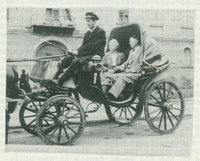 The ARABA, the horse drawn carriages were as numerous as the taxi cabs, and were much less expensive. It was slower and safer. The drivers usually didn't speak English and it took a lot of sign language until we learned a little Turkish.
 -
 It was some time before we knew what the fuss was all about. The Greeks had damaged a statute of Ataturk in Greece and the Turks were showing their anger. This was the famous Istanbul riots of September 5, 1955. We reached the Consulate at about 10:30 p.m., and saw the American flag draped over the gate of the compound, and I never was so glad to see some sign of America. We didn't leave the Consulate until 2:00 a.m. when the all clear signal was given, and we were taken to our hotel. This was our first trip out of the United States and we thought that perhaps we should have stayed home. The next morning we could see the mess that had been left in the streets. There were armed soldiers and army tanks in every street around the hotel. I will never forget the sound of broken glass being swept up in the streets the next morning. Many of the Greek shops were looted and the goods strewn all over the sidewalk. We stayed in Istanbul only the one night. The next evening we rode the ferry across the Bosphorus and took the train to Ankara. It was a comfortable night ride on the Orient Express. I wakened early and looking out the window and watched the sun rise over the dry, over-grazed, pasture of Central Turkey, a sight I would see often during the next five years. The train came to a halt in the Ankara station at 8:30. We were met by the Mission Director, Mr. Hedges and the American Engineer who was to be my supervisor, Mr. Forsburg. The person to step forward first was Naki Uner. Naki was to be my Turkish counterpart for the next five years. The story of our travels, the work we did, the people we met, proved to be one of the most rewarding times of our lives.
 -
 It was some time before we knew what the fuss was all about. The Greeks had damaged a statute of Ataturk in Greece and the Turks were showing their anger. This was the famous Istanbul riots of September 5, 1955. We reached the Consulate at about 10:30 p.m., and saw the American flag draped over the gate of the compound, and I never was so glad to see some sign of America. We didn't leave the Consulate until 2:00 a.m. when the all clear signal was given, and we were taken to our hotel. This was our first trip out of the United States and we thought that perhaps we should have stayed home. The next morning we could see the mess that had been left in the streets. There were armed soldiers and army tanks in every street around the hotel. I will never forget the sound of broken glass being swept up in the streets the next morning. Many of the Greek shops were looted and the goods strewn all over the sidewalk. We stayed in Istanbul only the one night. The next evening we rode the ferry across the Bosphorus and took the train to Ankara. It was a comfortable night ride on the Orient Express. I wakened early and looking out the window and watched the sun rise over the dry, over-grazed, pasture of Central Turkey, a sight I would see often during the next five years. The train came to a halt in the Ankara station at 8:30. We were met by the Mission Director, Mr. Hedges and the American Engineer who was to be my supervisor, Mr. Forsburg. The person to step forward first was Naki Uner. Naki was to be my Turkish counterpart for the next five years. The story of our travels, the work we did, the people we met, proved to be one of the most rewarding times of our lives.
 -
 TRIP TO TURKEY 1955 The flight to Washington left Denver at noon, via Chicago, where the temperature was 100 and humidity 95. It was the first ride on an airplane for Verna and Ken. Dale, Peggy and Gordon returned to Longmont, but within a week they would be going their separate ways. Dale went to Antioch College, Peggy to Ohio and Gordon returned to Nebraska Wesleyan University. We arrive in Washington in the rain and wind, the end of a hurricane, we had a very rough ride. We spent the first night in the President Hotel, where Verna got a bad burn in the bath tub, when the hot water faucet wouldn't turn off. We rented an apartment from a friend of Peggy's who was going on a vacation, and were able to keep it for the two weeks were in Washington, D. C. The next two weeks were spent at orientation courses, that were required of all personnel going overseas. My assignment was IRRIGATION ADVISOR to the Turkish Government (FDA), Foreign Operations Administration. It later became The Agency for International Development, and we were to be stationed in Izmir. We left the U.S. on Sept. 3, 1955, with a stopover in Copenhagen. We then flew to Istanbul on Sept. 5th. A driver from the American Consulate met us at the airport. He was a Greek by the name of Leo, a very friendly and intelligent man who talked a lot on our way into town. When we got close to the city he became very quiet. There were crowds of people milling around in the streets and carrying clubs and signs. Obviously, something was wrong, and Leo was not telling us anything. The slow trip into Istanbul soon came to a halt at the Galata Bridge. The police refused to let us cross the bridge and Leo left us, to find some one who would escort us to the American Consulate, while three of us were left sitting in the station wagon with the Turks milling around the car and looking in the windows as if we were monkeys in a cage. It was at least a half hour before Leo returned, and when he did, he asked for my passport, he said he could get help if he could prove that we were Americans. We had been instructions in Washington, to hang on to those special passports, but he finally convinced me that he could get police help, so I turned my passport over to him. We reached the Consulate after driving thru streets that were strewn with refrigerators, typewriters, and many other item that were hard for the Turks to get.
 -
 The days from March 15, to Aug. 16 were hectic. I learned in the meantime that FOA in Turkey was very anxious to fill a vacancy at Izmir. The person who had filled the position, died in Feb. of 1955. I was to replace him as Irrigation Advisor to the Turkish Government in Western Turkey, where two large dams were under construction. The assignment was to assist in teaching modern irrigation practices on farms that would receive water from the dams. The problems that Verna and I had to solve before we could leave, is the subject for another story. We had three young people in college, and a junior in High School. Arrangements had to be made to keep the business running, and we would have to rent the house. We had an opportunity to sell the farm, and we wanted to make the sale, but there had to be some type of settlement with the tenant. Official papers confirming the assignment arrived in July, and on August 16 the truck backed up to the door of our house to load our household goods. I can still see Verna sitting in the yard, with a clip board and three lists, this goes to Turkey with us on the plane, this goes by ship, and this will go to storage. Aug. 16, and all systems are "go". We had taken all vaccinations, our passports are in order and our tickets have been issued. Dale, Peggy and Gordon will take us to Denver to our plane. The plane leaves Stapelton [sic] Airport at noon, we arrive in Washington at 7:00 p.m.
 -
 WE MEET HOWARD FINCH I often wonder if it is by accident, or design that we meet someone that changes our lives. I can understand how people we live with, influence our lives, but to meet some one for a short period of time, as ships passing in the night, that change life completely, seems to be nothing less than a miracle. We were living in Longmont [sic] Colo. in March 1955. For more than a year I had been the Lay Leader for the Methodist Church in North Eastern Colo. On March 2, Verna and I were to attend a District Conference in Denver, and I was to meet the person that would be my assistant for the coming year. Dr. Howard Finch, the Director of the Agricultural Extension Service for Uni. of Colorado. Dr. and Mrs. Finch had just completed a 2 year tour in Turkey, Howard had been Agricultural Advisor for the Food and Agricultural Organization, (FOA) under the Marshal Plan, the assistance program established in foreign countries following World War II. I was not only interested in meeting Howard for the first time, but I wanted to know more of his experiences while in Turkey. Much of our time was spent talking about problems that Turkey had in Agricultural Development. My interest was in Irrigation and flood control projects. After the conference Howard and I resumed our discussion of Turkey. As we were preparing to leave, Howard said to me, "Would you and Verna be interested in going to Turkey for two years?" The idea was intriguing and we said that perhaps we would be. His next statement was, " You might as well pack your duds." I thought it was a joke, I had worked for the Government for 10 years and left, because it was more often than not, "Hurry up and wait", that was one thing that prompted me to leave the Government Service. Life after March 1955 would change completely for us. Two day after meeting Howard, I received a copy of a letter he had written to the Ministry of Agriculture in Turkey, a copy of a another letter that he wrote to the Director of the U.S. Agency in Turkey. Three weeks later I received a phone call from Washington, wanting to know if we could be ready to go to Izmir, Turkey, by June 1. I informed them that it would be impossible to make arrangements for someone to take over the business at that early date, but we could be ready by the middle of August.
 -
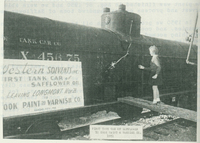
 We were now needing another $50,000, and we were able to raise it locally. By this time the Metzgers had $35,000 in the project and more than half of that was borrowed from friends and banks, with unsecured notes. We were now receiving attention from some large companies. We were corresponding with Archer Daniels and Midland, Kellog was interested, and a company from El Centro California. Rolston Purina were interested in the high protein meal which was a by-product that was used as feed for livestock. The Korean war started in 1952, and the demand for wheat was increasing. Wheat was now worth $4.00 a bushel so it was no longer profitable to raise Safflower. Suddenly our supply of raw material was gone, and Western Solvents had no product to process. We finally had to admit that we could no longer operate, so we sold the plant to a local feed company in Longmont and went out of business. This was the second time in my life that I would have been better off to have taken a vacation for three years. We lost $5,000 in the depression of 1929, and $35,000 in the Safflower business. The education was expensive, but we did get the $5,000 and the $35,000 paid back. For years we paid interest on interest, in order to keep the notes up to date. Every time I go into a Super Market I shed a few tears. Safflower oil, and Saffola are available in every store, everyone is buying some of it to-day. All the Metzgers have is 10,000 shares of Western Solvents stock certificates that would make good wall paper.
 -
-
 SAFFLOWER To go broke during the big depression of the 1930's was bad enough, but I had to do it again. The next depression was what I call the Safflower depression. World War II ended in 1945 and brought a sudden halt to the manufacture of war equipment, and a change in agriculture in the western plains area of the United States. Thousands of acres had been devoted to wheat production. When the war came to a close, many farmers were looking for a crop that could replace wheat, of which there was a surplus. A personal friend of mine from Uni. of Nebraska, Dr. Leo Christensen, had done a great deal of research on oil seed crops that could be grown in the High Plains area. Safflower was one of those seed crops. It appeared that it was a good crop for land not planted to wheat. The oil was a good cooking oil, and it could also be used for paints an varnishes. It looked as if there would be a ready market for the oil, and the by-product after processing, was good livestock feed. With a lot of enthusiasm, four of us formed a general corporation in Longmont, Colorado. We called this company, WESTERN SOLVENTS; the organizers, Robert Bowers, a business man in Longmont, Al Lane, County Agricultural agent, Dr. Christensen, Uni. of Nebr. director of research, and Jim Metzger, Farm management, real estate and insurance broker. We raised $100,000 and set out to promote the growing of safflower and to construct the Oil Processing plant. The plant was finished in Aug. of 1950 and we were able to harvest and process several hundred tons of Safflower seed. In 1950 we produced enough oil to sell to a few paint companies, and cooking oil for some local restaurants. Everything seemed to be going according to schedule, but by that time we needed another $50,000. We received this support from local bankers, but they insisted that we have some local farmers and a banker on the board of directors. The next year the acreage planted increased, and we had nearly three thousand acres in safflower production. The processing plant operated well and we were producing oil by the car load. Cook Paint and Varnish Co. of Kansas City agreed to take a car load of oil every six months, for two years and then they wanted a car load a month there after. By 1952 it appeared that we were assured of having a market for all the oil. Cook Paint and Varnish agreed to take it all. and we now had the capacity to produce a tank car every month.
 -
 The Rocky Mountains area had always held an attraction for me, and since I had a brother living in Boulder whom we often visited; perhaps this might be a good move. Verna's brother Weston, was a Vocational Agriculture teacher in Grant, Nebraska. He worked as a field inspector for a canning factory in Western Nebraska, during the summer when he was not teaching, and he agreed to take the farm management business if we moved to Colorado, and on the first of June I went to Longmont, and the family followed in August. I will always have a sense of guilt for having pushed to make this move. We had spent most of our married life moving every few years, and we were well established in Gering. Dale, Peggy and Gordon were enjoying their school, and had many friends, Ken had not yet started school. Verna was President of her PEO Chapter, and we were both taking part in church and community activities. Verna never complained, but I knew it hurt. Both Peggy and Dale left some very close friends. Longmont became our home town, and the ten years was a happy time for all of us. Dale, Peggy and Gordon graduated from High School, Ken went thru grade school and two years of High School, all participated in school activities, football, basketball, track, band and others. It was their home town when they went to college. Verna helped organize another PEO Chapter and became it's President. We lived on an acreage and produced a lot of our own food. We had a cow, chickens, garden and rabbits. We sold the farm in Nebraska and bought another in Colorado. The business did well, but I did take time out to help start the Safflower business, which failed and lost $35,000 for the Metzgers.
 -
 FROM A GOVERNMENT JOB TO PRIVATE ENTERPRISE There have been several occasions in my life when I felt as if it were time to move on, but to make a final decision can be a painful process. The first decision of this nature, was when I left home to go to college, the second one was when I decided that it was time to leave the Government, and resigned my position as Director of the Soil Conservation District in Scotts Bluff County [sic] Nebraska. Verna supported me in making this decision, but I knew that she appreciated a regular monthly check, after the long period of cash shortage when we left the ranch and I went back to college. I knew the time was coming when I would have to make a change, the red tape, the endless delays and the impractical decisions by my superior, was getting on my nerves. I knew if I set a date to leave in advance, that I could work up the nerve to quit when the time came. On May 1, 1943, I wrote a letter of resignation to the Nebraska State Office for Soil Conservation Service, and set the date for November 1, 1943. My replacement arrived in August, so I took my accumulated annual leave, and turned my attention to a new field of activity. During the depression, from 1930 to 1940, many folks lost their farm and ranches. The Federal Land Bank, and Life Insurance companies owned properties that had been foreclosures, I knew that I could manage these properties but didn't know how to start. The Scotts Bluff County Engineer had resigned his position and moved to California and was working in a War Defense Industry. I agreed to take the job on a part time basis, if I could get my own business started. For nearly two years I worked as County Engineer, with a salary of $150.00 per month, and established the company that is now known as MIDWEST FARM SERVICE. MIDWEST FARM SERVICE, offered farm management services on irrigated farms. I had six farms the first year, and designed and developed an irrigation system, on a ranch in Banner County. The Air Force built an airport at Scottsbluff for a bombing training field, and MIDWEST FARM SERVICE, seeded land, harvested crops, and maintained areas adjacent to the runways, while bombers were taking off and landing. I passed my Real Estate and Insurance Brokers examinations for Nebraska and Colorado, and we bought a 160 acre irrigated farm that I managed, along with the others. In 1945 I developed allergies that appeared to come from grain dusts and pollens. The Equitable Life Assurance Society, one of the companies I represented in Nebraska, was establishing a home loan service in Longmont [sic] Colorado, and I was offered the position.
 -
 Verna and I felt very comfortable with the people in the Fairbury community. I joined the Chamber of Commerce and Verna was soon a member of the PEO chapter. I had received invitation from both Kiwanis and Rotary. The community put on dances and parties for the camp boys, and on many occasions took them into their homes. When the New York City boys started to come to the parties, and date the girls, the attitude of the townspeople changed, many refused to let their daughters come to the parties. As Superintendent, I was getting complaints from some very unhappy people. I had no authority over the men after they left the work project, but I did feel that I should go to the commanding officer with the complaints. This didn't help my standing with Gidinsky, and with much gusto, he demanded to talk to the accusers. I didn't want to expose my source of information, but he insisted, and I had no choice but get him in my car and take him to town. I was embarrassed and frustrated. I didn't know what to say, so I said nothing. Before we arrived at the City Hall, Gidinsky suggested we pull over to the curb and talk it over. From that time on, the situation did improve. Lesson learned: If you don't talk too much you might win your point. Gidinsky didn't like me any better after that but he did listen to me. In March 1937 Soil Conservation Service took over the camps in Nebraska. All personnel in the CCC camps that had technical training were to be transferred to Soil Conservation Districts, and given Civil Service Classifications. We were moved to the District at Syracuse Nebr. I worked as a field conservationist in charge of personnel training for CCC camps, that were working on water development projects. We remained in Syracuse for three years. I was then assigned the task of establishing water development projects in Rushville, Chadron and Scotsbluff [sic], mainly flood control and irrigation. When the Soil Conservation District was established in Scottsbluff, I was assigned as District Conservationist. We lived in Gering, which was just across the river. There was much to be done in soil conservation and irrigation, but I was tiring of the red tape and restrictions of government employment, and resigned in November 1943, and started our own business. We established MIDWEST FARM SERVICE, a farm management, real estate and insurance business.
 -
 SUPERINTENDENT OF A CCC CAMP In March 1935, Ben Osterloh, the camp Superintendent, was assigned as District Supervisor, and I was promoted to Camp Superintendent. From a technical standpoint I felt qualified, but to supervise, 2 engineers, 4 foremen, an agronomist and a work force of 200 men would be something different. I was hardly prepared for some of the headaches that were to follow. The engineer taking my former position came from the east coast and had no farm experience. He did not know the difference between alfalfa, corn, oats or any other crop, and this created a real problem with the farmers. There was no choice but to transfer him to another location. The foremen all had different qualifications. It was important to assign tasks that would best fit the man. Bill Whitfield, a draftsman, had little farm experience, but he did an excellent job of designing structures, and keeping records. Jess Money was a graduate forester, he took charge of tree planting. Pop Cramer was the age of my father, a portly, good humored gentlemen that always seemed to be able to settle arguments among supervisory personnel and enrolled men. Pop was a peacemaker. I suppose that anytime you have a 200-man work force there will be problems. I remember only one that really embarrassed me, I was out witted by a truck driver. There was always a shortage of trucks to transport men to the field, and we would occasionally assign one driver to cover several projects. When I didn't find him on one project I assumed that he was on another. After he delivered his crew he would disconnect the odometer and drive 60 miles to Lincoln to see his girl friend. This accounted for the fact that we were getting such poor mileage on the one truck. He was soon replaced by another driver. My most frustrating task was not with the work crews, but with the army. Captain Phillips, the camp commander, was a pleasure to work with, and if we had differences we could always work them out. Transportation was a problem for us, we tried to keep at least 185 men in the field, and the army had to get lunch to them at noon, and had to use the same trucks we used on the work projects. My real problems began when a company of 200 men came from New York. The commanding officer, Leut. Gidinsky, brought his entire staff with him. Most of the men had lived in New York City, and the philosophy of the people in a small town in Nebraska was not the same as New York.
 -
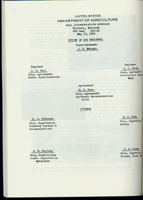 UNITED STATES DEPARTMENT OF AGRICULTURE SOIL CONSERVATION SERVICE Fairbury, Nebraska ECW Camp SCS-15 May 18, 1936 DUTIES OF SCS PERSONNEL Superintendent- J. D. Metzger Engineer C.R. Dahl Coop. Agreements Const. Specifications Engineer C.J. Novak Coop. Agreements Preliminary Surveys Maps Agronomist M.C. Husa Coop. Agreements Agronomic Recommendations Soils FOREMAN [sic] H.O. Pederson Proj. Supervision Forestry Surveys & Recommendations D.A. Burn Proj. Supervision Safety B.W. Woolsley Proj. Supervision Const. Supervision Materials C.L. Cramer Proj. Supervision Trucks, Tools, Equip.
 -
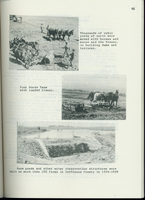 Thousands of cubic yards of earth were moved with horses and mules and the fresno, in building dams and terraces. Four Horse Team with loaded fresno. Farm ponds and other water conservation structures were built on more than 100 farms in Jefferson County in 1934-1938 [sic]