
Nu History
Item set
- Title
- Nu History
Items
-
 RED SHIRT It was not always easy to communicate with our neighbors before 1914, we had a telephone before that date, but some of the neighbors did not. One of them was a bachelor who lived in a sod house that was only a little more than a mile from where we lived. I never heard him called anything but "Squeaky Johnson." Squeaky got his name from his high pitched voice. He always made me feel as if he were yelling at me. He was a good neighbor, and could always be depended upon to help us when we needed him. One of my mother's complaints, was, when some one wanted to get in touch with Squeaky, they would call her. It was not uncommon for her to stop her work, and walk more than a mile to get the message to him. When I became old enough, I must have been 5 or 6, she would write out the message on a piece of paper and I would deliver it. The little sod house where Squeaky lived was not one of my favorite spots. During the summer he kept a large bull snake around to keep the mice and rats from invading the sod house. The bull snake was a welcome visitor; it also kept the rattlesnakes away. I hated to go near when the snake was around. One July morning, Mumsie received a message to deliver. She was making shirts for my brother Lawrence and me. She had completed a bright red one for Lawrence, and I was to get the next one. She didn't want to stop her work, so she asked me to deliver the message, and to take Lawrence with me. I was busy pounding nails in a box, trying to make a house for our dog. I was unhappy and didn't want to take Lawrence with me, he was not able to go as fast as I wanted to go, so I went off and left him. As soon as I had delivered the message I hurried home to get back to my work. We had taken a short cut thru a wheat field, the wheat was as high as my head, and it wasn't long before I lost sight of Lawrence. I was mad, and didn't care that I had lost him. As soon as I returned, I got back to my task of building the dog house. Noon arrived, Dad came from the field, and Mumsie called us to dinner. The first comment from Dad was, "Where is Lawrence?" I said I didn't know. The next question was directed to me. "James, didn't he go with you to deliver the message to Squeaky?" It had been three hours since I got back home. I didn't know where he was.
 -
 NO CASH I have heard that there is a lot of business conducted in the United States by using the barter system. You can trade commodities with out showing any record of a cash transaction. I am told that millions of dollars are lost in taxes, and that the IRS frowns on this type of business. Business transactions, where no cash was used, were common when I was a boy. It was not the intent to avoid taxes, it was because there was no cash. Business conducted by the barter system, could be for services or commodities. My mother always planned to raise chickens for meat and eggs, enough to supply our own food, and we always seemed to have eggs to take to the grocery store and trade for other produce. Eggs from the flock of laying hens, and cream and butter from the cows we milked, were bartered for groceries at Frank Lewis' grocery store. The list of things needed was prepared by Mumsie, there was usually, salt, sugar, pepper, baking powder and other items needed in cooking. The eggs and butter were carried in a large basket, which would then be used for groceries. The process of obtaining the groceries always interested me. I would watch Dad count the eggs, then watch Frank get each item from the shelves as Dad read the list Mumsie had prepared. Some times a shipment of oranges had been received and Dad would select one for Mumsie, Lawrence, himself and me. Some times Frank would give me a piece of chocolate candy. I was just tall enough to stand on my toes and look over the counter, and reach the candy. When the groceries were in the basket, Dad would take a small pencil from his pocket, scribble on a piece of paper, Frank would do the same, Dad would say, "I owe you $1.50," Frank would then say, "I will put it on the books until next time." I never did see any money change hands. I think that my brother Lawrence is the only person who will remember this next story. Dad, on one of his trips to town, had a nice team of well matched grays, he was alone, and carrying a large basket of eggs on his arm. As he crossed the R.R. tracks a switch engine hit him. The engine ran over his team and made kindling wood of his wagon. The team had to be destroyed, they were so badly mangled. Dad came out without a scratch. His clothes were completely covered with egg yolks. He called Mumsie as quickly as he could get to a phone so that she would know that he was not hurt. He wanted to get the news to her before it got to the party line.
 -
 EGGS "HELP! HELP! I can't get out!" I tried to go forward, I tried to go backward, nothing seemed to work. I was caught between the floor joists under the barn, and the hard ground. My 5 year old brother Lawrence, was the only person who knew where I was. I yelled at the top of my voice but got no answer. I was scared. How was I ever going to get out of this mess. I suppose it was no longer than 10 minutes, but it seemed like 10 days. I tried to crawl out of my clothes, but I couldn't unhook my suspenders. I was crying and yelling, and I finally got an answer from Lawrence. I didn't know where he was, but he was soon pulling on my pant leg. He unhooked my pants from a nail in the floor joist and gave me enough freedom to wriggle backward and free myself. Spring on the ranch brings calves, pigs, lambs, kittens, colts and chickens. As for the chickens, the eggs came first. My brother and I were hunting eggs. Mumsie was the proud owner of a flock of prize Buff Orpingtons that furnished her with eggs enough for the family table and a surplus with which she purchased most of the groceries that we needed. The selection of the breeding stock was an important process in maintaining a productive laying flock. Eggs were collected for several weeks and then placed in an incubator. In three weeks another laying flock was on the way. The chickens were allowed to run free at the ranch, and 1 eggs were not always laic in the proper nests in the chicken house. In the spring, a brooding hen had her own idea as to what was needed to raise young chicks, she would hide her eggs under the feed bunks in the barn or even under buildings. Lawrence and I could earn a little money if we found eggs in hidden nests. We would be paid a penny an egg for all we could collect. Trying to find eggs is what got me in trouble. I was under the barn and spotted a nest in the far corner. I tried to crawl thru the same opening that the hen had been using, but I didn't make it. Lawrence was a little smaller than I and did get thru and found six eggs. We divided the six cents. Years later I looked under that old barn. That hole as [sic] still there, but I didn't see any eggs.
 -
 With no refrigeration the next operations must be completed in a hurry. The hams are rubbed with saltpeter (Potassium Nitrate), put in a smoke chamber, (smoke house), for several days or even weeks. A wood fire, or ear corn, would create enough smoke to produce a delicious cut of ham or bacon. When the remainder of the meat was cut, there would be tenderloin, the back loin which is now served as pork chops Often because of lack of refrigeration, much of the meat was roasted and put in glass jars and sealed. Wonderful roast pork could be preserved for the rest of the year. The feet were well cleaned and pickled. The head became head cheese. The remainder was ground, and made into link sausage by cleaning the offal and stuffing it with ground meat, and smoked with the hams and shoulders. When Verna and I were living on the ranch in the 1930s we butchered a beef more often than hogs. Verna would preserve much of the beef by roasting and canning in glass jars, which made the best roast beef I have ever eaten. The farm flock of laying hens supplied the family with meat and eggs. Eggs were traded at the local grocery store for many items used in the kitchen. Mumsie was able to buy materials for making clothes for us.
 -
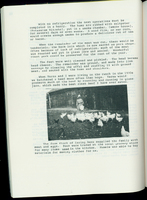
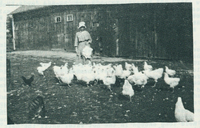 The farm flock of laying hens supplied the family with meat and eggs. Eggs were traded at the local grocery store for many items used in the kitchen. Mumsie was able to buy materials for making clothes for us.
 -
 FOOD The task of obtaining adequate food for each day is not a problem for most of us, we go to the super market and everything we need for a balanced diet is on the shelf. Today refrigeration, transportation and well organized distribution has made it possible, not only to get the necessary food for survival, but to have special foods at all seasons of the year. How different it was 80 years ago. There was no refrigeration, many perishable crops could be moved only a short distance from where they were raised. The majority of people had to provide all their own food and a little extra for those who lived close enough to get it before it spoiled. To grow the food and process it, required much time, and many skills. I learned many of these skills from my parents. On the ranch, we raised our own meat, vegetables, eggs and milk. We slaughtered and processed the meat. We grew the crops that could be dried, canned, or stored in caves. We bought only a few necessities, such as salt, sugar, kerosene for lights, and wood or coal for cooking. We raised wheat and had it ground into flour at the river mill, only a few miles from home. My father was an expert at butchering hogs and in preserving the meat. He not only did it for his family, but he often supervised the project for the neighbors. The killing of a hog was a painless process for the animal, it would be stunned with a heavy hammer, and with great skill, a knife would sever an artery at a point where it forked, between the jaw and the front legs. The blood was saved as food for the chickens. To clean and dress a hog required several operations. Water was heated in a 55 gallon barrel; when it reached the proper temperature, it would be lowered into the barrel and held long enough in the hot water until the hair could be scraped off. This was done with a scraper or large knife. The carcass is then hung with head down and offal removed. The liver and heart were quickly cooled, this would be the meat we would have for supper. The carcass is allowed to cool over night. It will then be cut into hams, sides for bacon, and other cuts.
 -
 Each ear of corn was to be carefully wrapped in paper to protect if from salty air while in shipment. We used many Montgomery Ward catalogues and newspapers. It was then packed in burlap bags, each bag was sewed shut and marked ARA FOR JDC ODESSA. I was given the task of lettering each bag, I stretched the bags out on the floor, and placed a stencil over each bag, and carefully filled in each letter with black paint. There were 100 bags, each holding two bushels of ear corn. We prepared the corn for shipment in December. It was very cold so we did the work in the house. Mumsie cleared the kitchen table and we set up sawhorses with planks as work benches. This became a family project for my parents, my younger brother and myself. I was 10 year old, I felt VERY IMPORTANT and I made sure the bags were lettered properly.(ARA FOR JDC, ODESSA), The project was the talk of the neighborhood. Our teacher, William Forbes, lost no time in getting a world map on the wall of our one room school house. He showed us where Russia was located on the globe, he read from the encyclopedia and told us about the people, the country and the Czar. The Russian Revolution of the 1990's is different but there are many similarities. Will there be food shortages? Will people starve as they did in 1917? Will there be a civil war? What will the new government be? As events unfold in the 1990s we will see them happen, they will come to us in the living rooms. We will have many opinions from people who know a great deal about the country and its people. In 1917 we had no radio, no television, our information came to us from the local paper that we received weekly. We always had the Nebraska Farmer, an agricultural paper that was concerned with local agricultural matters in the state and nation but little was ever said about the world. The little one room school house, in 1917 boasted of fourteen students, grades one thru eight. The 21 year old year old teacher with his maps, the globe and the monthly Current Events paper was our source of information. HE was our expert.
 -
 ODESSA ARA FOR JDC ODESSA, I will always remember ARA FOR JDC, (AMERICAN RELIEF ASSOCIATION FOR JEWISH DISTRIBUTION COMMITTEE). For 75 years this has been in my mind. The Russian Revolution of the 1990's brings memories of the Russian Revolution of 1917. The one in 1917 was important to me because I played a part in a project that was designed to help the food shortage. The total deaths from starvation was never known, some estimates placed it at a hundred thousand. Alan Moorehead's book; THE RUSSIAN REVOLUTION describes in detail the plight of the Russian people during 1916 and 1917. "The winter of 1916-1917 was particularly severe--at one stage no less than 1200 locomotives burst their frozen pipes--making it impossible for adequate food distribution. In Odessa, people had to wait two days in line to get a little cooking oil. In Petrograd and Moscow bread lines formed through out the freezing night." By the time the fighting had ended, all the seed grains had been eaten, and there was no seed available for planting the 1918 crop. In 1917 my father received a request for seed corn, from the American Relief Association for Jewish Distribution Committee. Russia needed seed corn that came from a land with climate similar to that of the Ukraine. Western Nebraska: Elevation 4000 feet above sea level: annual rainfall of 20-24 inches, and lying between the 40th. and 50th. parallel, with a 90 to 100-day growing season, met these requirements. As Dad picked the corn, ear by ear, and threw them in the wagon, he carefully selected the best ears and threw them in the front of the load. When he unloaded, he put the selected ears in a separate bin. He gathered his own seed corn in this manner, but this year it would include 200 bushels of ear corn that would be shipped to Odessa [sic] Russia. By December all the corn was harvested, and special instructions were given for shipment. The American Relief Association would pay for the corn, the price would be double that received for livestock feed. I think the price paid was $.50 per bushel.
 -
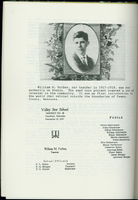 William M. Forbes, our teacher in 1917-1918, was our authority on Russia. The seed corn project created a lot of interest in the community. It was my first introduction to the world that existed outside the boundaries of Dawes, County, Nebraska. Valley Star School DISTRICT NO. 28 Crawford, Nebraska December 25, 1917 William M. Forbes, Teacher School Officers P. L. Raben Director F. G. Metzger Treasurer T. G. Hunter Moderator PUPILS Edwin Ostermeyer Alma Ostermeyer Alfred Ostermeyer William Ostermeyer Ralph Ostermeyer Martha Ostermeyer Maude Dahlheimer Catherine Raben Jennings Raben Elmer Raben James Metzger Lawrence Metzger
 -
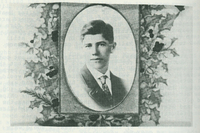 William M. Forbes, our teacher in 1917-1918, was our authority on Russia. The seed corn project created a lot of interest in the community. It was my first introduction to the world that existed outside the boundaries of Dawes, County, Nebraska.
 -
 Several miles from this fire there was another. Little damage was done because one of the neighbors, Walter Heath, was able to stop it from spreading by plowing a guard around the burned area. Walter didn't come home when the fire was out. They found him sitting up against the wagon wheel. The team came home and were standing by the barn, still hitched to the plow. Walter had died of a heart attack. It would appear that once a prairie fire was put out that it would be safe for the fighters to go home, but this was not the case. Some one had to stay on the job, perhaps for several days. Hot weather in Western Nebraska would breed small twisters or whirl winds. Some times dust and ash would get caught in one of these twisters, and be lifted a 100 feet in the air. At the same time unburned weeds or cow chips would get caught in the up draft and be rolled along the ground and start another fire. Cow chips could hold fire for several days. I was fascinated by the burned areas, I would walk over the area to see what took place. Only a few birds ever lost their lives. Most of the meadow lark nests would be empty. Snakes often didn't find a place to hide, and would die. Some times a turtle would be found dead, but most often they escaped the heat. Baby rabbits could be found with singed bodies killed by fire or smoke. The wooden fence posts would often be burned off at ground level and would need to be replaced. If rain fell in the fall the area would green pasture again. If there was no rain it remained a black carpet all winter, if not covered by snow. I never hear of fires being started by trains any more. Lightening will sometimes start one, but the prairie fire in the ranch country of Nebraska, Wyoming and Colorado is still to be feared.
 -
 We loaded two barrels on the wagon, drove to the water tank, and filled the barrels with water. We then took a walking plow, a roll of sacks and started for the fire. When we left the house, we could see a little smoke in the south west, it didn't look to be much of a fire, but when we came to the top of the hill we could see that we were in trouble. The fire was definitely headed for our house. It had been fully an hour since the heavily loaded freight train, headed for Sheridan, Wyoming, had passed by. I could only imagine what had happened. The Fireman was stoking a big fire to keep up a head of steam. The huffing and puffing locomotive had belched hot cinders with the smoke. It had started five fires within the mile. The fire guards had stopped all but one of them. That one had jumped the guards and was headed for our buildings. We were not the first to get to the fire, two neighbors had been there ahead of us. Harold Shipman and John Dodd were plowing another fire guard several hundred yards ahead of the fire. They had successfully shut off the part that was headed for our house. We were probably safe, but Harold's wheat field had not fared so well, thirty acres of shocked grain were already lost. The grass and stubble was short, this meant that we could get close enough to the fire without getting caught with the team and wagon. I drove as closely as I could to the fire line and neighbors,who [sic] had come by horse back and buggy, were able to take the gunny sacks, soak them in water from the barrels and hit the fire with the wet sacks. It is amazing how well this could control a fire. I was under orders from Dad to stay on the wagon, and keep a good distance from the fire. He hitched his team to a plow and joined the others in plowing more fire guards. I drove as close to the fire as I dared, while the men flung the soaked sacks to snuff our the fire. In order not to get caught with the flames, they worked in from the side and directed the fire to an area where the men and teams were plowing the guards, turning the prairie land into brown strips of freshly turned soil. With grass that is no more than four to six inches tall, the fire line looked like a red fringe to a large, black rug that was being unrolled. The fire is swept along by the wind as fast as a horse could walk. It was only four or five miles per hour, but if you owned hay stacks, grain fields or farm buildings in its path, that seemed much too fast. One neighbor lost a wheat field that had the grain in the shock. Another lost a stack of hay. We escaped with only burned grazing land
 -
 PRAIRIE FIRES It hasn't rained for a month. The temperature ranges from 65 degrees in the morning to 105 in the afternoon. It seems that every day about 2:00 O'clock the wind blows from the south, and it feels as if it were blowing over a hot stove. Everything is dry, and the grain fields that are not yet harvested are so ripe that a heavy wind shatters some of the grain on the ground. The only time it can be cut is in the early morning, or we lose half the crop. Dad is cutting grain on the east eighty, and starts cutting early in the morning about sunup. I will take a fresh four-horse team to him about 9:00 O'clock so that he does not have to rest the team. I feel that I am grown up at age 10, because I can go to the barn, get the collar that fits each horse and lead them to the field. Dad will then remove the harness from the team he is working and put it on the fresh team that I bring. The harness will fit the team I have brought, but each horse has to have a collar that is specially fit, in order not to damage the animal. It is the middle of August, 1917, at 10.00 O'clock in the morning, I have returned with the team that Dad used earlier. I take them to the water tank, then to the barn and feed them. It seems to me that the day is hotter than usual. By 11:00 O'clock the wind begins to blow and Dad comes home early, he says he is losing too much grain because it is so dry. When I was a boy, dinner came at noon, and then a nap. We had just finished dinner and the telephone began to ring. It wasn't the regular long and short combination that calls some one to the phone, it was a series of short quick rings that lasted for only a few seconds. This was an emergency call and every one would get to the phone as fast possible. Dad went to the phone, without saying a word to any one on the line, he quickly banged the receiver down, turned and said. " A fire on Dawes Forbes' place. The fire has jumped the fire guard." That means only one thing, the fire is heading for our place. Dad grabbed his hat and gloves, and turned to me and motioned for me to come with him. We went to the barn, took the four horses he had been using, hitched one team to the wagon. I took the other team, rode one and led the other horse.
 -
 We had good roads and fences to follow when it was stormy, there were many stories in homesteading days when children got lost in blizzards. There was only one time that the storm came so quickly that we were picked up at the school. The only warning we had, that a blizzard was on the way, came over the wires from the Burlington R.R. A call would be sent out over the country lines that we could expect a storm to reach us soon. The nine months of school were over on the last day of May. We would often have a picnic, and the parents would celebrate with us. This last day could be a big affair, parents and relatives would arrive at the school at about ten o'clock. They would arrive by wagon, buggy, or horseback and some would walk. We had only a small hitch rack for horses, but there would be teams tied to wagons and fence posts that were close by. When it came time to start the activities, everyone would go into the school house. The teacher would speak for a few minutes, she would proudly tell of the accomplishments of her students during the past year. There would be high praise for the students who had excelled in their grades for the year. I don't remember receiving any awards, except in mathematics. If it were nice weather we would then gather outside and share our lunches. If it were bad weather we would push the desks back against the wall and set up some plank tables where we spread our lunches. If it was warm weather there was always someone who brought a freezer of home made ice cream, and there was always lots of cakes and cookies. The last day of school that I remember best, was on the 31st day of May 1917. It was the only time I remember seeing snow in May. It had snowed enough, that Dad took the sleigh, saying "I never have gone sleigh riding in May, this will be the time." When we came home most of the snow was gone and we rode at the side to keep the sleigh runners on grass, we called our sleigh a grass schooner.
 -
 THE ONE ROOM SCHOOL There were two of us in my class for the years that I was in country school, Catherine Raben and myself. When we were called on to recite our lessons, the teacher would call us to the front of the room, and we would sit on chairs facing her as she sat at her desk. If I was poorly prepared, or had forgotten some of that day's assignment, I felt as if I were being called before a judge for some traffic violation. Normally, the teacher's questions began with our assignment that day, but it could be on something we should have remembered from the day before. Some times she would ask for illustrations on the black board. Arithmetic, English and geography were often assignments that called for black- board work. I liked mathematics and geography but English and grammar gave me a headache, and it remains one of my problems as I write the story of my life. The early grades were not hard for me, but I found the eighth grade more difficult. I have decided that the students in the lower grades had the advantage of hearing the higher grades recite their lessons. It was a help for those who followed, but by the time I got to the eighth grade, I was on my own. One of the highlights of my time in the country school were the two recess periods, we had 15 minutes in morning about 10 o'clock and another in the afternoon at 2:30. We usually played outside if the weather permitted, snow on the ground meant we could play fox and geese, or snow ball. The snowball fights often ended in some of the small children getting hit hard enough to call for intervention from the teacher. We played baseball in the spring when it was warm, and this included both girls and boys. The school house was a cold place in the winter. We were always dressed well, long johns and heavy undershirts. The stove in the middle of the room was usually fired with wood or coal that we would carry in from a shed close by. The most difficult time to stay in school was when spring came. It was hard to stay inside and study when the birds were singing and flowers blooming. To get to school during the winter could be a problem if the snow was deep, and to get caught at school in a blizzard was a worry for parents. There was little warning if there was a blizzard on the way. The weather could be nice when left home in the morning and be a raging storm by the time school was out.
 -
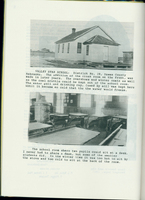 VALLEY STAR SCHOOL: District No. 28, Dawes County Nebraska. The addition of the cloak room on the front, was made in later years. The overshoes and winter coats as well as the coal scuttle could be kept out of the school room. The water pail and drinking cup, (used by all) was kept her until it became so cold that the the [sic] water would freeze. The school room where two pupils could sit at a desk. I never had to share a desk, but some of the smaller students did. In the winter time it was too hot to sit by the stove and too cold to sit at the back of the room.
 -
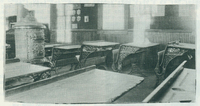 The school room where two pupils could sit at a desk. I never had to share a desk, but some of the smaller students did. In the winter time it was too hot to sit by the stove and too cold to sit at the back of the room.
 -
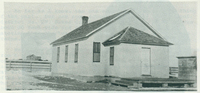 VALLEY STAR SCHOOL: District No. 28, Dawes County Nebraska. The addition of the cloak room on the front, was made in later years. The overshoes and winter coats as well as the coal scuttle could be kept out of the school room. The water pail and drinking cup, (used by all) was kept her until it became so cold that the the [sic] water would freeze.
 -
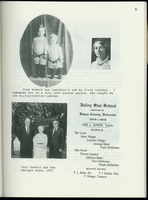 Valley Star School District No. 28 Dawes County, Nebraska 1914-1915 CORA L. SOWERS, Teacher PUPILS Bert Lewis James Metzger Lawrence Metzger Jennings Raben Frank Dahlheimer Julia Hunter Florence Leonard Catherine Raben Eeva Dahlheimer Maude Dahlheimer SCHOOL BOARD P. L. Raben, Dir. T. J. Hunter, Mod. F. Metzger, Treasurer Cora Sowers was Lawrence's and my first teacher. I remember her as a very soft spoken person, who taught me the multiplication tables.
 -
-
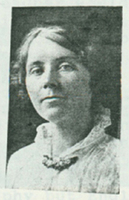 Cora Sowers was Lawrence's and my first teacher. I remember her as a very soft spoken person, who taught me the multiplication tables.
 -
-
 As far as I know, the one room school house is a thing of the past. Our one room school, was Valley Star School, District No. 28. Dawes County, Nebraska. The one room was about 30 feet wide and 60 feet long, and contained the material that the teacher needed to teach the first eight grades. We were a motley bunch of youngsters, we ranged in ages from 6 to 14 years. The 14 year old girl, Maude Dahlheimer, considered herself a mature lady. The little 6 years old lad that didn't make it to the privy in time, and went all day with wet pants, considered him self an outcast. I often wonder how we appeared to the County Superintendent, who visited us twice a year to inspect our work. I am sure that the teacher knew when she was to coming, because we would get instructions to put on our best manners. We often worked very hard on some project in order to have it completed in time for inspection. I can still see the two rows of seats, that extended from the platform where the teacher sat, to the back of the room. There was the potbelly stove that was located in the center of the room, the pail of water with the one dipper that every one used. There was a line of clothes hook that stretched across the back of the room, with a name above every one of them, and there was the blackboard in the front of the room with a crack down the middle. The teacher rang the bell at 9:00 o'clock, and we would be considered tardy if we were not in our seat within five minutes. If I was late getting in my seat, I could miss the first recess, and be required to clean the black board, and empty the waste paper baskets. I remember being tardy only once, and it was very embarrassing, I was the laughing stock of all my friends, Mumsie had sewed some buttons on my pants and I couldn't keep them buttoned. I thought if I got there a little late that no one would notice. My memories of country school have always been good. My problems with grammar and spelling have followed me all my life, but I don't think it was the teachers fault. The girl I married was an English teacher, and I am still going to her for help in spelling or grammar.
 -
 COUNTRY SCHOOL My introduction to formal education was in a one room country school. It was 1.75 miles from home and there were very few days that my brother and I didn't walk this distance. Occasionally on stormy days Dad would hitch old Charley to the buggy, and take us. I remember one day in September when the temperature was above 90 degrees F, and one winter day when it was 40 below zero. I was 7 years old and my brother 6, so this was in 1914. The only early record I have is a souvenir from my first teacher, Cora Sowers, dated 1914. The 1.75 miles to the school was the longest mile and three quarters I ever saw. Lawrence and I tried every device, and every method possible to break the monotony of this walk. We would take the shortest route as often as possible by crawling over fences and walking thru fields. This method was frowned upon by the neighbors, because we broke down their fences and sometimes damaged young crops. Mumsie did not like it, because it meant torn clothes that she had to mend. We devised methods of travel that helped time pass. If we could ride a stick horse, it seemed to us to shorten the distance. The most useful to us was a machine that we make ourselves. This machine consisted of a small wheel about 12 inches in diameter, we would put a small 3 inch board on each side of the wheel, put a half inch bolt thru the boards and the wheel. The bolt would serve as an axle. The boards were fastened together at the top, about six feet from the wheel, so this served as a wheelbarrow. The use of the wheel kept our minds occupied, and time seemed to pass more rapidly. To make it useful we would put a nail in the board about half way from the handle to the wheel. This was a machine to carry our lunch pails. When the ground was smooth it worked fine, but when the ground was frozen, where the cattle had walked in the mud, it was a disaster. Mumsie made sandwiches, some with jam or jelly, or perhaps we would have a small jar of stewed fruit, and when we arrived at school it was hard to tell just what we had for lunch. It wasn't soup, but it looked like it. It was some time before Mumsie found out what happened. There was dried jelly and fruit stuck to the pail, and when she packed our lunch the next day she would have to give the pail a good cleaning.
 -
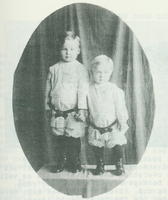
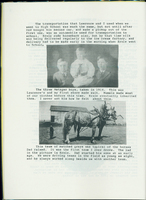 The transportation that Lawrence and I used when we went to High School was much the same, but not until after Dad bought his second car, and made a pickup out of the first one, was an automobile used for transportation to school. Ernie rode horseback also, but by that time milk was being delivered regularly to the ice cream factory, and delivery had to be made early in the morning when Ernie went to School. The three Metzger boys, taken in 1914. This was Lawrence's and my first store made suit. Mumsie made most of our clothes before this time. Ernie eventually inherited them. I never ask him how he felt about this. This team of matched grays was typical of the horses Dad raised. It was the first team I ever drove. The lad in the picture is Ernie. Dad started his sons at an early age. We were driving teams in the field as young as eight, and he always worked along beside us with another team.