
Purple Journal_158
Item
- Title
- Purple Journal_158
- Alternative Title
- Purple Journal
- Creator
- Karen Blessen
- Date
- 2017
- Description
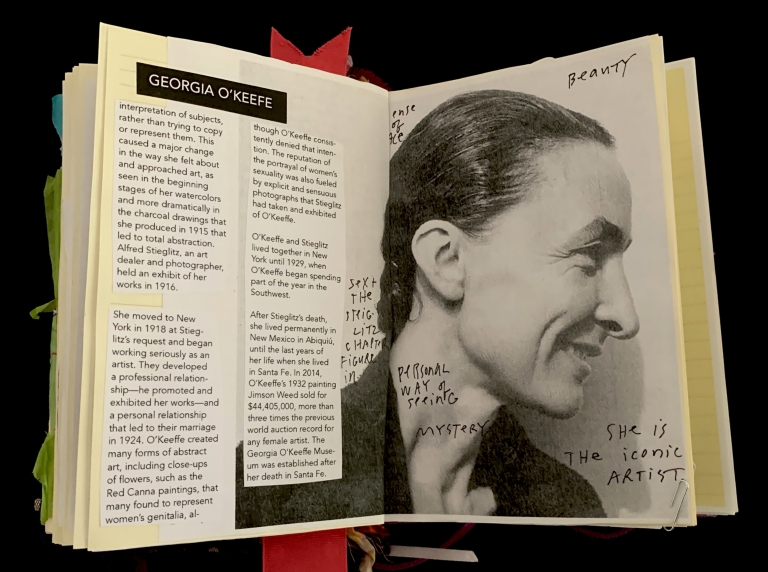
- The page is a collage of various media, including ink, pencil, and possibly digital elements. It features a black-and-white photograph of Georgia O'Keeffe on the right side, with handwritten notes and phrases scattered around the image. The left side contains a printed text block with biographical information about O'Keeffe, and a smaller text box with her name. The layout is informal and personal, with handwritten notes adding a layer of intimacy and reflection.
- Identifier
- 016_061717-122517_purple_journal
- Dates Completed
- June 17, 2017 - Dec. 25, 2017
- Keywords
- Purple; Prince; June 7; Blank journal; Barnes and Noble; 2016–2017; Trump election; 29 Pieces; Funding crisis; Board realities; Come to Jesus moment; Remote work; Gut punches; Dana moves; Emotional loss; Political uncertainty; Life necessities; Calling the angels; Unshakeable faith; State of Contentment; Sacred feminine; Tramadol; Pleasing Daddy; Embodying HER; Yayoi Kusama; Frida Kahlo; Missing Barbara Boster; Mantrams for Trump; Anger chart; Charlottesville; Compassionate Path; Critical Path; Chronic hip pain; Angst and joy; Friendship and forgiveness; NYC trip; Times Square BID; Women artists; Left vs. right hand writing; No backyard studio
- Transcription
-
Georgia O'Keefe
interpretation of subjects, rather than trying to copy or represent them. This caused a major change in the way she felt about and approached art, as seen in the beginning stages of her watercolors and more dramatically in the charcoal drawings that she produced in 1915 that led to total abstraction. Alfred Stieglitz, an art dealer and photographer, held an exhibit of her works in 1916.
She moved to New York in 1918 at Stieglitz's request and began working seriously as an artist. They developed a professional relationship - he promoted and exhibited her works - and a personal relationship that led to their marriage in 1924. O'Keeffe created many forms of abstract art, including close-ups of flowers, such as the Red Canna paintings, that many found to represent women's genitalia, al-
though O'Keeffe consistently denied that intention. The reputation of the portrayal of women's sexuality was also fueled by explicit and sensuous photographs that Stieglitz had taken and exhibited of O'Keeffe.
O'Keeffe and Stieglitz lived together in New York until 1929, when O'Keeffe began spending part of the year in the Southwest
After Sieglitz's death, she lived permanently in New Mexico in Abiquiú, until the last years of her life when she lived in Santa Fe. In 2014, O'Keeffe's 1932 painting Jimson Weed sold for $44,405,000, more than three times the previous world auction record for any female artist. The Georgia O'Keeffe Museum was established after her death in Santa Fe.
Sex + the Steiglitz Chapter Figure in
Personal way of seeing
Mystery
Beauty
She is the iconic artist - Rights
- To inquire about usage, please contact Archives & Special Collections, University of Nebraska-Lincoln Libraries. These images are for educational use only. Not all images are available for publication.
- Is Part Of
- Purple Journal
- Relation
- Image Gallery