
Purple Journal_067
Item
- Title
- Purple Journal_067
- Alternative Title
- Purple Journal
- Creator
- Karen Blessen
- Date
- 2017
- Description
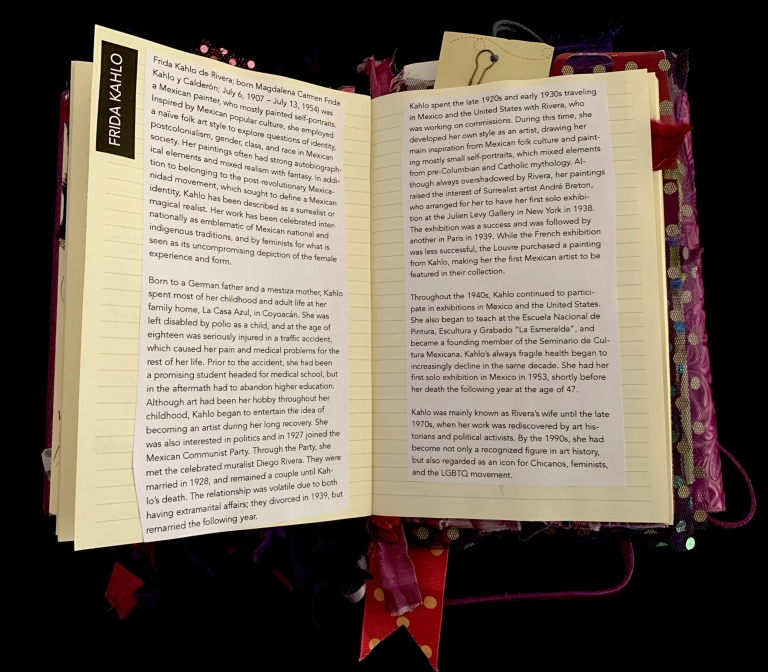
- The page is a printed text on lined notebook paper, with decorative ribbon featuring red and gold polka dots. The paper is slightly curled at the edges, and the background includes a patterned fabric with red and gold accents.
- Identifier
- 016_061717-122517_purple_journal
- Dates Completed
- June 17, 2017 - Dec. 25, 2017
- Keywords
- Purple; Prince; June 7; Blank journal; Barnes and Noble; 2016–2017; Trump election; 29 Pieces; Funding crisis; Board realities; Come to Jesus moment; Remote work; Gut punches; Dana moves; Emotional loss; Political uncertainty; Life necessities; Calling the angels; Unshakeable faith; State of Contentment; Sacred feminine; Tramadol; Pleasing Daddy; Embodying HER; Yayoi Kusama; Frida Kahlo; Missing Barbara Boster; Mantrams for Trump; Anger chart; Charlottesville; Compassionate Path; Critical Path; Chronic hip pain; Angst and joy; Friendship and forgiveness; NYC trip; Times Square BID; Women artists; Left vs. right hand writing; No backyard studio
- Transcription
-
Frida Kahlo
Frida Kahlo de Rivera; morn Magdalena Carmen Frida Kahlo y Calderón; July 6, 1907 - July 13, 1954) was a Mexican painter, who mostly painted self-portraits. Inspired by Mexican popular culture, she employed a naïve folk art style to explore questions of identity, postcolonialism, gender, class, and race in Mexican society. Her paintings often had strong autobiographical elements and mixed realism with fantasy. In addition to belonging to the post-revolutionary Mexicanidad movement, which sought to define a Mexican identity, Kahlo has been described as a surrealist or magical realist. Her work has been celebrated internationally as emblematic of Mexican national indigenous traditions, and by feminists for what is seen as its uncompromising depiction of the female experiece and form.
Born to a German father and a mestiza mother, Kahlo spent most of her childhood and adult life at her family home, La Casa Azul, in Coyoacán. She was left disabled by polio as a child, and at the age of eighteen was seriously injured in a traffic accident, which caused her pain and medical problems for the rest of her life. Prior to the accident, she had been a promising student headed for medical school, but in the aftermath had to abandon higher education. Although art had been her hobby throughout her childhood, Kahlo began to entertain the idea of becoming an artist during her long recovery. She was also interested in politics and in 1927 joined the Mexican Communist Party. Through the Party, she met the celebrated muralist Diego Rivera. THey were married in 1928, and remained a couble until Kahlo's death. The relationship was volatile due to both having extramarital affairs; they were divorced in 1939, but remarried the following year.
Kahlo spent the late 1920s and early 1930s traveling in Mexico and the United States with Rivera, who was working on commissions. During this time, she developed her own style as an artist, drawing her main inspiration from Mexican folk culture and painting mostly small self-portraits, which mixed elements from pre-COlumbian and Catholic mythology. Although always overshadowed by Rivera, her ppaintings raised the interest of the Surrealist artist André Breton, who arranged for her to have her first solo exhibition at the Julien Levy Gallery in New York in 1938. The exhibition was a success and was followed by another in Paris in 1939. While the French exhibition was less successful, the Louvre purchased a painting from Kahlo, making her the first Mexican artist to be featured in their collection.
Throughout the 1940s, Kahlo contained to participate in exhibitions in Mexico and the United States. She also began to teach at the Escuela Nacional de Pintura, Escultura y Grabado "La Esmeralda", and became a founding member of the Seminario de Cultura Mexicana. Kahlo's always fragile health began to increasingly decline in the same decade. She had her first solo exhibition in Mexico in 1953, shortly before her death in the following year at the age of 47.
Kahlo was mainly known as Rivera's wife until the late 1970s, when her work was rediscovered by art historians and political activists. By the 1990s, she had become not only a recognized figure in art history, but also regarded as an icon of Chicanos, feminists, and the LGBTQ movement. - Rights
- To inquire about usage, please contact Archives & Special Collections, University of Nebraska-Lincoln Libraries. These images are for educational use only. Not all images are available for publication.
- Is Part Of
- Purple Journal
- Relation
- Image Gallery