
Limits no Limits_062
Item
- Title
- Limits no Limits_062
- Alternative Title
- Limits no Limits
- Creator
- Karen Blessen
- Date
- 2019
- Description
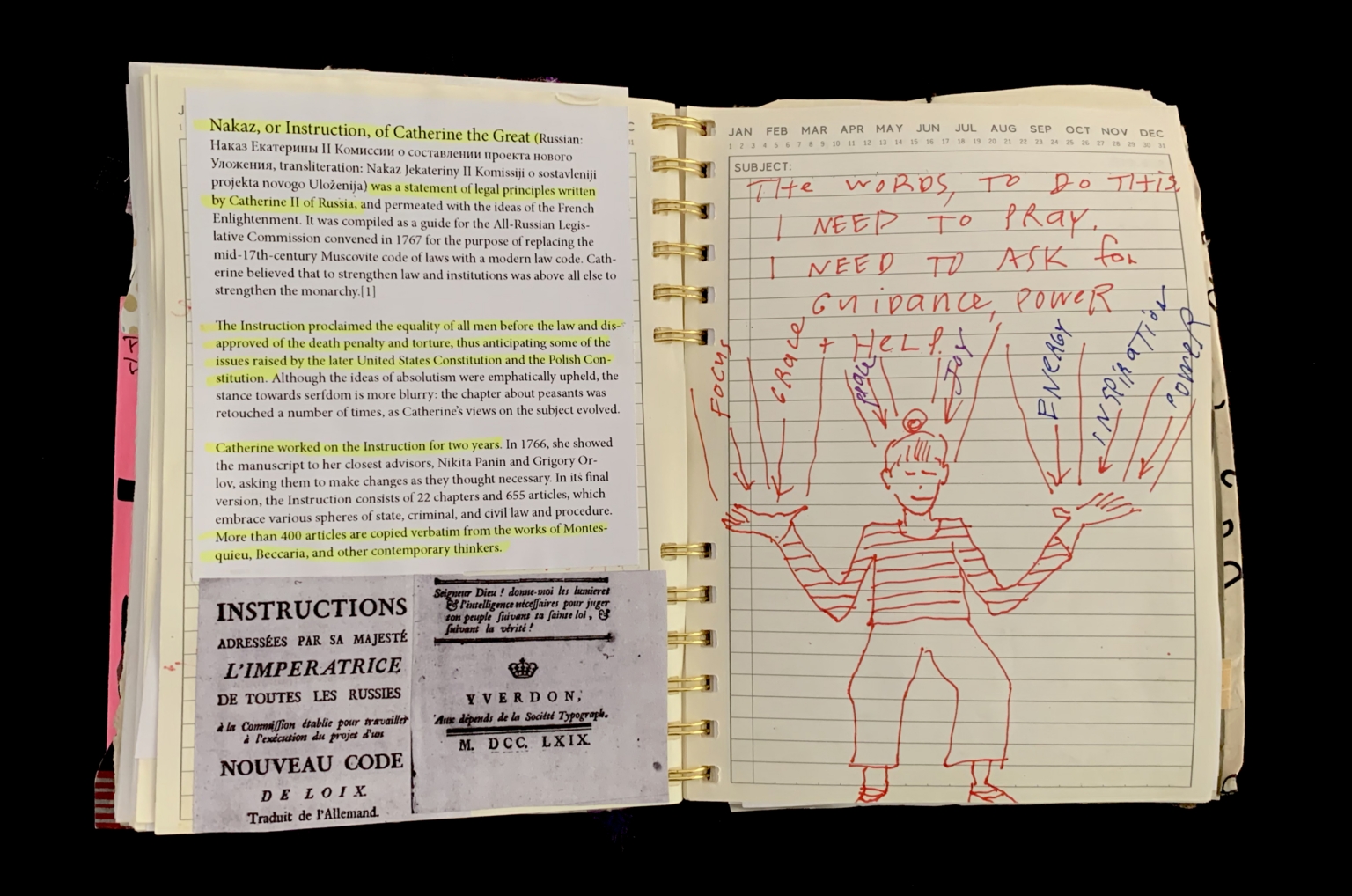
- The left side of the page features a printed text about "Nakaz, or Instruction, of Catherine the Great," with sections highlighted in yellow. Below the text is a black and white image of a document titled "Instructions adressées par sa majesté L'Imperatrice de toutes les Russies." The right side of the page includes handwritten text in red ink, a drawing of a person with arms outstretched, and various words and phrases such as "Focus," "Grace + Help," "Focus," "Energy," "Inspiration," and "Power."
- Identifier
- 011_070419-091519_limits_no_limits
- Dates Completed
- July 4, 2019 - September 15, 2019
- Keywords
- Limited; No limits; Death and loss; Barbara Boster Phillips; Missing Barbara; Fourth of July; Fireworks; Mourning Don; Grieving with Poppy; Mending quilts; Stitching and bleeding; Non-profit struggles; Artist conflict; Solitary tree; Communion; Dark days; Giving up dream; Joy in 29 Pieces; Reframing work; Will Richey; Baby Sol; Family tree; Surgery recommended; Mass shootings; Kindness; I have a dream; Fashion diversion; Christian Dior exhibit; PINK banner; Right action; Kelly and Joe mosaics; Phoebe Little paintings; Kinder world logos; Teachers as love; South Dallas Cultural Center; Epiphany; Injured wings; Consciousness; Betrayal; 29 Pieces compilation
- Transcription
-
Left Side:
Nakaz, or Instruction, of Catherine the Great (Russian: Наказ Екатерины II Комиссии о составлении проекта нового Уложения, transliteration: Nakaz Jekateriny II Komissiji o sostavleniji projekta novogo Uloženija) was a statement of legal principles written by Catherine II of Russia, and permeated with the ideas of the French Enlightenment. It was compiled as a guide for the All-Russian Legislative Commission convened in 1767 for the purpose of replacing the mid-17th-century Muscovite code of laws with a modern law code. Catherine believed that to strengthen law and institutions was above all else to strengthen the monarchy.[1]
The Instruction proclaimed the equality of all men before the law and disapproved of the death penalty and torture, thus anticipating some of the issues raised by the later United States Constitution and the Polish Constitution. Although the ideas of absolutism were emphatically upheld, the stance towards serfdom is more blurry: the chapter about peasants was retouched a number of times, as Catherine's views on the subject evolved.
Catherine worked on the Instruction for two years. In 1766, she showed the manuscript to her closest advisors, Nikita Panin and Grigory Orlov, asking them to make changes as they thought necessary. In its final version, the Instruction consists of 22 chapters and 655 articles, which embrace various spheres of state, criminal, and civil law and procedure. More than 400 articles are copied verbatim from the works of Montesquieu, Beccaria, and other contemporary thinkers.
Right Side:
SUBJECT:
THE WORDS TO DO THIS
I NEED TO PRAY.
I NEED TO ASK FOR
GUIDANCE, POWER
Focus
Grace + Help
Focus
Energy
Inspiration
Power - Rights
- To inquire about usage, please contact Archives & Special Collections, University of Nebraska-Lincoln Libraries. These images are for educational use only. Not all images are available for publication.
- Is Part Of
- Limited no Limits
- Relation
- Image Gallery